This comprehensive analysis compares STABLE and ATOM tokens across multiple investment dimensions including historical price performance, market positioning, and ecosystem development. STABLE, launched in 2025 as a USDT-native Layer 1 blockchain for stablecoin payments, currently trades at $0.015809 with high volatility characteristics. ATOM, operational since 2019 through the Cosmos network, maintains established cross-chain interoperability features at $2.542. The article evaluates tokenomics, institutional adoption, technological ecosystems, and risk factors to guide investor decision-making. Through 2031, price trajectories and allocation strategies vary by investor profile on Gate, with conservative investors favoring ATOM exposure while experienced investors balance both assets according to risk tolerance and strategic objectives.
Introduction: Investment Comparison Between STABLE and ATOM
In the cryptocurrency market, the comparison between STABLE vs ATOM has consistently been a topic investors cannot bypass. The two not only exhibit significant differences in market cap ranking, application scenarios, and price performance, but also represent distinct positioning within the crypto asset landscape.
STABLE (STABLE): Launched in 2025, it has gained market recognition by positioning itself as a USDT-native Layer 1 blockchain specifically designed for stablecoin payments, featuring sub-second finality and low transaction fees.
ATOM (ATOM): Since its launch in 2019, it has been recognized for building an interconnected blockchain ecosystem through the Cosmos network, enabling cross-chain communication and interoperability among various blockchain spaces.
This article will comprehensively analyze the investment value comparison between STABLE vs ATOM, focusing on historical price trends, supply mechanisms, institutional adoption, technological ecosystems, and future projections, attempting to answer the question investors care about most:
"Which is the better buy right now?"
I. Historical Price Comparison and Current Market Status
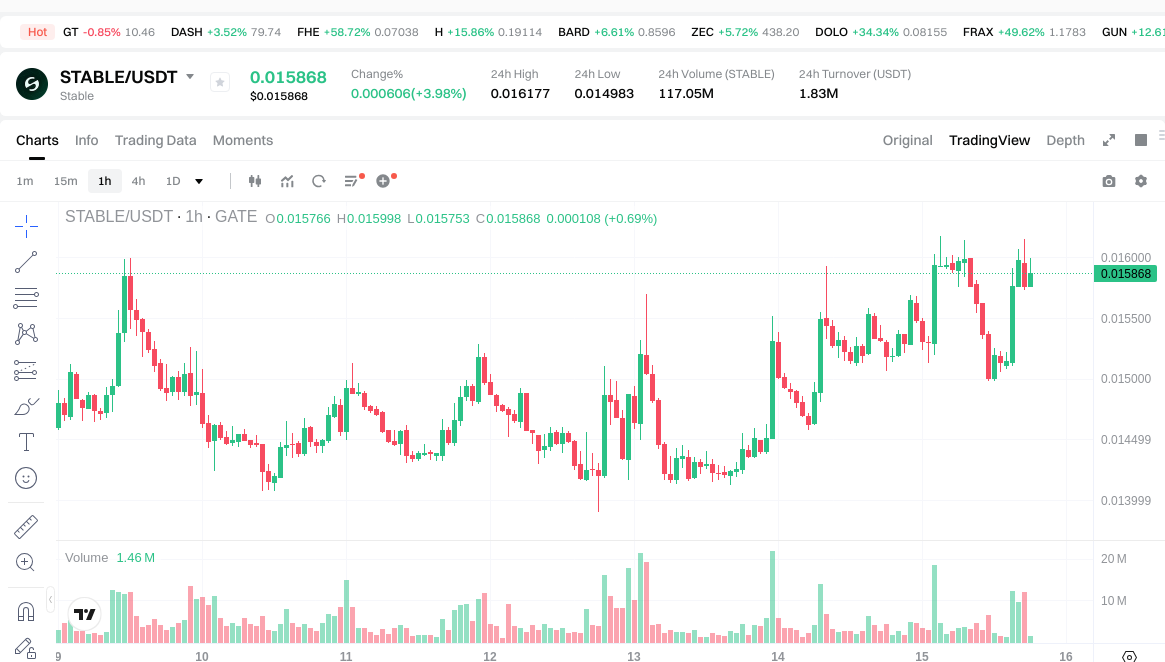
- 2025: STABLE experienced significant price volatility following its launch, with prices ranging from a high of $0.05 in December 2025 to a low of $0.00913 later that month.
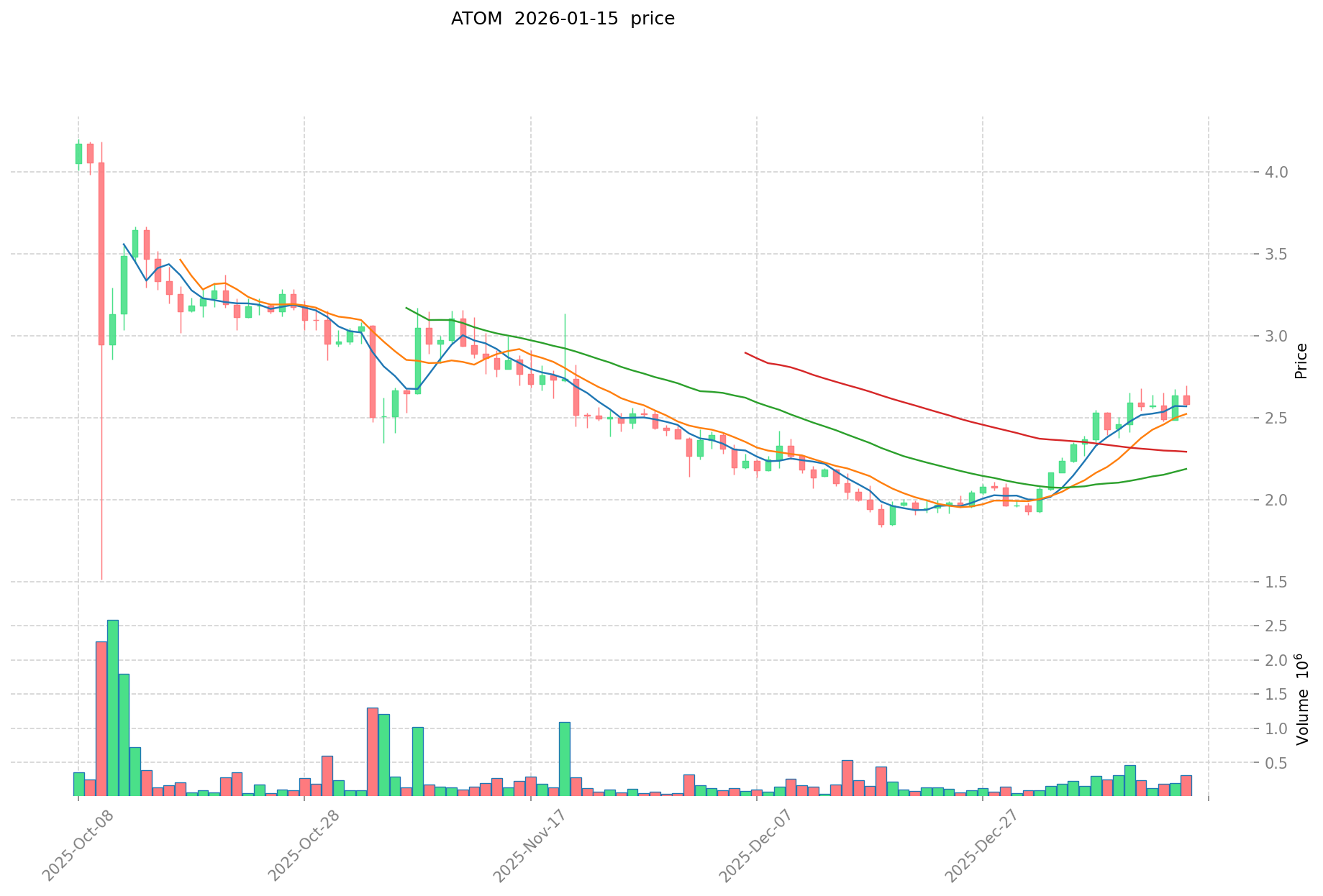
- 2022: ATOM reached its all-time high of $44.45 in January 2022, before entering a prolonged downtrend as broader market conditions shifted.
- Comparative Analysis: Throughout recent market cycles, STABLE has shown higher volatility as a newer asset, while ATOM has demonstrated more established trading patterns. ATOM declined from its peak of $44.45 to current levels around $2.54, representing approximately a 94% decline from its all-time high, whereas STABLE has traded within a narrower range since its recent launch.
Current Market Status (2026-01-15)
- STABLE current price: $0.015809
- ATOM current price: $2.542
- 24-hour trading volume: STABLE $1,820,951 vs ATOM $433,686
- Market Sentiment Index (Fear & Greed Index): 61 (Greed)
View real-time prices:
- Check STABLE current price Market Price
- Check ATOM current price Market Price
II. Core Factors Influencing STABLE vs ATOM Investment Value
Supply Mechanism Comparison (Tokenomics)
- ATOM: Functions as the native token of the Cosmos ecosystem, with staking mechanisms that influence circulating supply and network security.
- STABLE: Specific supply mechanism details were not available in the provided materials.
- 📌 Historical Pattern: Supply mechanisms can drive price cycle variations through market dynamics, liquidity conditions, and staking participation rates.
Institutional Adoption and Market Application
- Institutional Holdings: ATOM benefits from a mature ecosystem that may attract institutional interest in interoperability solutions.
- Enterprise Adoption: Cross-chain functionality and interoperability features represent potential application areas for blockchain networks in enterprise environments.
- Regulatory Landscape: Policy attitudes toward different digital assets vary across jurisdictions and continue to evolve.
Technology Development and Ecosystem Building
- ATOM Technology Development: Cross-chain functionality serves as a key technical feature within the Cosmos network architecture.
- STABLE Technology Development: Technical specifications were not detailed in the available materials.
- Ecosystem Comparison: Key factors for evaluation include technological innovation, market demand, staking mechanisms, liquidity conditions, and ecosystem development across DeFi, NFT, payment, and smart contract implementation areas.
Macroeconomic Environment and Market Cycles
- Inflationary Context Performance: Asset characteristics may respond differently to varying macroeconomic conditions.
- Macroeconomic Monetary Policy: Interest rate adjustments and currency index movements can influence digital asset market dynamics.
- Geopolitical Factors: Cross-border transaction requirements and international developments may affect adoption patterns and market sentiment.
III. 2026-2031 Price Forecast: STABLE vs ATOM
Short-term Forecast (2026)
- STABLE: Conservative $0.009045-$0.015869 | Optimistic $0.015869-$0.023327
- ATOM: Conservative $1.5222-$2.537 | Optimistic $2.537-$3.45032
Medium-term Forecast (2028-2029)
- STABLE may enter a gradual growth phase, with estimated price range of $0.017573-$0.028917 in 2028 and $0.022255-$0.033766 in 2029
- ATOM may enter a consolidation phase, with estimated price range of $1.964140-$4.437502 in 2028 and $2.705058-$4.158522 in 2029
- Key drivers: institutional capital inflows, ETF developments, ecosystem expansion
Long-term Forecast (2030-2031)
- STABLE: Baseline scenario $0.024332-$0.029673 (2030) and $0.025237-$0.036053 (2031) | Optimistic scenario $0.042433 (2030) and $0.047951 (2031)
- ATOM: Baseline scenario $3.360328-$4.097961 (2030) and $4.530910-$4.979022 (2031) | Optimistic scenario $5.860084 (2030) and $6.024617 (2031)
View detailed price predictions for STABLE and ATOM
Disclaimer
Price predictions are based on historical data analysis and market trends. Cryptocurrency markets are highly volatile and subject to various risk factors. These forecasts should not be considered as investment advice. Investors should conduct independent research and risk assessment before making any investment decisions.
STABLE:
| Year |
Predicted High Price |
Predicted Average Price |
Predicted Low Price |
Price Change |
| 2026 |
0.02332743 |
0.015869 |
0.00904533 |
0 |
| 2027 |
0.02488973305 |
0.019598215 |
0.01156294685 |
23 |
| 2028 |
0.0289171662325 |
0.022243974025 |
0.01757273947975 |
40 |
| 2029 |
0.03376635256995 |
0.02558057012875 |
0.022255096012012 |
61 |
| 2030 |
0.04243304972957 |
0.02967346134935 |
0.024332238306467 |
87 |
| 2031 |
0.047950829867482 |
0.03605325553946 |
0.025237278877622 |
128 |
ATOM:
| Year |
Predicted High Price |
Predicted Average Price |
Predicted Low Price |
Price Change |
| 2026 |
3.45032 |
2.537 |
1.5222 |
0 |
| 2027 |
4.2809338 |
2.99366 |
2.5146744 |
17 |
| 2028 |
4.437502218 |
3.6372969 |
1.964140326 |
43 |
| 2029 |
4.15852154577 |
4.037399559 |
2.70505770453 |
58 |
| 2030 |
5.86008358991055 |
4.097960552385 |
3.3603276529557 |
61 |
| 2031 |
6.024616706088807 |
4.979022071147775 |
4.530910084744475 |
95 |
IV. Investment Strategy Comparison: STABLE vs ATOM
Long-term vs Short-term Investment Strategies
- STABLE: May appeal to investors interested in emerging payment infrastructure and stablecoin-focused ecosystems, particularly those with higher risk tolerance for newer market entrants
- ATOM: May suit investors seeking exposure to established cross-chain interoperability solutions and mature blockchain ecosystems with longer operational histories
Risk Management and Asset Allocation
- Conservative Investors: STABLE 20-30% vs ATOM 70-80%
- Aggressive Investors: STABLE 50-60% vs ATOM 40-50%
- Hedging Tools: Stablecoin allocations, options strategies, cross-asset portfolio diversification
V. Potential Risk Comparison
Market Risks
- STABLE: Higher volatility characteristics associated with newer market entry, limited historical price data for pattern analysis, narrower liquidity conditions in certain market environments
- ATOM: Price decline patterns observed from historical peaks, market sentiment fluctuations affecting interoperability-focused assets, competitive pressures from alternative cross-chain solutions
Technical Risks
- STABLE: Scalability considerations for emerging payment infrastructure, network stability factors during early operational phases
- ATOM: Network complexity inherent in cross-chain architecture, technical implementation challenges across interconnected blockchain environments
Regulatory Risks
- Evolving regulatory frameworks may affect payment-focused infrastructure and cross-chain interoperability solutions differently across jurisdictions, with varying compliance requirements and policy approaches impacting operational models and market access
VI. Conclusion: Which Is the Better Buy?
📌 Investment Value Summary:
- STABLE Characteristics: Positioning in stablecoin payment infrastructure, newer market presence with associated growth potential and volatility considerations
- ATOM Characteristics: Established cross-chain interoperability framework, mature ecosystem with longer operational track record, broader ecosystem development history
✅ Investment Considerations:
- Novice Investors: May consider starting with more established assets like ATOM while conducting thorough research on market dynamics, risk factors, and portfolio diversification principles
- Experienced Investors: Could evaluate balanced exposure across both assets based on individual risk profiles, market analysis, and strategic allocation objectives aligned with distinct technological positioning
- Institutional Investors: May assess ecosystem maturity, liquidity conditions, regulatory clarity, and infrastructure development trajectories when evaluating allocation strategies across payment-focused and interoperability-oriented blockchain networks
⚠️ Risk Disclosure: Cryptocurrency markets exhibit high volatility characteristics. This content does not constitute investment advice. Investors should conduct independent research and risk assessment before making any investment decisions.
VII. FAQ
Q1: What are the main differences between STABLE and ATOM in terms of use cases?
STABLE focuses on stablecoin payment infrastructure as a USDT-native Layer 1 blockchain, while ATOM serves as the foundation for cross-chain interoperability through the Cosmos ecosystem. STABLE was launched in 2025 with features including sub-second finality and low transaction fees specifically designed for payment scenarios. ATOM, operational since 2019, enables communication and interoperability among various blockchain networks through its cross-chain architecture, positioning it as an infrastructure solution for blockchain interconnectivity rather than a payment-specific platform.
Q2: How do the historical price performances of STABLE and ATOM compare?
ATOM has experienced a significant decline from its peak while STABLE shows high volatility as a newer asset. ATOM reached its all-time high of $44.45 in January 2022 and has declined approximately 94% to current levels around $2.54, reflecting established trading patterns through multiple market cycles. STABLE, launched in 2025, demonstrated price ranges from $0.05 to $0.00913 in December 2025, currently trading at $0.015809, exhibiting the higher volatility typical of newly launched assets with limited historical data for pattern analysis.
Q3: Which asset is more suitable for conservative investors?
ATOM may be more appropriate for conservative investors seeking lower risk exposure. Conservative allocation strategies suggest a 70-80% ATOM versus 20-30% STABLE portfolio weighting, reflecting ATOM's longer operational history since 2019, more established ecosystem maturity, and broader historical price data for analysis. STABLE's newer market presence, higher volatility characteristics, and limited track record position it as a higher-risk allocation more suitable for investors with greater risk tolerance or those seeking exposure to emerging payment infrastructure developments.
Q4: What are the key risk factors to consider when investing in STABLE versus ATOM?
Both assets face distinct risk profiles across market, technical, and regulatory dimensions. STABLE's primary risks include higher volatility as a newer market entrant, limited historical data for pattern recognition, and narrower liquidity conditions in certain environments, alongside scalability and network stability considerations during early operational phases. ATOM faces risks from price decline patterns observed from historical peaks, competitive pressures from alternative cross-chain solutions, network complexity inherent in cross-chain architecture, and technical implementation challenges across interconnected blockchain environments. Both assets remain subject to evolving regulatory frameworks that may affect payment infrastructure and cross-chain solutions differently across jurisdictions.
Q5: What are the price forecast ranges for STABLE and ATOM through 2031?
Price forecasts indicate different growth trajectories for each asset through 2031. STABLE's conservative estimates range from $0.009045-$0.015869 in 2026, gradually expanding to $0.025237-$0.036053 by 2031, with optimistic scenarios reaching $0.047951 in 2031. ATOM's conservative projections span $1.5222-$2.537 in 2026, extending to $4.530910-$4.979022 by 2031, with optimistic scenarios reaching $6.024617 in 2031. These forecasts are based on historical data analysis and market trends, though cryptocurrency markets remain highly volatile and subject to various risk factors that may significantly impact actual outcomes.
Q6: How do institutional adoption patterns differ between STABLE and ATOM?
Institutional adoption characteristics vary based on each asset's ecosystem maturity and positioning. ATOM benefits from a more mature ecosystem with a longer operational history that may attract institutional interest in cross-chain interoperability solutions and enterprise applications requiring blockchain interconnectivity. STABLE's positioning in stablecoin payment infrastructure represents a different institutional value proposition focused on payment processing and transaction efficiency. Institutional investors evaluating allocation strategies typically assess factors including ecosystem maturity, liquidity conditions, regulatory clarity, and infrastructure development trajectories specific to each network's technological focus area.
Q7: What portfolio allocation strategies are recommended for different investor types?
Portfolio allocation approaches should align with individual risk profiles and investment objectives. Conservative investors may consider allocations of 70-80% ATOM versus 20-30% STABLE, prioritizing established ecosystem exposure with lower volatility characteristics. Aggressive investors could evaluate balanced allocations of 40-50% ATOM versus 50-60% STABLE, accepting higher volatility for potential growth exposure in emerging payment infrastructure. Novice investors may benefit from starting with more established assets like ATOM while conducting thorough research on market dynamics and risk factors, while experienced investors could assess balanced exposure based on strategic objectives aligned with distinct technological positioning across both payment-focused and interoperability-oriented blockchain networks.
Q8: How do macroeconomic factors affect STABLE and ATOM differently?
Macroeconomic conditions may influence each asset through different transmission mechanisms based on their distinct positioning. Interest rate adjustments and monetary policy shifts can affect digital asset market dynamics broadly, though payment-focused infrastructure like STABLE and interoperability solutions like ATOM may respond differently to varying economic conditions. Inflationary contexts, currency index movements, and geopolitical factors affecting cross-border transaction requirements may create divergent impacts on adoption patterns and market sentiment for payment-oriented versus cross-chain interoperability solutions. Investors should monitor macroeconomic developments and assess how evolving conditions may affect each asset's fundamental value proposition and market positioning.
* The information is not intended to be and does not constitute financial advice or any other recommendation of any sort offered or endorsed by Gate.