Analysis of $1.38 Billion Institutional Outflow from BTC ETFs

Last Updated 2026-03-25 22:55:29
Reading Time: 1m
Over the past four days, Bitcoin ETF funds saw a total net outflow of about $1.38 billion, while Ethereum ETFs continued to experience sustained selling pressure. This analysis examines capital flows, price trends, and the broader market impact in detail.

Market Background: Why ETF Fund Flows Matter

Exchange-traded funds (ETFs) have emerged as essential tools for institutions and high-net-worth investors to access the crypto market, thanks to their transparency and ease of use. ETF inflows and outflows directly reflect market risk appetite and capital allocation, making them a key indicator for assessing bull and bear cycles.

In traditional finance, large-scale ETF net outflows typically signal that institutional investors are turning cautious or seeking safety. The same logic applies in the crypto sector, often accompanied by significant price volatility.

Bitcoin ETF Net Outflows Reach $1.38 Billion
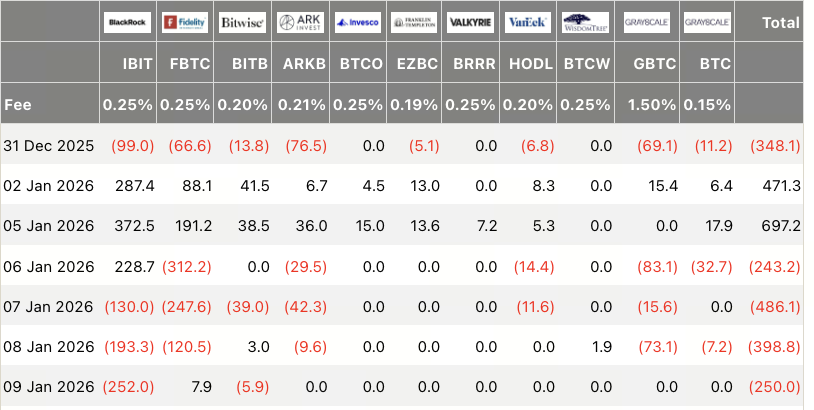
Spot Bitcoin ETFs recorded cumulative net outflows of about $1.38 billion over four trading days from January 6 to 9, 2026. Leading products—including BlackRock’s IBIT and other major Bitcoin ETFs—saw substantial capital withdrawals.

This wave of outflows reversed the earlier bullish momentum. At the start of the month, strong inflows had pushed Bitcoin prices higher, but as institutions began to take profits at elevated levels, funds started flowing out.

Data indicates that Bitcoin ETFs saw consecutive net outflows over several trading days, totaling $1.38 billion. This points to a short-term cooling in institutional appetite for risk assets.

Ethereum ETF Selling Pressure Continues

Ethereum spot ETFs are also facing ongoing capital withdrawals. According to reports, Ethereum ETFs posted several hundred million dollars in net outflows during a similar timeframe.

While Ethereum’s long-term fundamentals remain robust—driven by network upgrades and ecosystem growth—current institutional risk preferences have resulted in selling pressure for Ethereum ETFs as well.

This divergence in ETF fund flows highlights differing institutional risk assessments between Bitcoin and Ethereum.

How Fund Flows Impact Prices
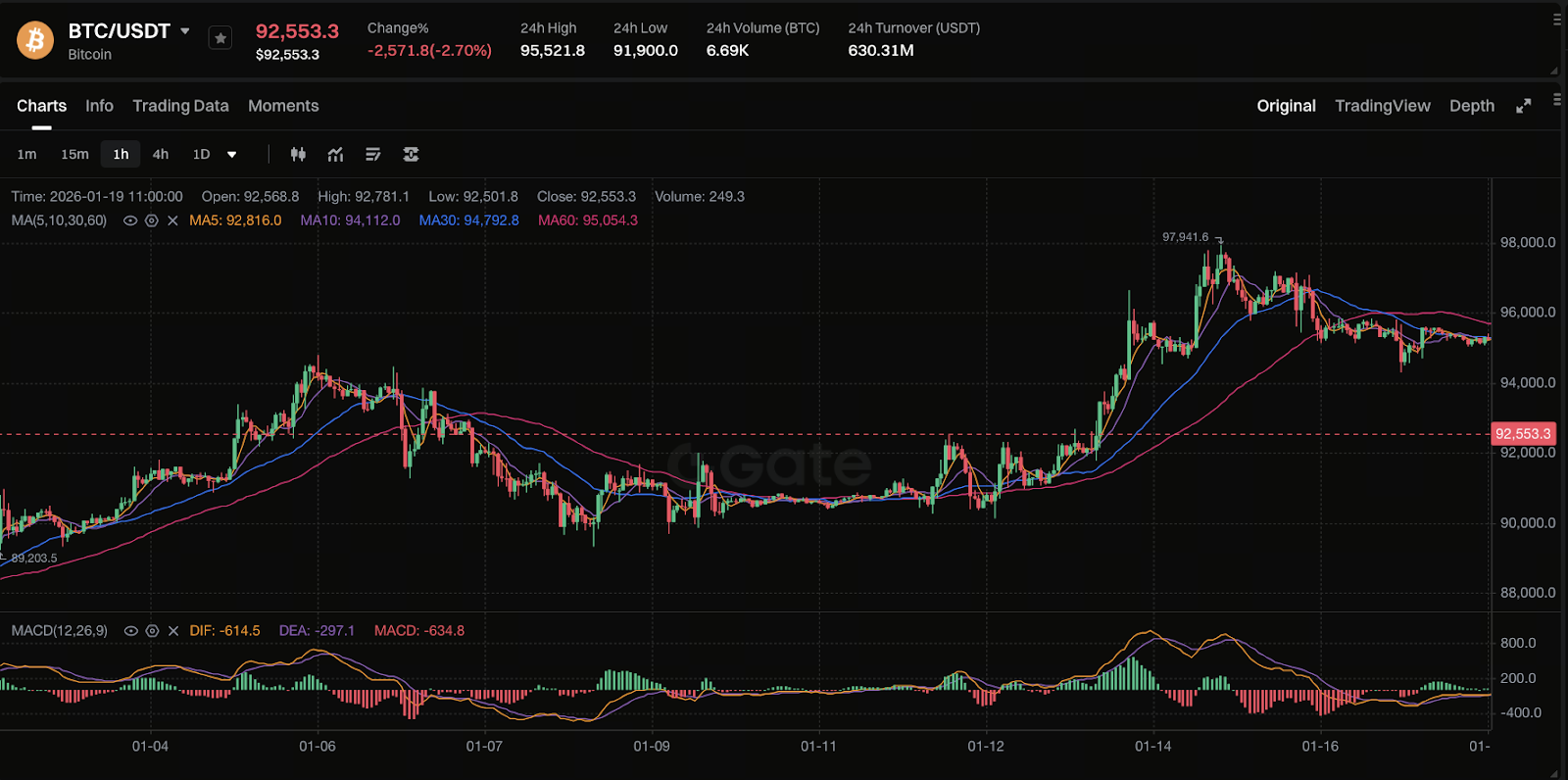

Chart: https://www.gate.com/trade/BTC_USDT

Capital movement in ETFs and other institutional products directly influences spot prices. In recent weeks:

  • During inflow periods, Bitcoin ETFs attracted strong capital, pushing prices to highs.
  • During outflow periods, as capital exited, core prices came under pressure and volatility increased.

This further demonstrates the close link between ETF fund flows and price volatility. For traders and investors, ETF flow metrics are vital reference signals.

Why Are Institutions Withdrawing?

Institutional withdrawals are typically driven by a mix of factors:

  • Profit-taking at high valuations—locking in gains on long positions
  • Macroeconomic uncertainty—global inflation and interest rate expectations shaping asset allocation
  • Rising crypto market volatility—short-term contraction in risk appetite

ETF investors are largely institutional in nature. When financial or risk preferences shift toward caution, these investors are more likely to reduce exposure to mitigate potential risks.

Market Outlook and Strategic Guidance

Although ETFs are currently experiencing net outflows, this does not necessarily signal the end of the bull market:

  • The market may enter a consolidation phase
  • Short-term capital may rotate into other asset classes
  • Price corrections could offer medium- to long-term entry points

For medium- and long-term investors, monitoring inflow trends and key support levels, while aligning strategies with personal risk tolerance, remains crucial.

Conclusion

Recent sharp outflows from Bitcoin and Ethereum ETFs reflect short-term risk aversion and profit-taking at elevated levels. Fund flows remain a key gauge of market sentiment and price direction; understanding these dynamics can help investors seize opportunities. As market conditions evolve, ongoing data tracking will be critical for sound investment decisions.

Author: Max
Disclaimer
* The information is not intended to be and does not constitute financial advice or any other recommendation of any sort offered or endorsed by Gate.
* This article may not be reproduced, transmitted or copied without referencing Gate. Contravention is an infringement of Copyright Act and may be subject to legal action.

Related Articles

AI-Native Settlement Layers: How United Stables Is Building the Next Financial Rail
Beginner

AI-Native Settlement Layers: How United Stables Is Building the Next Financial Rail

Stablecoins were originally designed as dollar substitutes within exchanges, primarily used for asset pricing and trade settlement. As on-chain financial ecosystems have matured, their role has expanded beyond simple payments to include collateral assets, cross-chain liquidity mediums, and unified settlement units. In particular, as AI systems and automated agents begin to participate directly in economic activity, demand has risen sharply for programmable value units capable of instant settlement. This shift is pushing stablecoins toward the role of foundational financial infrastructure.
2026-03-25 03:16:17
The ve(3,3) Flywheel Explained: How AERO Tokenomics Powers Aerodrome’s DeFi Economy
Beginner

The ve(3,3) Flywheel Explained: How AERO Tokenomics Powers Aerodrome’s DeFi Economy

In the competition for DeFi liquidity, high-inflation mining alone is no longer enough to build lasting advantages. Aerodrome applies the ve(3,3) economic model to redesign token emissions, voting mechanisms, and revenue distribution, creating a liquidity flywheel centered on governance and cash flow. This article examines AERO tokenomics, the veAERO locking mechanism, and protocol revenue models to explain how Aerodrome builds a sustainable DeFi economic system.
2026-03-25 06:41:58
How is the price of PAXG determined? Pegging mechanism, trading depth, and influencing factors
Beginner

How is the price of PAXG determined? Pegging mechanism, trading depth, and influencing factors

PAXG (Pax Gold) is a tokenized asset backed by physical gold reserves, launched by fintech firm Paxos and issued as an ERC-20 token on the Ethereum blockchain. The core concept is to digitally represent real-world gold assets, allowing investors to hold and trade gold via the blockchain network. Because each PAXG token corresponds to a specific quantity of physical gold, its price is theoretically expected to closely track the global gold market.
2026-03-24 19:11:40
Aerodrome Tokenomics: How ve(3,3) Powers Base's Most Profitable DEX
Beginner

Aerodrome Tokenomics: How ve(3,3) Powers Base's Most Profitable DEX

AERO is the native token of Aerodrome Finance, a core decentralized exchange and liquidity protocol in the Base ecosystem. It is primarily used for liquidity incentives and ecosystem operations. veAERO is a governance NFT that users receive by locking AERO, representing both voting power and the right to share protocol revenue. Through a dual track structure of AERO as a utility token and veAERO as a governance credential, Aerodrome separates liquidity usage value from long term governance power, allowing participants to act as liquidity providers, governance decision makers, and revenue sharers within the same system.
2026-03-25 06:40:31
How Does PAXG Work? In-Depth Overview of the Physical Gold Tokenization Mechanism
Beginner

How Does PAXG Work? In-Depth Overview of the Physical Gold Tokenization Mechanism

PAXG (Pax Gold) is a tokenized asset backed by physical gold, issued by the fintech company Paxos and traded on the Ethereum blockchain as an ERC-20 token. The core concept is to tokenize physical gold on-chain, with each PAXG token representing ownership of a certain amount of gold. This structure enables investors to hold and trade gold in the form of a digital asset.
2026-03-24 19:12:51
Aster vs Hyperliquid: Which Perp DEX Will Prevail?
Beginner

Aster vs Hyperliquid: Which Perp DEX Will Prevail?

Aster and Hyperliquid are the two representative protocols of the "purpose-built L1 path" within the current decentralized perpetual exchange (Perp DEX) sector. As a pioneer in the field, Hyperliquid has built a deep liquidity moat through its highly mature order book architecture and strong community consensus. Conversely, Aster, as a rising challenger, seeks to leapfrog the competition in high-performance trading through more aggressive multi-chain aggregation logic, private transaction modules, and an underlying execution environment optimized for 2026 market demands.
2026-03-24 11:58:33





