For users new to prediction markets, both projects may seem focused on "predicting future event outcomes." However, they differ significantly in underlying architecture, liquidity management, market organization, and target audience.
Understanding these differences not only reveals the development path of the prediction market industry but also illustrates how various Web3 protocols use blockchain technology to build information discovery and market pricing mechanisms.
Dexsport vs Polymarket: Project Positioning
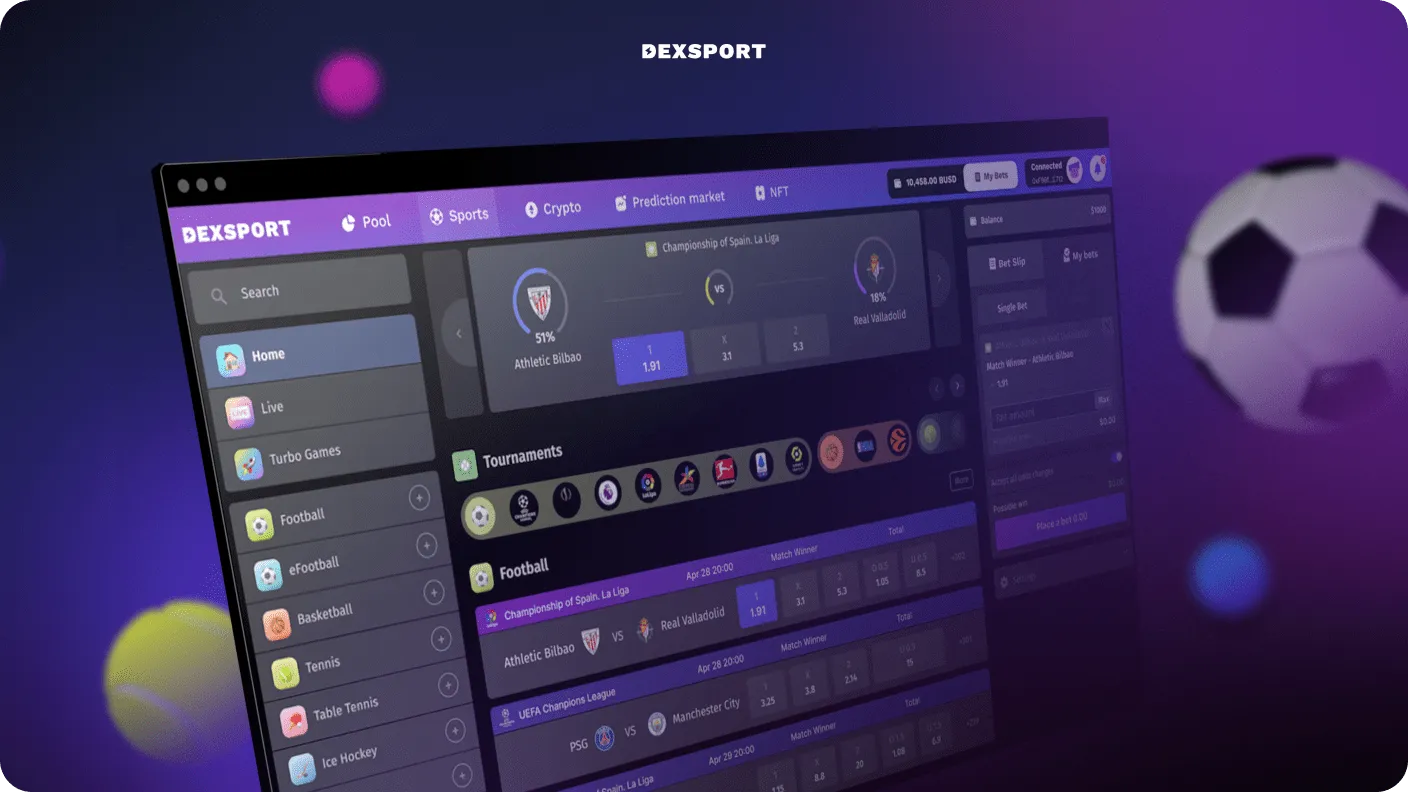
Unlike many single-purpose protocols, Dexsport’s long-term vision extends beyond sports predictions to include prediction markets, digital asset price forecasts, P2P event predictions, and NFT-related ecosystem modules. The project aims to create an on-chain market network covering multiple prediction scenarios.
A key feature of Dexsport is its shared liquidity model. The protocol manages capital through a unified liquidity pool, allowing multiple markets to share a single liquidity source. This approach improves capital efficiency and lowers the barrier to launching new markets.
Polymarket’s core goal is to aggregate participant information and judgment through market mechanisms, generating probabilistic expectations about future events. Market prices are generally seen as a reflection of collective participant opinion, making Polymarket a frequent tool for observing shifts in public expectations on major events.
Compared to platforms focusing on specific verticals, Polymarket emphasizes an open market structure. Users can engage in predictions across a broad range of topics, while the market itself handles information discovery and probability pricing.
From a positioning standpoint, Dexsport is more like a comprehensive prediction ecosystem than a single prediction market platform. Polymarket has become one of the most representative projects in the prediction market space, with its market size and user activity driving the entire on-chain prediction market industry.
Architectural Differences Between Dexsport and Polymarket
Though both are prediction market protocols, their architectural designs differ markedly.
Dexsport adopts an architecture centered on a shared liquidity pool. Different prediction markets draw from a unified liquidity source, enabling centralized capital management. This design emphasizes capital efficiency and ecosystem scalability, allowing new markets to quickly gain liquidity.
Polymarket leans toward a market-driven model. The platform builds prediction markets around numerous independent events, with each market developing its own trading depth and price discovery based on demand. Its focus is on improving information aggregation efficiency rather than centrally managing liquidity.
In short, Dexsport prioritizes resource integration within the ecosystem, while Polymarket focuses on open markets and information discovery. These two models represent distinct directions in prediction market protocol evolution.
Market Mechanism Differences Between Dexsport and Polymarket
Market mechanisms represent one of the most critical distinctions between the two.
Dexsport’s design originates from sports event prediction scenarios, so the protocol must handle many markets with clear start and end times. Market structures typically revolve around event outcomes or specific occurrences, with reward distribution and settlement handled through the shared liquidity system.
Polymarket, on the other hand, more frequently adopts an open-event market model. Any verifiable data event with a clear outcome can form an independent market. Market prices adjust continuously as participant expectations evolve, reflecting collective judgment.
The table below highlights the main differences:
| Comparison Dimension |
Dexsport |
Polymarket |
| Market Origin |
Sports event prediction |
Open event prediction |
| Core Goal |
Prediction ecosystem building |
Information discovery |
| Liquidity Model |
Shared liquidity pool |
Market-driven |
| Market Structure |
Scenario-oriented |
Event-oriented |
| Expansion Direction |
Multi-prediction ecosystem |
Broad event market |
In essence, Dexsport focuses more on user participation experience and ecosystem expansion, while Polymarket emphasizes the ability of market prices to genuinely reflect expectations.
Source: dexsport.io
Incentive Mechanism Differences Between Dexsport and Polymarket
Incentive mechanisms determine what drives user participation in a protocol.
Dexsport has a native token, DESU. DESU serves reward distribution, community governance, and ecosystem incentives. Through its token system, the protocol builds long-term collaborative relationships among users, liquidity providers, and the community.
Polymarket, by contrast, focuses more on market activities themselves. The core motivation for users comes from judging event outcomes and capitalizing on market price movements. Rather than a token-driven model, Polymarket emphasizes the inherent appeal of market mechanisms.
This difference reflects two distinct development philosophies. Dexsport aims to drive ecosystem growth through its token system, while Polymarket relies on network effects and market scale.
For users, the former emphasizes ecosystem participation value, while the latter stresses market information value.
Data and Control Differences Between Dexsport and Polymarket
A key principle in blockchain is enhancing data transparency and user control. Although both Dexsport and Polymarket operate in on-chain environments, their emphases differ.
Dexsport places greater emphasis on user asset control and transparency within the ecosystem. The shared liquidity pool and on-chain recording let users intuitively understand fund flows and market logic. Users interact via digital wallets and maintain direct control over their assets.
Polymarket, on the other hand, prioritizes the openness of market data. Since many markets revolve around real-world events, the price and probability data generated carry significant informational value. Research institutions, media, and market observers frequently use this data as a reference.
Thus, Dexsport focuses on operational transparency within its ecosystem, while Polymarket focuses on market information transparency. These reflect different priorities for prediction market protocols.
Application Scenario Differences Between Dexsport and Polymarket
Application scenarios determine the ultimate user base served.
Dexsport’s core scenario remains sports event predictions, with gradual expansion into digital asset price predictions, P2P event predictions, and other on-chain market activities. Its user base comes primarily from sports and vertical prediction markets.
Polymarket’s coverage is much broader. Political elections, macroeconomic events, tech product launches, international events, and sports matches can all form markets. Users often leverage these markets to gauge public expectations and sentiment shifts.
From an application perspective, Dexsport is better suited for building long-term ecosystems around specific verticals, while Polymarket resembles an open prediction network covering global events.
As the prediction market industry continues to evolve, these models may learn from each other and gradually converge, but for now, they represent distinct paths.
Summary
Dexsport and Polymarket are both significant on-chain prediction market projects, but they differ clearly in product positioning and development direction.
Dexsport builds on sports event predictions, using a shared liquidity pool and the DESU token system to create a comprehensive prediction ecosystem. It emphasizes capital efficiency and ecosystem scalability. Polymarket focuses on open-event markets, using market prices to reflect collective judgment, with a stronger emphasis on information discovery and probability pricing.
For understanding the prediction market industry, these two represent the "ecosystem-driven prediction protocol" and the "market-driven prediction platform" models, respectively. They also showcase the potential future directions of Web3 prediction markets.
FAQ
Are Dexsport and Polymarket both prediction markets?
Yes. Both are on-chain prediction market protocols, but their product positioning and market structures differ significantly.
What is the biggest difference between Dexsport and Polymarket?
The biggest difference is market positioning. Dexsport emphasizes sports predictions and shared liquidity ecosystems, while Polymarket focuses on open-event markets and information discovery.
Why does Dexsport use a shared liquidity pool?
A shared liquidity pool improves capital efficiency by letting multiple prediction markets draw from the same liquidity source, reducing the cost of launching new markets.
Why has Polymarket gained attention?
Polymarket converts the judgments of a large user base into market prices, making it a valuable tool for observing public expectations and market sentiment.
What is the role of the DESU token in Dexsport?
DESU is the native token of Dexsport, primarily used for ecosystem incentives, community governance, and protocol functionality.
Which has a wider range of applications, Dexsport or Polymarket?
In terms of topic coverage, Polymarket has a broader event scope. From an ecosystem-building perspective, Dexsport focuses more on building a comprehensive ecosystem around sports predictions and related markets.







