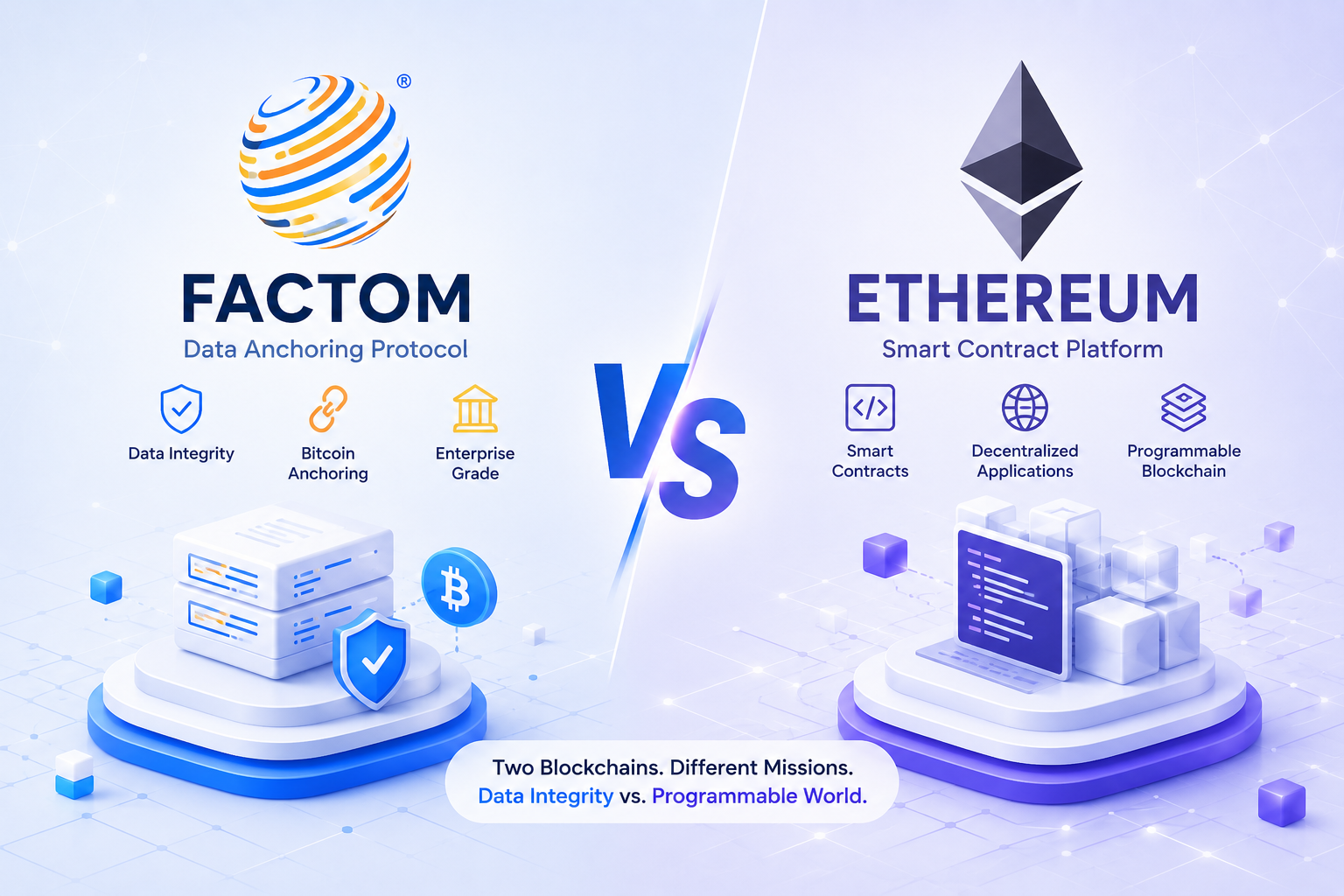
Traditional databases can store massive amounts of data, but they lack public verifiability, making it difficult for enterprises to prove whether the data has been tampered with. Factom verifies data authenticity through hash structures and Bitcoin anchoring mechanisms, while Ethereum maintains on-chain state via global network nodes.
Factom and Ethereum differ primarily in network architecture, data processing methods, incentive logic, and application positioning. Factom focuses on data integrity and enterprise verification, whereas Ethereum emphasizes open application ecosystems and on-chain programmability.
What Is Factom?
Factom is a data attestation protocol based on the Bitcoin anchoring mechanism. It writes data hashes into the Bitcoin network, leveraging Bitcoin's security to verify data authenticity.
Factom does not store complete files directly on the Bitcoin blockchain. Instead, it generates data hashes, organizes multiple hashes into a Merkle Root, and then anchors the verification result to Bitcoin.
Factom's data flow revolves around verification. Users first submit data records. The Factom network then generates hashes, organizes data blocks, and finally Bitcoin provides an immutable proof.
This means Factom prioritizes data integrity over on-chain program execution. Its network focus is on building an enterprise-grade verifiable record system.
According to official sources, Factom's primary applications include enterprise auditing, document verification, and data attestation.
What Is Ethereum?
Ethereum is a blockchain network that supports smart contracts and decentralized applications (dApps). It executes on-chain programs through the Ethereum Virtual Machine (EVM) and global network nodes, making it ideal for open blockchain applications.
Ethereum is not merely a data verification network. It allows developers to deploy smart contracts and enables different applications to share a unified state layer.
Ethereum's operating logic centers around smart contracts. Users first submit transactions. Ethereum nodes then execute the contract code, the network synchronizes the on-chain state, and finally Ethereum completes block confirmation.
This enables Ethereum to support:
- DeFi
- NFT
- DAO
- Layer 2
- On-chain games
These applications contrast sharply with Factom's enterprise data focus.
Structurally, Ethereum emphasizes on-chain programmability, while Factom focuses on data verification.
Architectural Differences Between Factom and Ethereum
The core architectural difference lies in network objectives and data organization. Factom uses a layered structure to manage data, while Ethereum maintains on-chain applications via a unified state layer.
Factom's core modules include:
- Entry Chain
- Directory Block
- Entry Credit
- Bitcoin Anchoring
Ethereum's core modules include:
- EVM
- Smart Contract
- Validator Network
- Global State
Factom's network processes data records. It generates hashes, organizes the data structure, anchors the result to Bitcoin, and then enterprises can verify record authenticity.
Ethereum's network continuously maintains on-chain state. Users call contracts, validators execute code, the network synchronizes state changes, and all nodes update the global state.
The table below outlines the main architectural differences:
| Architecture Aspect |
Factom |
Ethereum |
| Core Positioning |
Data Attestation Protocol |
Smart Contract Platform |
| Security Layer |
Bitcoin Anchoring |
Ethereum Itself |
| Data Structure |
Layered Data Chain |
Global State Tree |
| Network Focus |
Data Verification |
Application Execution |
| Account Logic |
Weak |
Native Support |
This means Factom is better suited for enterprise data scenarios, while Ethereum excels in open application ecosystems.
Differences in Data Processing Mechanisms
Both Factom and Ethereum process on-chain data, but their logic differs entirely. Factom emphasizes data proof, while Ethereum focuses on state execution.
Factom does not store complete raw files. It generates hashes first and writes data proofs to Bitcoin, resulting in lower on-chain storage costs.
Ethereum directly maintains on-chain state. Smart contracts, token balances, and application data are synchronized across the network, making its data structure more complex.
Factom's processing flow centers on verification: users submit data, Factom generates hashes, organizes data blocks, and Bitcoin records the final verification result.
Ethereum's flow revolves around state changes: users call contracts, the EVM executes logic, the network synchronizes changes, and Ethereum updates the global state tree.
Thus, Factom is ideal for low-cost data verification, while Ethereum suits complex on-chain logic execution.
Comparison of Incentive Mechanisms
Factom and Ethereum also differ significantly in incentives. Factom emphasizes stable data fees, whereas Ethereum focuses on open network incentives.
Factom uses a dual-token model. FCT coordinates value, while Entry Credit pays for data writing fees.
Entry Credit cannot be freely traded, allowing enterprises to calculate data costs stably. Factom's design minimizes fee volatility for enterprise users.
Ethereum uses ETH as a unified Gas asset. Users must pay ETH to execute transactions and smart contracts.
Ethereum's Gas structure changes with network conditions: users submit transactions, validators compete to include them, Gas prices fluctuate, and Ethereum completes execution.
This gives Ethereum higher fee flexibility but also greater cost volatility.
The table highlights the incentive differences:
| Incentive Aspect |
Factom |
Ethereum |
| Core Asset |
FCT |
ETH |
| Usage Fee |
Entry Credit |
Gas |
| Fee Volatility |
Relatively Stable |
Dynamic |
| Network Focus |
Enterprise Data |
On-chain Applications |
Differences in Data Control Methods
Factom and Ethereum also differ in data control logic. Factom emphasizes data proof, while Ethereum focuses on open on-chain state.
Factom does not require full data disclosure. It verifies authenticity through hashing, allowing enterprises to verify without exposing file contents.
Ethereum's smart contract data is typically public. Token states, contract logic, and on-chain interactions are synced to all nodes.
Factom's verification process relies on hash checking: enterprises submit data, Factom generates hashes, Bitcoin records the result, and users verify the file status.
Ethereum's public logic suits open application ecosystems: users execute transactions, the network syncs data, nodes verify changes, and the entire network reads the result.
Therefore, Factom is better for enterprise-level privacy verification, while Ethereum suits public on-chain applications.
Differences in Application Scenarios
Factom and Ethereum have distinct use cases. Factom leans toward enterprise data verification, while Ethereum targets open blockchain ecosystems.
Typical Factom scenarios include:
- File auditing
- Medical records
- Government data
- Enterprise verification
- Immutable attestation
Typical Ethereum scenarios include:
- DeFi
- NFT
- DAO
- Layer 2
- On-chain games
Factom's network focus is on data credibility: enterprises submit data, Factom syncs hashes, Bitcoin provides the final audit, and enterprises confirm authenticity.
Ethereum's focus is on on-chain program execution: developers deploy contracts, users interact, the network syncs state, and the ecosystem runs.
Thus, Factom resembles an enterprise data protocol, while Ethereum is like an open blockchain operating system.
Summary
Both Factom and Ethereum support on-chain data verification, but their network goals are entirely different. Factom emphasizes data attestation and Bitcoin anchoring, while Ethereum prioritizes smart contracts and open application ecosystems.
Factom's core strengths are low-cost data verification and enterprise-grade immutable records. Ethereum's strengths lie in on-chain programmability and a vast developer ecosystem.
Overall, Factom is better suited for enterprise data integrity scenarios, while Ethereum is ideal for building complex blockchain applications.
FAQ
What is the biggest difference between Factom and Ethereum?
Factom is oriented toward enterprise-level data attestation protocols, while Ethereum focuses on smart contracts and decentralized application platforms.
Why does Factom anchor to Bitcoin?
Factom uses Bitcoin's security and immutability to verify data authenticity without writing complete data onto Bitcoin.
Why is Ethereum more suitable for DeFi and NFT?
Ethereum supports smart contracts and the EVM, enabling developers to build complex on-chain applications and open protocol ecosystems.
Does Factom support smart contracts?
Official sources show that Factom focuses on data verification and enterprise attestation, so it does not support a full smart contract ecosystem like Ethereum.
Which is more suitable for enterprise data verification, Factom or Ethereum?
Factom is better suited for enterprise-level data verification because its structure prioritizes immutable records and low-cost data proof.







