Hong Kong's stock market is one of the world's most important international capital markets and serves as a key bridge between China's economy and global capital. Well-known companies such as Tencent Holdings, Alibaba Group, Xiaomi Corporation, Meituan, and BYD are listed in Hong Kong, making the market a long-term focus for global investors.
Against the backdrop of rapid digital finance development, the way investors participate in the Hong Kong stock market is also evolving. In addition to traditional Hong Kong stock brokers, digital asset platforms represented by Gate Stocks have begun offering Hong Kong stock trading services, enabling users to invest in the stock market through stablecoins such as USDT. While both models ultimately connect investors to the Hong Kong stock market, they differ significantly in account structures, funding pathways, and trading experiences.
What Is Gate Hong Kong Stock Trading?
Gate Hong Kong Stocks, offered through Gate Stocks, is a Hong Kong stock trading service that allows users to invest in the Hong Kong stock market through digital asset accounts.
After completing identity verification and opening a Stocks account, users can manage Hong Kong stock holdings through a unified account and use USDT as the funding entry point for trading. The launch of the Hong Kong Stocks section further expands Gate Stocks' global equity market coverage, enabling digital asset users to access more real-world assets (RWA) within the same ecosystem.
What Are Traditional Hong Kong Stock Brokers?
Traditional Hong Kong stock brokers refer to financial institutions that conduct stock brokerage business through the Hong Kong securities market.
Traditional brokers typically provide services such as securities account opening, stock trading, market data, and asset custody. Investors are generally required to fund their accounts through bank transfers and trade using HKD or other settlement currencies. For many years, this model has been the primary way global investors access the Hong Kong stock market.
What Is the Biggest Difference Between Gate Hong Kong Stocks and Traditional Hong Kong Stock Brokers?
The biggest difference between Gate Hong Kong Stocks and traditional Hong Kong stock brokers lies in their funding entry points and account structures.
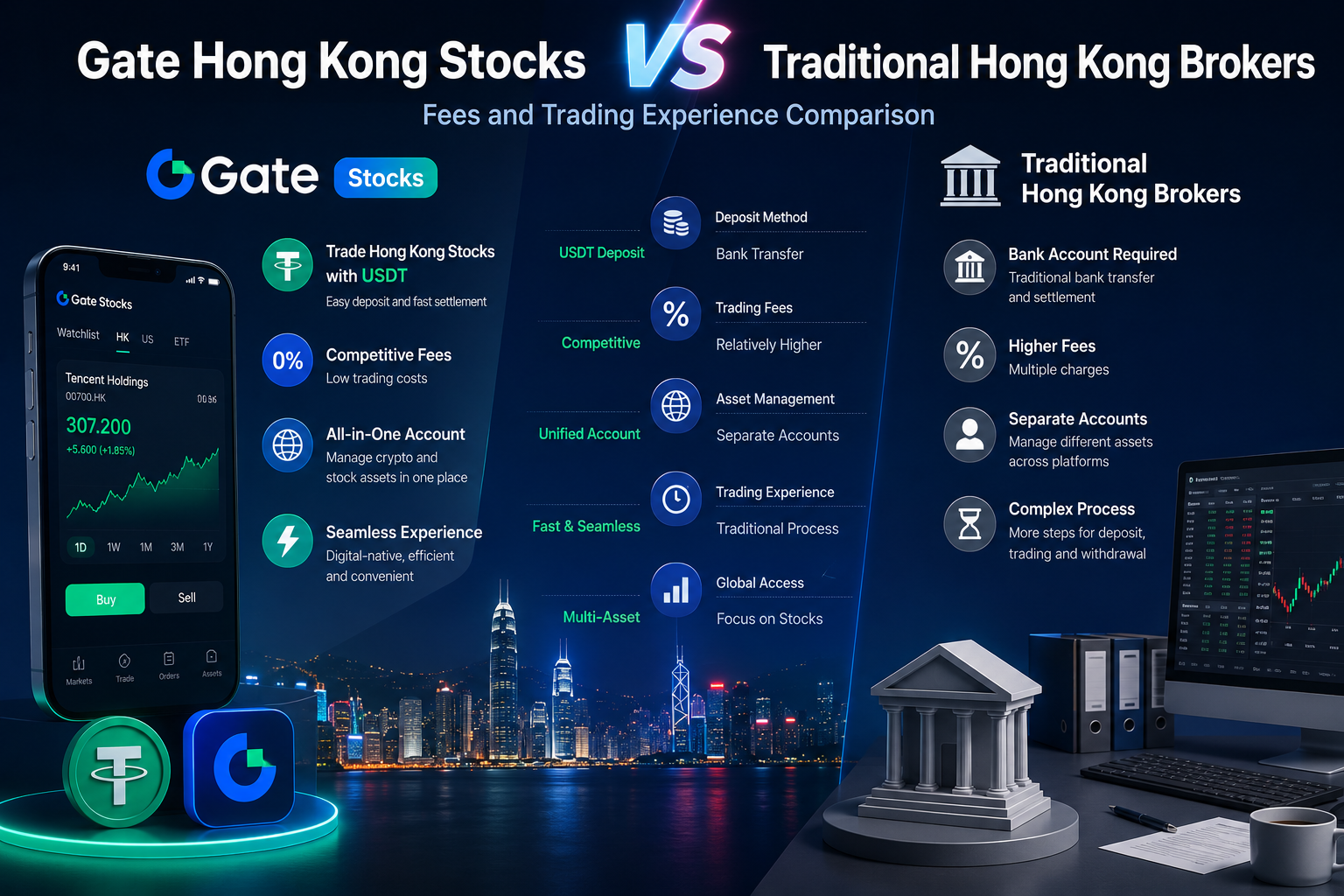
Traditional brokers primarily rely on the banking system for capital transfers, while Gate Stocks adopts a digital asset account system and uses USDT as the medium of funding. For users who already hold digital assets, this model reduces the need for currency conversion and cross-border bank transfers.
In addition, Gate Stocks incorporates both stock assets and digital assets into a unified account framework, whereas traditional brokers typically focus solely on securities asset management.
How Do Their Fund Management Methods Differ?
Fund management is one of the most noticeable areas of difference between the two models.
Traditional Hong Kong stock brokers generally require investors to deposit and withdraw funds through bank accounts, with settlements relying on traditional financial infrastructure. For cross-border investors, this may involve currency exchange and international wire transfer procedures.
Gate Stocks, on the other hand, operates through a digital asset account system. Users can use their USDT holdings to enter the stock account for trading and manage both stock assets and digital assets within a unified account. For users actively participating in the digital asset market, this approach offers a higher level of convenience.
How Does the Trading Experience Differ?
The differences in trading experience are primarily reflected in account management and asset integration capabilities.
Traditional brokers generally focus on securities services, meaning stock assets and digital assets must be managed separately across different platforms. Investors may need to maintain securities accounts, bank accounts, and digital asset accounts simultaneously.
Gate Stocks adopts a unified account design, allowing stock assets and digital assets to be viewed and managed on the same platform. This integrated model helps improve cross-market asset management efficiency and provides a more streamlined experience for global asset allocation.
How Do the Fee Structures Differ?
Whether using Gate Hong Kong Stocks or traditional Hong Kong stock brokers, trading fees generally consist of multiple components.
Traditional Hong Kong stock trading typically involves commissions, transaction levies, trading fees, stamp duties, and settlement-related charges. Fee structures may vary among brokers.
Gate Hong Kong Stocks charges relevant fees according to platform rules and market requirements. Specific rates may be adjusted based on market policies and platform arrangements. Therefore, investors should refer to the information published on official channels when trading.
Fundamentally, both models operate under the regulatory and settlement framework of the Hong Kong stock market, although the presentation and structure of fees may differ.
Comparison Between Gate Hong Kong Stocks and Traditional Brokers
| Comparison Dimension |
Gate Hong Kong Stocks |
Traditional Hong Kong Stock Brokers |
| Funding Entry Point |
Digital assets such as USDT |
Bank account |
| Deposit Method |
Digital asset transfer |
Bank transfer |
| Account Structure |
Unified management of stocks and digital assets |
Independent securities account |
| Asset Coverage |
Stocks + digital asset ecosystem |
Primarily securities assets |
| Global Asset Allocation |
Integrated management experience |
Fragmented management model |
| Market Access Method |
Digital finance gateway |
Traditional finance gateway |
Conclusion
Both Gate Hong Kong Stocks and traditional Hong Kong stock brokers enable investors to participate in the Hong Kong stock market, but they are built on different financial infrastructures. Traditional brokers operate through banking and securities systems, whereas Gate Stocks connects users to the stock market through USDT and digital asset accounts.
For users focused on traditional securities investing, conventional brokers remain a mature and established way to access the market. For investors interested in both digital assets and global equity markets, Gate Stocks offers a more integrated asset management experience.
FAQs
Can I Buy Hong Kong Stocks Through Both Gate Hong Kong Stocks and Traditional Hong Kong Stock Brokers?
Yes. Both provide access to the Hong Kong stock market, although they use different account structures and fund management models.
Do I Need a Bank Account to Fund a Gate Hong Kong Stocks Account?
Gate Stocks primarily uses digital assets such as USDT as its funding entry point. Specific fund management procedures are subject to platform rules.
What Currency Is Commonly Used by Traditional Hong Kong Stock Brokers?
Traditional Hong Kong stock brokers typically facilitate trading through HKD and related settlement systems in the Hong Kong stock market.
Are the Fees Exactly the Same Between Gate Hong Kong Stocks and Traditional Brokers?
Not entirely. Both involve market-related fees, but their specific fee structures and standards may differ. Investors should refer to officially published information.
Who Is Gate Hong Kong Stocks Suitable For?
For users who already hold digital assets and wish to manage both stock assets and digital assets simultaneously, Gate Hong Kong Stocks provides a convenient unified account experience.