Gate US Stock Liquidity is not a fixed number; it changes by stock, ETF, trading session, order size, market volatility, and the spread visible at the time of order review. Gate Stocks lets eligible users access supported U.S. stocks and ETFs with USDT settlement, but execution still follows market conditions. A highly traded stock during regular U.S. market hours may have tighter pricing, while a less active symbol or an extended-hours session may show wider spreads and greater slippage risk.
Gate US Stock Liquidity refers to how easily a supported U.S. stock or ETF position can be bought or sold on Gate at a price close to the displayed market price, after considering bid-ask spread, available market depth, order size, session timing, and execution rules.
The key point is simple: access does not remove market friction. Users can buy and sell supported U.S. stocks and ETFs through Gate Stocks, but they cannot assume every order will fill at the last displayed price. Liquidity matters because it affects the actual cost of entering and exiting a position.
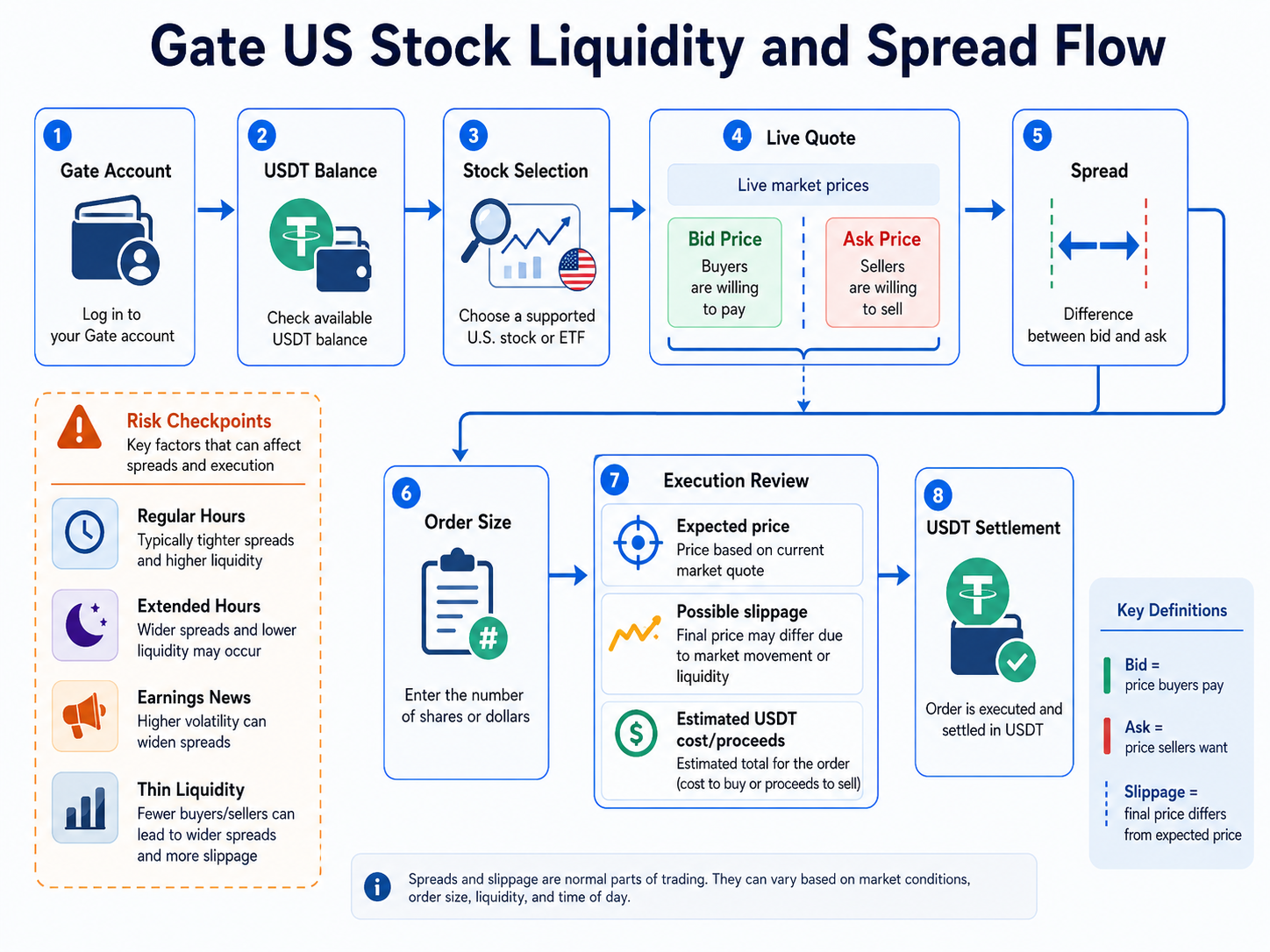
What Is Gate US Stock Liquidity?
Gate US Stock Liquidity describes the ease of buying or selling a supported U.S. stock or ETF through Gate Stocks without causing or experiencing a large difference between the expected price and final execution price.
In practice, liquidity is shaped by three layers. The first is the underlying U.S. market, where the stock or ETF trades. The second is the trading session, because regular hours usually have more participation than pre-market or after-hours sessions. The third is the order itself, including size, order type, and whether the user accepts the displayed price.
A simple analogy may help. Liquidity is like walking into a busy marketplace. When many buyers and sellers are present, prices are usually easier to compare and trades may happen closer to the expected level. When fewer people are present, the gap between what sellers want and buyers offer can become wider.
Users who are new to USDT-based stock access may first understand how U.S. stock trading with USDT works before focusing on spread and slippage.
How Do Spread and Slippage Affect Gate US Stocks?
Spread and slippage are related, but they are not the same.
The spread is the gap between the bid price and the ask price. The bid is the price buyers are willing to pay. The ask is the price sellers are asking for. When a user buys, the relevant price is usually closer to the ask. When a user sells, the relevant price is usually closer to the bid.
Slippage is the difference between the expected price and the final execution price. Slippage can be small, large, positive, or negative, depending on market movement and execution conditions. For most risk education, users focus on negative slippage, where a buy order fills higher than expected or a sell order fills lower than expected.
| Term |
What It Means |
Why It Matters |
| Bid price |
Highest visible price a buyer is willing to pay |
Important when selling |
| Ask price |
Lowest visible price a seller is willing to accept |
Important when buying |
| Spread |
Difference between bid and ask |
A wider spread can raise trading cost |
| Slippage |
Difference between expected and executed price |
Affects the final USDT cost or proceeds |
| Market depth |
Available quantity near current prices |
Thin depth may worsen execution for larger orders |
This table shows why the last displayed price is not enough. A user should look at the current buy and sell quote, estimated execution value, fees, and spread before confirming an order.
Why Can Slippage Happen When Buying US Stocks?
Slippage when buying US stocks can happen when the price moves before the order is executed, when available liquidity near the displayed price is thin, or when the order size is large relative to the visible market depth.
This matters because the order confirmation screen may show an estimate rather than a guaranteed final price. A fast-moving stock can change within seconds. A market order may prioritize execution over price certainty, while a limit order may provide more price control but may not fill if the market moves away.
Common causes include:
-
Earnings releases or company-specific news
-
Macroeconomic data such as inflation or employment reports
-
Market open and market close volatility
-
Low-volume stocks or ETFs
-
Extended-hours sessions with fewer active participants
-
Large orders placed into thin liquidity
A user comparing simple spot-style access with derivative products should keep the distinction clear. US stock spot and futures on Gate involve different execution, leverage, and risk mechanics.
What Changes When Selling US Stocks on Gate?
Selling has its own liquidity risk because the user exits through the available buy-side demand. If the bid is lower than expected, or if the spread widens, the USDT received after selling may be lower than the last visible price suggested.
The sell-side problem is often overlooked. Users may focus on the buy price, but liquidity also matters when leaving a position. In calmer conditions, the difference may be small for highly active stocks. In volatile conditions, or for less liquid names, the gap can become more noticeable.
A selling checklist should include the current bid, estimated USDT proceeds, order size, supported trading session, product rules, and whether the selected order type matches the user’s risk preference.
Users comparing crypto-platform stock access with traditional securities accounts may review traditional brokers vs crypto platforms for U.S. stocks to understand funding, settlement, rights, and execution differences.
How Do Trading Hours Affect Gate US Stock Liquidity?
Trading hours can strongly affect Gate US Stock Liquidity. Regular U.S. stock market hours usually have more participants, more quote activity, and deeper liquidity than pre-market or after-hours sessions. Extended-hours trading may offer more flexibility, but flexibility does not mean equal liquidity.
Gate’s extended-hours stock access expands the trading window for supported products, but users still need to check whether the chosen stock or ETF is available in the current session. They should also confirm the live spread, order type, estimated execution, and current product rules before confirming an order.
| Session |
Typical Liquidity Condition |
Spread Risk |
Practical Check |
| Regular market hours |
Usually deeper for active stocks |
Often tighter, but not guaranteed |
Check live bid, ask, and estimated cost |
| Market open |
Often active but volatile |
Can widen quickly |
Avoid assuming the opening quote is stable |
| Market close |
High activity with price movement risk |
Can change quickly |
Review final order estimate carefully |
| Pre-market |
Fewer participants than regular hours |
Often wider |
Use price control where available |
| After-hours |
Liquidity depends heavily on symbol and news |
Often wider |
Watch earnings and news-driven moves |
The main takeaway is that session availability and liquidity quality are different ideas. A stock may be tradable in a session, but the spread may still be wide. The mechanics of Gate US Stocks extended hours are important for users who want to trade outside the regular U.S. session.
What Is a Practical Example of Spread and Slippage?
Assume a user wants to buy a supported U.S. stock through Gate Stocks using USDT. The last displayed price is 100 USDT. The live bid is 99.90, and the live ask is 100.10. The visible spread is 0.20 USDT.
If the user places a buy order, the expected execution may be closer to the ask than the last price. If the market moves quickly and the order fills at 100.25, the user experiences 0.15 USDT of slippage compared with the 100.10 ask level, or 0.25 USDT compared with the last displayed price.
Now consider a sell order. If the last displayed price is 100 USDT but the bid is 99.80, the user may receive less than the last price suggests. If the bid moves to 99.60 before execution, the realized exit price may be lower.
This example is simplified, but it shows the core lesson: the last price is a reference point, not a guarantee. The live bid, ask, spread, order size, and execution rules matter more at the moment of confirmation.
How Can Users Check Liquidity Before Placing an Order?
Users can reduce avoidable execution surprises by checking liquidity before every order. The goal is not to predict price movement. The goal is to understand the current trading conditions.
A practical checklist includes:
-
Check whether the product is Gate Stocks spot, a stock contract, a CFD, or another stock-linked product.
-
Confirm that the stock or ETF is supported in the current session.
-
Review the live bid and ask, not only the last displayed price.
-
Compare the spread with the total order size.
-
Look at the estimated USDT cost or proceeds before confirmation.
-
Avoid oversized orders in thin markets.
-
Consider whether the order type gives enough price control.
-
Be extra cautious around earnings, macro news, market open, and market close.
-
Recheck product availability, fees, and regional eligibility in the live interface.
Users who do not want a separate securities brokerage workflow may compare the operational path in USDT stock trading without a brokerage account. Users evaluating margin or leveraged stock-linked products should separately review Gate US stock contract leverage, because leverage adds liquidation, margin, and faster loss risk.
Summary
Gate US Stock Liquidity depends on the stock or ETF, session timing, market conditions, order size, spread, and execution rules. It should not be treated as a fixed platform-wide feature.
Spread is the gap between the bid and ask price. Slippage is the difference between the expected price and the final execution price. Both can affect the true cost of buying and selling U.S. stocks with USDT.
The safest educational approach is to check the live quote, order estimate, supported session, product type, and risk terms before placing an order. Convenience does not remove market risk, execution risk, or liquidity risk.
FAQs
What is Gate US Stock Liquidity?
Gate US Stock Liquidity is the ease of buying or selling a supported U.S. stock or ETF on Gate near the expected price. It depends on the underlying market, trading session, order size, spread, volatility, and platform execution rules.
Is Gate US Stock Liquidity the same for every stock?
Gate US Stock Liquidity is not the same for every stock. Large, actively traded stocks may have tighter spreads during regular hours, while less active stocks or ETFs may show wider spreads and thinner depth.
What causes slippage when buying US stocks on Gate?
Slippage when buying US stocks on Gate can happen when prices move before execution, liquidity near the displayed price is limited, or the order size is large relative to available depth. It may be more noticeable during volatile periods, market open, market close, and extended-hours sessions.
Does a wider spread mean higher trading cost?
A wider spread can increase the effective cost of trading because buyers may pay closer to the ask and sellers may receive closer to the bid. Users should review the live bid-ask spread and estimated USDT amount before confirming an order.
Can limit orders reduce slippage when buying US stocks?
Limit orders can provide more price control when they are available, but they do not guarantee execution. A limit order may remain unfilled if the market does not reach the selected price.
Is Gate US Stock Liquidity better during extended hours?
Gate US Stock Liquidity may be thinner during extended hours than during regular U.S. market hours. Users should check live spreads, market depth, session availability, and order estimates before trading outside the regular session.
Stock investing involves market risk, and prices may fluctuate significantly. Please make decisions carefully based on your own risk tolerance.







