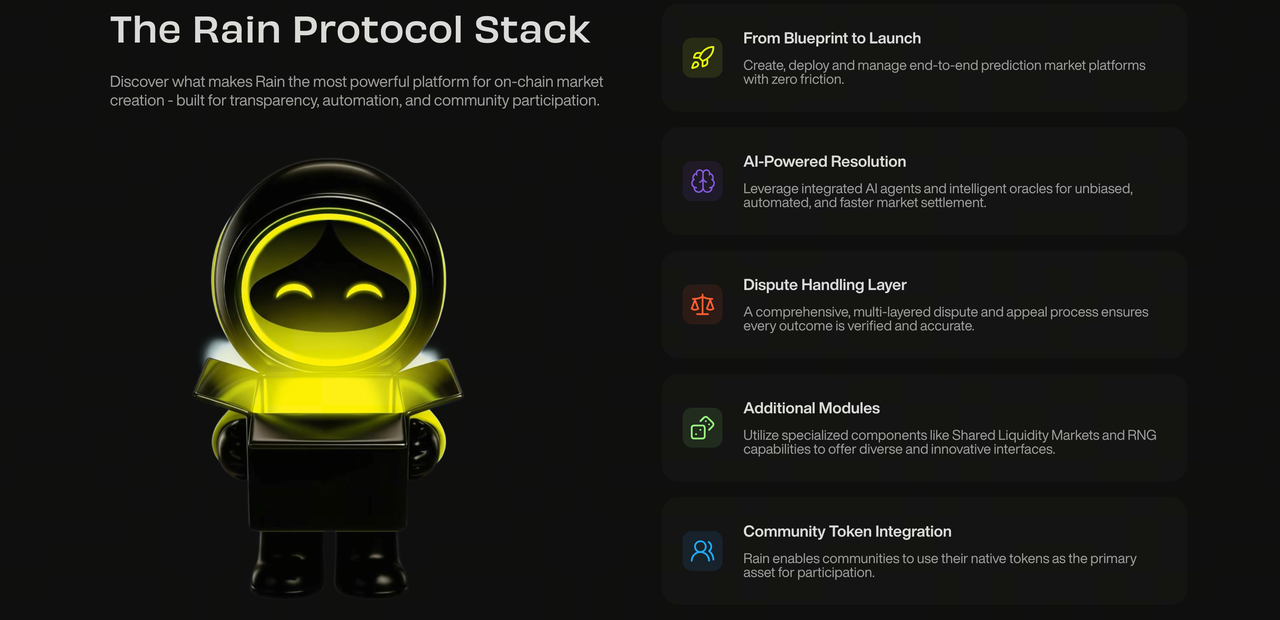
Rain Protocol is a prediction market protocol built exactly for this trend. Unlike traditional prediction market platforms, Rain focuses on deep protocol capabilities and an AI-native architecture. Rain isn’t just a platform for users to place bets—it’s an infrastructure layer that lets developers, creators, and AI Agents create prediction markets autonomously.
Rain Protocol is a prediction market protocol built exactly for this trend. Unlike traditional prediction market platforms, Rain focuses on deep protocol capabilities and an AI-native architecture. Rain isn’t just a platform for users to place bets—it’s an infrastructure layer that lets developers, creators, and AI Agents create prediction markets autonomously.
How Does Rain’s Market Creation Mechanism Work?
One of Rain’s core features is the Prediction Market Engine — the prediction market creation engine.
Developers can create markets for specific events, such as:
Once a market is live, participants trade on different outcomes. As trading activity grows, the market price shifts dynamically, producing probability signals.
For instance, if the market price for an event outcome reaches 70%, it generally means the market believes the event has roughly a 70% chance of occurring. Rain aims to standardize this creation process so AI Agents can automatically generate prediction markets, too.
How Do AI Agents Integrate with Rain?
Native AI Agent support is a key differentiator between Rain and traditional prediction markets.
Rain offers composable interfaces for AI systems, enabling AI Agents to:
-
Automatically create markets
-
Automatically submit predictions
-
Access real-time market probabilities
-
Analyze market trends
-
Execute on-chain transactions
In the coming Agentic Economy, AI Agents won’t just rely on internet data—they may also tap prediction markets for real-time consensus signals.
For example, an AI trading agent can use Rain to fetch probability predictions for a specific asset’s price movement and adjust its strategy accordingly.
This AI-meets-prediction-market model is a major reason Rain is classified as an AI × Crypto infrastructure.
How Does Rain Verify Outcomes?
One of the biggest challenges for prediction markets is verifying event outcomes.
Rain typically combines an Oracle system with community verification to settle markets. Oracles pull real-world results from off-chain sources and sync them on-chain.
In more complex markets, the protocol may introduce community arbitration, decentralized verification, multi-source cross-validation, and on-chain dispute resolution. These measures boost prediction credibility and reduce reliance on any single data source.
What Is Rain’s Liquidity Mechanism?
Prediction markets need sufficient liquidity to form efficient prices, so Rain designs dedicated liquidity and incentive mechanisms.
Market participants can provide liquidity, trade predictions, create high-quality markets, supply market data, and earn protocol rewards. As more AI Agents and users join the ecosystem, market depth and prediction efficiency will gradually improve.
Traditional prediction market platforms are typically consumer-facing apps where users trade only in predefined markets.
Rain, in contrast, is an infrastructure protocol that prioritizes:
-
Open market creation
-
AI Agent integration
-
Developer tools
-
Modular architecture
-
Creator Economy
Rain aims to let any developer quickly build their own prediction market product—without being tied to a single platform.
This protocol-layer positioning makes Rain more like Web3 infrastructure than a traditional betting platform.
Summary
Rain Protocol is building prediction market infrastructure for the AI age.
It doesn’t just let users create prediction markets—more importantly, it gives AI Agents, developers, and autonomous networks a composable information coordination system. As the Agentic Economy, InfoFi, and Forecasting Economy take shape, prediction markets could become a critical data layer for the future internet, with Rain serving as the underlying engine.
FAQs
How Does Rain Protocol Work?
Rain operates through its prediction market engine, Oracle system, liquidity mechanisms, and AI Agent interfaces, enabling developers and AI agents to create and run prediction markets.
What Is Rain’s Market Creation Mechanism?
Developers can create prediction markets around future events, and participants trade to form dynamic probability prices.
Why Are AI Agents Suited for Rain?
Rain provides AI Agents with real-time probability data and market prediction signals, helping AI automate decisions and trades.
How Does Rain Verify Prediction Outcomes?
Rain typically uses Oracle data feeds, community arbitration, and decentralized verification to confirm outcomes.