As Web3 games evolve from simple Play-to-Earn models toward immersive metaverse ecosystems, more projects are zeroing in on user experience, digital asset ownership, and long-term ecosystem building. World of Dypians is a standout project that has grown out of this shift, and its operating model shows how Web3 games can weave entertainment, economics, and community governance into one cohesive system.
What Is the Basic Architecture of World of Dypians?
World of Dypians uses a multi-layered ecosystem architecture that fuses gameplay with blockchain functionality.
The outermost layer is an open-world MMORPG environment that handles character progression, combat, exploration, and social interaction. Most player actions take place here.
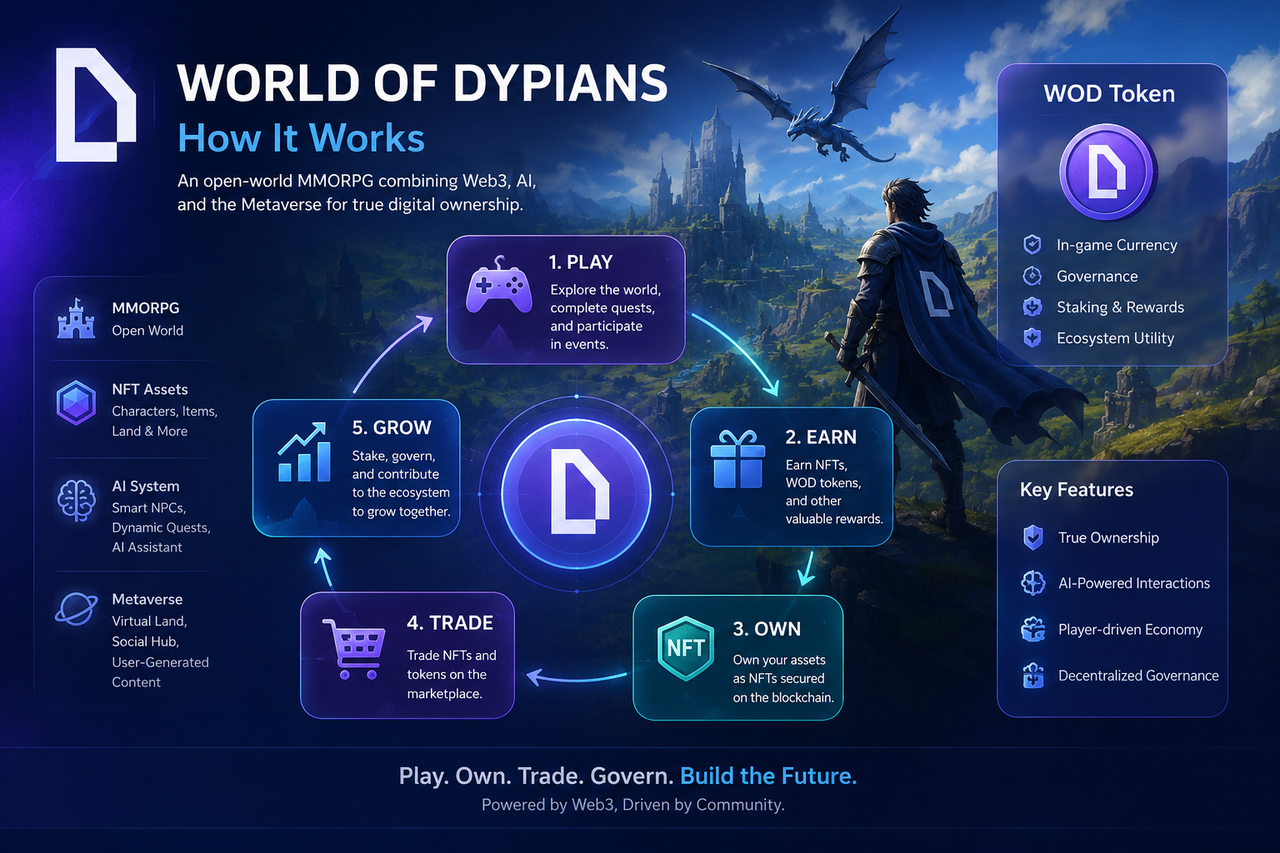
The middle layer consists of the NFT system, virtual land system, and AI modules. These components manage digital assets, content interaction, and player experience.
The bottom layer is powered by the blockchain network and the WOD token economy, ensuring that asset ownership, transaction records, and governance activities are publicly verifiable and securely executed.
Together, the entire system forms a complete Web3 gaming ecosystem, rather than a set of siloed modules.
What Processes Do Players Go Through Upon Entering World of Dypians?
The first step for players entering World of Dypians is usually to create a game character and connect a digital wallet.
After completing account setup, players enter the open-world map to take on quests, explore areas, interact with NPCs, or join various game activities.
As the game progresses, characters gradually earn resources, equipment, experience points, and other digital assets.
Some assets exist as NFTs. Players can choose to hold them long-term, use them for in-game upgrades, or trade them on the market.
From the player’s perspective, the process feels like a traditional MMORPG—but behind the scenes, many asset activities are simultaneously recorded on the blockchain.
How Are Game Accounts and Blockchain Wallets Connected?
The blockchain wallet is the key gateway into the World of Dypians digital asset system.
Traditional online games have the platform manage accounts and assets centrally. World of Dypians, by contrast, lets players control on-chain assets directly through their wallets.
Once connected, the wallet can store NFTs, WOD tokens, and other ecosystem assets.
When players buy, sell, or transfer digital assets, the relevant transactions are verified on the blockchain and recorded on the ledger.
This setup gives players true ownership and control over their assets, rather than relying on a centralized server.
How Are NFT Assets Created and Transferred?
NFTs are a core part of the World of Dypians digital economy.
After players complete certain quests, join events, or receive special rewards, the system may generate NFTs. These can represent equipment, land, collectibles, or functional items.
Once created, NFTs are recorded on the blockchain and linked to the player’s wallet.
Players can freely trade NFTs on the ecosystem market or use them for character growth, resource production, and other ecosystem activities.
Because ownership records are public and transparent, NFTs can be transferred trustlessly between users.
How Does the WOD Token Participate in the Ecosystem Cycle?
WOD is the core token of the World of Dypians ecosystem.
By participating in ecosystem activities, players can earn WOD as a reward. At the same time, WOD is used to buy game resources, pay service fees, and join special events.
Some users stake WOD to take part in the ecosystem incentive mechanism.
Governance also relies on WOD. Token holders can vote on community proposals and shape the project’s direction.
Through spending, rewards, staking, and governance, WOD creates a continuously flowing economic cycle.
What Are the Differences Between World of Dypians and Traditional MMORPG Operating Models?
Both World of Dypians and traditional MMORPGs feature character growth and open-world exploration, but their underlying logic is fundamentally different.
In traditional MMORPGs, assets are stored on centralized servers, giving players only usage rights.
World of Dypians uses blockchain technology to record asset ownership, letting players truly own and manage digital assets.
Item trading in traditional games is often restricted by the platform, while NFT assets can circulate freely on on-chain markets.
In addition, the WOD token and governance system give players far more say in the ecosystem—a capability rarely seen in traditional MMORPGs.
What Are the Key Stages in On-Chain Asset Transfer?
On-chain asset transfer typically goes through five main stages: creation, holding, use, trading, and governance.
Assets are first generated through gameplay or ecosystem rewards and recorded in the player’s wallet.
Players can then use these assets in the game—upgrading equipment, unlocking features, or joining events.
If the assets have trading value, players can also transfer them via the NFT market.
Some assets eventually enter governance or staking mechanisms, cycling back into the ecosystem incentive loop.
This process forms a complete closed loop from gameplay behavior to digital assets to ecosystem participation.
Summary
World of Dypians (WOD) operates by deeply integrating an MMORPG experience with a blockchain digital asset system. Players enter the ecosystem through their wallets, explore and grow in an open world, and earn NFT assets and WOD token rewards.
Compared to traditional games, World of Dypians stands out for its digital asset ownership, on-chain trading capabilities, and community governance. Through the combined operation of NFTs, WOD tokens, AI systems, and metaverse infrastructure, the project builds a full Web3 gaming economic cycle—demonstrating how blockchain games are moving from simple reward models toward comprehensive digital ecosystems.
FAQs
How does World of Dypians work?
World of Dypians operates through an MMORPG world, an NFT asset system, a WOD token economy, and blockchain infrastructure. Players earn digital assets through gameplay and can use and circulate them within the ecosystem.
Do Players Need to Connect a Wallet to Experience World of Dypians?
Some Web3 features—like NFT management, token trading, and on-chain asset holding—require a blockchain wallet. However, the exact experience may vary by version and feature set.
Where Do World of Dypians NFTs Come From?
NFTs can be obtained by completing game quests, joining events, earning ecosystem rewards, or trading on the market. Different NFTs serve different functions and use cases.
What Is the Main Role of the WOD Token in the Game?
WOD is used to pay service fees, buy resources, participate in governance, earn ecosystem incentives, and support staking. It is a key value carrier for the entire ecosystem.
What Role Does AI Play in World of Dypians?
AI is applied to NPC interactions, quest generation, content recommendations, and user guidance. It helps enhance immersion and lower the barrier to entering Web3.
What Is the Biggest Difference Between World of Dypians and Traditional MMORPGs?
The biggest difference is digital asset ownership. World of Dypians uses blockchain and NFT technology to give players true ownership of in-game assets, whereas traditional MMORPG assets are typically controlled by the game operator.