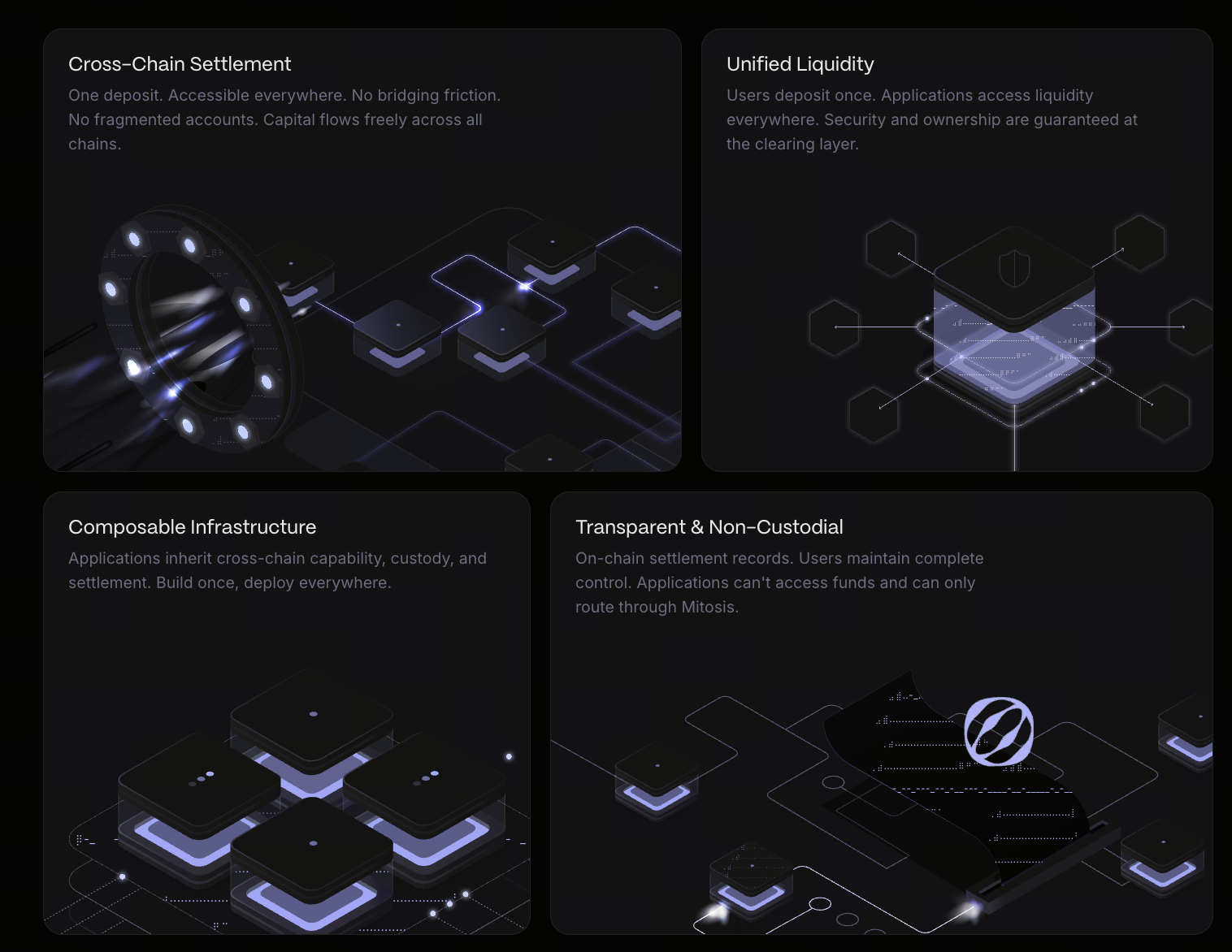
Multi-chain DeFi's structural pain point is clear: liquidity gets locked in single-chain, single-pool setups, forcing users to repeatedly bridge assets chasing yields—leading to low capital efficiency and heightened bridge risk. Mitosis does not take the "build another bridge" route. Instead, it integrates cross-chain interoperability, on-chain settlement, strategy execution, and yield distribution into a single architecture—allowing the same underlying asset to simultaneously participate in DeFi strategies across multiple chains, with the Asset Manager and Settlement System maintaining omnichain state consistency.
From an infrastructure evolution perspective, Mitosis represents a deep convergence of the "liquidity layer" and "interoperability layer": Cosmos modular consensus delivers fast finality and IBC scalability; Hyperlane provides permissionless cross-chain messaging; and EOL (Ecosystem-Owned Liquidity) transforms protocol-level liquidity from "rented" to "shared." The sections below break down its core architecture, modular implementation, multi-chain aggregation logic, asset routing process, differences from traditional bridges, security verification mechanisms, sector challenges, and technical roadmap.
Mitosis Core Technical Architecture
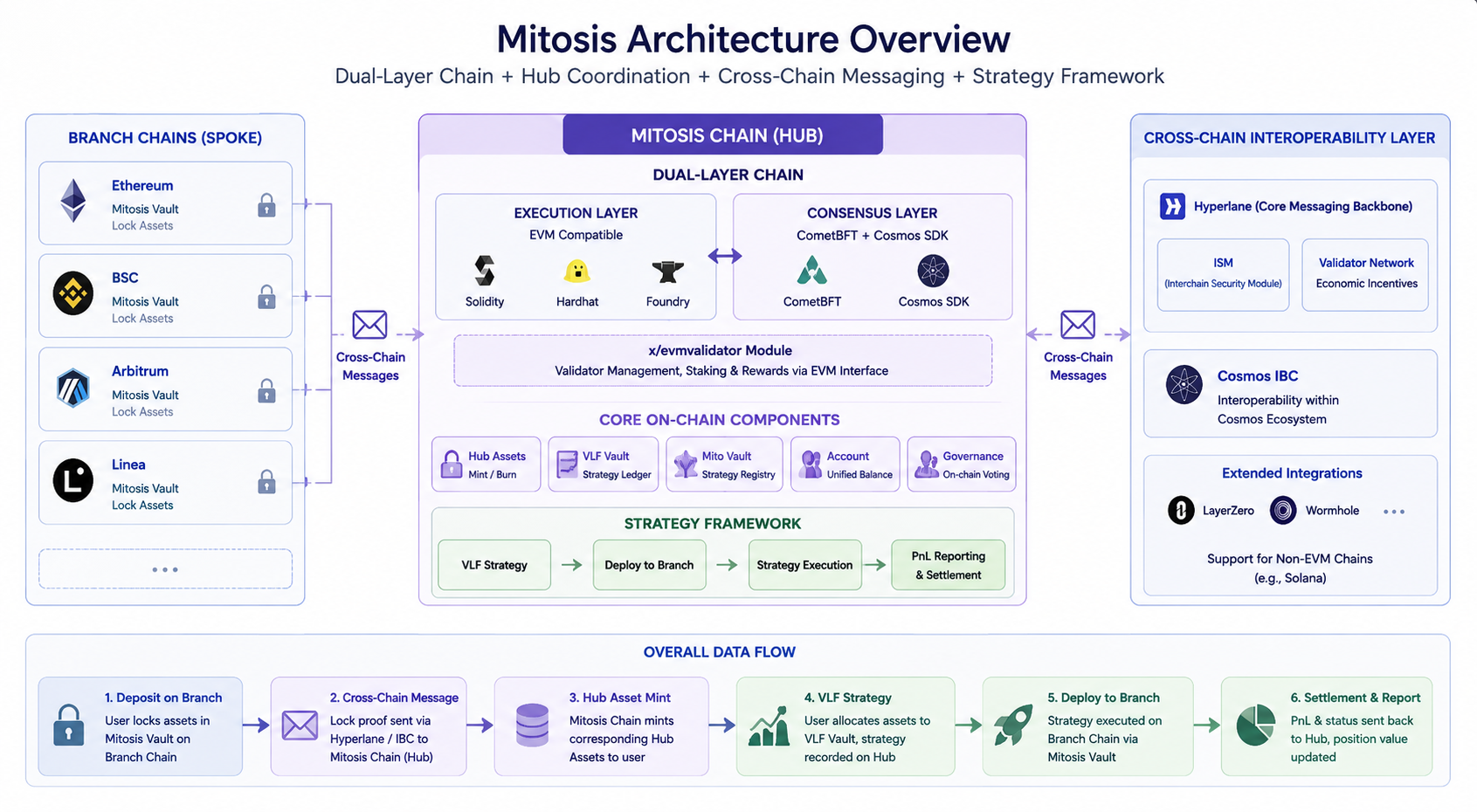
Mitosis's tech stack can be summarized as a four-layer structure: dual-layer chain body, hub coordination, cross-chain messaging, and strategy framework.
1. Execution and Consensus Layer Separation (Engine API)
Mitosis Chain separates its execution and consensus layers. The execution layer offers a fully EVM-compatible environment, enabling developers to deploy contracts using Ethereum ecosystem tools like Solidity, Hardhat, and Foundry. The consensus layer, built on CometBFT (formerly Tendermint) and the Cosmos SDK, implements PoS staking consensus, block times in seconds, and instant finality. The project also developed its own x/evmvalidator module, allowing validator creation, staking, and reward distribution to be governed via the EVM interface within the consensus layer, rather than relying solely on the traditional x/staking module.
2. Hub-Spoke Topology
- Mitosis Chain (Hub): Central settlement hub responsible for minting/burning Hub Assets, VLF strategy accounting, governance, and the omnichain liquidity ledger.
- Branch Chains (Spoke): External blockchains (e.g., Ethereum, BSC, Linea, Arbitrum) hosting Mitosis Vault smart contracts that lock user assets and execute DeFi strategies. Asset changes on Branch Chains are synced to the Hub via cross-chain messages, ensuring consistency between on-chain deposits and hub accounting.
3. Core On-Chain Components
| Component |
Function |
| Mitosis Vault |
Securely locks user deposits on Branch Chains |
| Asset Manager |
Central coordinator on the Hub chain, maintaining the cross-chain liquidity ledger |
| VLF (Vault Liquidity Framework) |
Defines reward, lock-up, and distribution rules for strategies like EOL and Matrix |
| Strategist / Strategy Executor |
Handles liquidity allocation, strategy deployment, and settlement triggers |
| Settlement System |
Manages cross-chain synchronization of returns, losses, and additional rewards |
4. Cross-Chain Interoperability Layer
Hyperlane serves as the core messaging backbone, using the Interchain Security Module (ISM) and validator economic incentives to relay lock-up proofs from Branch Chains to Mitosis Chain, triggering Hub Asset minting. Cosmos IBC handles interoperability within the Cosmos ecosystem. Future integration with LayerZero, Wormhole, and others is on the roadmap to cover non-EVM chains like Solana.
Data flow: Branch deposit → cross-chain message → Hub minting → VLF strategy → Branch deployment → settlement return → Hub position value adjustment.
How Modular DeFi Infrastructure Is Achieved
Mitosis's modularity spans three dimensions: chain-layer, liquidity framework, and asset representation.
Chain-Layer Modularity (Cosmos SDK)
The Cosmos SDK allows functions like consensus, staking, governance, and EVM execution to be split into independent modules, combined and upgraded as needed. Mitosis adds business modules—Vault, VLF, Asset Manager—on top of the standard set, decoupling liquidity logic from the underlying consensus and enabling easy expansion with new strategy types or chain integrations.
VLF Framework Modularity
The VLF is an abstraction layer connecting Hub Assets to external DeFi yields. Each VLF instance defines:
- Reward accumulation and distribution mechanisms
- Activity duration and lock-up requirements
- The type of VLF asset generated upon participation (miAssets / maAssets)
Two current VLF implementations:
- EOL: Community-governed, long-term liquidity pools where holders vote via gMITO to decide capital routing.
- Matrix: Curated activities with pre-negotiated terms (interest rate, duration, reward tokens) transparent on-chain, ideal for fixed-term, high-yield scenarios.
Asset Representation Modularity
Liquidity within Mitosis goes through multi-layer tokenization, with each layer serving a distinct function:
| Asset Type |
Generation Stage |
Characteristics |
| Vanilla Assets |
1:1 representation on the Hub after deposit (e.g., vETH) |
Can enter EOL/Matrix; maintains underlying backing |
| Hub Assets |
Minted by Asset Manager upon Vault deposit |
Unified cross-chain capital unit; users choose whether to deploy into VLF |
| miAssets |
Obtained after participating in EOL |
Yield rights + governance voting rights, composable |
| maAssets |
Obtained after participating in Matrix |
Activity-specific positions; early redemption possible (may forfeit rewards) |
Before Hub Assets are actively deployed into VLF, their underlying assets remain securely stored in the Branch Vault—untouchable by the protocol. This creates a critical isolation boundary between user control and protocol strategy.
Programmability
miAssets / maAssets follow the ERC-20 standard and can be transferred as collateral or liquidity positions in Morph, lending protocols, and AMMs, transforming traditional DeFi's "locked-up and frozen" LP shares into liquid, divisible financial primitives.
How Mitosis Aggregates Multi-Chain Liquidity
Mitosis's core aggregation logic: centralized accounting, decentralized execution, and unified settlement—rather than deploying isolated pools on each chain.
-
Step 1: Deposit Aggregation
Users deposit assets (ETH, USDC, LSTs, etc.) into Mitosis Vaults on Branch Chains (Ethereum, BSC, Linea, etc.). Each chain's Vault independently locks assets; Aggregate TVL is visible at the Hub layer. After mainnet launch, the ecosystem reported total TVL exceeding $185 million, with BNB Smart Chain representing a significant share.
-
Step 2: Hub Standardization
Deposit information is transmitted via Hyperlane and other messaging layers to Mitosis Chain, where the Asset Manager mints Hub Assets at 1:1. Deposits from different chains and tokens become a unified capital unit at the Hub level, eliminating fragmentation (e.g., ETH on Chain A and ETH on Chain B cannot be combined in strategies).
-
Step 3: Strategy Pooling
Users deploy Hub Assets into EOL or Matrix:
- EOL: Multi-user assets flow into a community pool; governance decides allocation to Aave, Osmosis, partner DEXs, etc. Returns are distributed as Omni-yield to miAssets holders.
- Matrix: Locked per activity terms; capital deployed to specific protocols (e.g., Zootosis on Morph Layer). Participants receive maAssets and partner token rewards.
-
Step 4: Cross-Chain Deployment
The Asset Manager maintains an "allocated / idle liquidity" ledger for each Branch Chain. The Strategist calls fetchLiquidity() to withdraw funds from the Vault to the Strategy Executor, generating yields in target chain DeFi protocols. Capital under a single Hub accounting can simultaneously serve Ethereum lending, Arbitrum AMM, Linea activities, and more.
-
Step 5: Yield Recirculation
The Settlement System periodically compares asset balances before and after strategy execution. Profits and losses are transmitted back to the Hub via cross-chain messages, triggering minting or burning of Hub Assets / VLF assets for fair distribution.
Compared to the traditional model—bridge to Chain A to stake, redeem, bridge to Chain B to stake again—users deposit once, and the backend handles all multi-chain capital scheduling. The experience: Deposit Once, Earn Across Chains.
How Cross-Chain Asset Routing Works
Cross-chain asset routing is the technical core of Mitosis, broken into five flows: deposit, allocation, execution, settlement, and redemption.
1. Deposit Flow
User → Branch Vault lock → Hyperlane message → Asset Manager → Hub Assets minted → user wallet
The Asset Manager tracks each chain's Vault balance and updates the omnichain liquidity view in real time.
2. Allocation Flow
After the user deposits Hub Assets into the VLF Vault, the Strategist selects a target Branch Chain and executes allocation via the Asset Manager:
- Verify that the target chain Vault has sufficient idle liquidity.
- Change the ledger status from "idle" to "allocated."
- Send a cross-chain message notifying the Branch Vault to release funds to the Strategy Executor.
- The Executor implements the VLF strategy (lending, LP, restaking, etc.).
3. Execution & Return
When a strategy expires or rebalancing triggers, the Executor closes the position and calls returnLiquidity() to return assets to the Vault, then calls deallocateLiquidity() to restore the ledger status to idle for the next allocation.
4. Settlement Flow
Settlement falls into three categories:
- Yield Settlement: Strategy profitable, reward same type as underlying → Hub mints equivalent Hub Assets to increase VLF position value.
- Loss Settlement: Strategy incurs loss → Hub burns Hub Assets from VLF Vault, accurately reflecting Net Asset Value (NAV) change.
- Extra Rewards Settlement: Reward is a heterogeneous token (e.g., governance token) → converted to Hub Assets and distributed proportionally.
The Strategist triggers settlement on the VLF Strategy Executor → cross-chain message to Asset Manager → Hub mint/burn → user miAssets/maAssets Net Asset Value (NAV) updated.
5. Withdrawal Flow
User requests redemption → Asset Manager burns Hub Assets → checks target Branch liquidity threshold → Branch Vault releases underlying assets → user receives funds
The Asset Manager enforces liquidity threshold management: withdrawals only allowed when a Branch Chain's liquidity is above a set threshold, preventing single-chain bank runs. Users can choose which Branch Chain to receive assets from.
Essence: Assets physically reside in Branch Vaults; capital logic sits on the Mitosis Hub. The two are continuously synchronized through the messaging and settlement layers.
How Mitosis Differs from Traditional Cross-Chain Bridges
Traditional bridges and Mitosis differ fundamentally in goals, architecture, and capital efficiency:
| Dimension |
Traditional Bridges (Wormhole, Stargate, etc.) |
Mitosis |
| Core Goal |
Move assets from Chain A to Chain B |
Let the same capital earn returns on multiple chains simultaneously |
| Asset Form |
Often produces wrapped tokens (e.g., wETH) |
Hub Assets backed 1:1; underlying native assets locked in Vault |
| Liquidity Model |
Independent pools per chain or lock-mint; capital duplicated |
Unified Hub accounting; Branch allocation on demand, boosting efficiency |
| User Operation |
Each cross-chain move requires an active bridge transaction |
Deposit once; backend automatically handles cross-chain scheduling |
| Source of Returns |
Bridge itself typically generates no DeFi yield |
Built-in EOL/Matrix strategies; returns endogenous to protocol |
| Governance |
Bridge token governance (e.g., STG, W) |
Morse DAO + gMITO decides liquidity routing |
vs. Lock-and-Mint Bridges
Lock-and-Mint locks assets on the source chain and mints wrapped tokens on the target chain, causing liquidity fragmentation. Users must often swap to "native" assets before using DeFi. Mitosis does not mint independent wrapped versions for users; the protocol uniformly coordinates underlying native assets at the Branch layer.
vs. Lock-and-Unlock Bridges
Lock-and-Unlock requires pre-positioned idle liquidity on each chain, leading to low capital efficiency and rebalancing difficulty. Mitosis reduces idle capital through centralized Hub accounting and dynamic allocation.
vs. Pure Messaging Protocols (LayerZero)
LayerZero provides omnichain messaging infrastructure, leaving cross-chain logic to developers. Mitosis builds a complete Vault, settlement, governance, and strategy framework on top of the messaging layer—a vertically integrated solution for liquidity, not a general-purpose messaging SDK.
Caveat: Mitosis still relies on Hyperlane for cross-chain messaging; it is not "zero-bridge." Its innovation lies in moving bridging from user-side operation to protocol-side infrastructure, reducing users' exposure time and frequency to bridge risks.
Data Security and Cross-Chain Verification
A cross-chain liquidity protocol's security model must cover consensus, message verification, contract isolation, and liquidity risk control.
1. Consensus Layer Security (Mitosis Chain)
- CometBFT PoS consensus; validators must stake MITO (min ~100,000 MITO) to participate in block production.
- 21-day unbonding period reduces short-term attack incentives.
x/evmvalidator module links validator management with EVM, enabling auditability and on-chain transparency.
2. Multi-Layer Economic Security
Official materials describe three layers:
- Level 1: Mitosis's own Tendermint PoS consensus.
- Level 2: EigenLayer Restaking, using ETH restaking to raise attack costs.
- Level 3: Hyperlane ISM modular verification, supporting multi-validator confirmation (not a single multisig).
3. Hyperlane Message Verification
- After user deposit, the Branch Vault contract locks assets and generates a lock-up proof.
- Hyperlane relay network broadcasts a verifiable payload to Mitosis Chain.
- Mitosis contract verifies the message, then mints Hub Assets—"lock first, then mint" prevents unbacked minting.
- Withdrawals reverse the process: burn Hub Assets first, then release Branch lock-up.
4. Contract and Fund Isolation
- Hub Assets not deployed into VLF remain physically in the Branch Vault.
- VLF allocation, execution, and return are handled by the Strategist via permissioned contracts; the Asset Manager maintains the ledger to prevent overallocation.
- The settlement system forces Profit/Loss (PnL) on-chain, preventing divergence between Hub Net Asset Value (NAV) and Branch actual assets.
5. Liquidity Risk Control
- Real-time tracking of each Branch Chain's liquidity level.
- Withdrawal thresholds prevent single-chain bank runs.
- Proportional burning of Hub Assets (1:1 redemption) preserves backing integrity.
6. Governance Security
gMITO is non-transferable, preventing flash loan vote buying and secondary market speculation—tying voting power to genuine staked participation.
Residual risks: No cross-chain system can fully eliminate smart contract bugs, message delays, or target-chain DeFi protocol risks. Users should review audit reports, bug bounty programs, and historical integration events.
Challenges Facing the Cross-Chain Liquidity Sector
The cross-chain liquidity infrastructure sector faces multiple technological, market, and trust challenges in 2025–2026, including for Mitosis.
Technical Challenges
- Messaging Layer Dependency: Stability and security of Hyperlane, IBC, and others directly impact the protocol. Message delays or verification failures can cause temporary state inconsistencies between Hub and Branches.
- Multi-Chain DeFi Integration Complexity: Each new chain integration requires deploying a Vault, adapting local DeFi protocols, and testing settlement logic—high engineering and audit costs.
- Settlement Accuracy: Cross-chain strategies involve multi-token yields, impermanent loss, and protocol rewards. The Settlement System must precisely handle heterogeneous rewards and book losses.
- Non-EVM Expansion: Integrating Solana, Move-based chains, etc., requires additional channels like Wormhole, increasing maintenance difficulty due to architectural heterogeneity.
Market and Competition Challenges
- Restaking Sector Drain: Protocols like EigenLayer and Symbiotic attract large amounts of LST capital, directly competing with Mitosis Vaults.
- L2 Native DeFi Rise: L2s like Arbitrum and Base are deepening their own liquidity, potentially reducing users' cross-chain motivation.
- Hired Capital Inertia: High APY incentives remain the default for many projects' cold starts; the EOL "long-term shared liquidity" model still needs to prove its appeal.
Liquidity Fragmentation Remains Unresolved
Mitosis aggregates only capital entering its Vaults; it cannot force external independent pools to consolidate. Liquidity outside the ecosystem remains scattered, requiring continuous competition for TVL and partners.
Trust and Operational Challenges (2025–2026 Reality)
Since 2025, the community has seen unfulfilled staking rewards and reduced team communication, causing significant MITO price volatility. Regardless of technical completeness, operational transparency and promise fulfillment have become critical variables for protocol continuity. Technical design addresses how something works; trust addresses whether anyone will maintain it—the two are not interchangeable.
Regulatory Environment
Jurisdictions like South Korea are tightening regulations on DeFi and token staking. Cross-chain liquidity protocols may face compliance reviews, affecting user access and exchange support in specific regions.
Future Directions for Mitosis Technology
Based on the official roadmap and tech blog, Mitosis's technical evolution includes:
Short-term (2025–2026)
- Solana Integration: Access non-EVM ecosystems via Wormhole to expand Branch Chain coverage.
- Deeper Cosmos IBC: Deploy Hyperlane CosmWasm modules for native cross-chain Vaults on Cosmos chains.
- BTC Support: Incorporate Bitcoin liquidity via wrapped BTC.
- Native DEX (Nautilus): Build an integrated trading and liquidity layer on Mitosis Chain, reducing dependence on external DEXs.
- Mobile App: Lower the entry barrier for ordinary users to participate in Vaults and governance.
Mid-term
- Institutional Vaults: Compliance and risk control modules for large LPs.
- miNFTs: Extend programmable liquidity to NFT collateral and yield scenarios.
- Hyperlane Nexus Integration: Provide real-time visualization of cross-chain vault health and rebalancing activities.
Long-term
- AI-Driven Yield Strategies: Automatically rebalance liquidity allocation based on multi-chain yield signals (mentioned in the official 2026 roadmap).
- Cross-Chain Derivatives: Build structured products and cross-chain hedging tools using miAssets/maAssets.
- DNA Plan Phase 2: Full launch of LMITO, with gMITO community fully leading emissions and ecosystem expansion decisions.
Technology realization depends on mainnet dApp count, TVL retention, developer tool completeness, and production stability of the cross-chain messaging layer. The architectural blueprint is clear; the next phase's differentiating factor lies in execution, integration breadth, and restoration of ecosystem trust.
Summary
Mitosis's technical architecture centers on: Hub-Spoke settlement hub + Branch Vault lock-up + Hyperlane cross-chain messaging + VLF strategy framework + Settlement P&L synchronization. This upgrades cross-chain liquidity from per-user bridging to protocol-level capital scheduling. Modularity appears in the Cosmos SDK chain layer, the dual EOL/Matrix frameworks, and the multi-layer asset representation (Vanilla → Hub → mi/ma).
Unlike traditional cross-chain bridges, Mitosis does not aim at single asset transfers but pursues parallel yields and community-governed routing for the same capital across multiple chains. Security layers include PoS consensus, Restaking economics, Hyperlane ISM verification, and Asset Manager liquidity thresholds to prevent single-chain bank runs.
The cross-chain liquidity sector still faces messaging layer risks, competition, capital fragmentation, and operational trust challenges. Mitosis's technical design provides a verifiable path for DeFi liquidity integration. Its long-term value ultimately depends on mainnet execution quality, ecosystem integration depth, and the community's ability to turn architectural advantages into sustained on-chain adoption.







