As the Web3 ecosystem moves toward multi-chain and intelligent evolution, the governance complexity faced by DAOs and on-chain protocols is rapidly increasing. Traditional governance models typically depend on human involvement—covering proposal discussions, community voting, and on-chain execution. While this approach is decentralized, it has notable limitations in governance efficiency, risk control, and cross-chain coordination.
The rapid rise of AI Agent technology is unlocking new automation possibilities for on-chain governance. A growing number of Web3 projects are exploring the fusion of AI and DAOs, aiming to boost governance efficiency, streamline decision-making, and reduce manual coordination costs through AI Agents. Against this backdrop, the AI Governance Layer launched by Quack AI stands out as a representative architecture within the AI Governance Infrastructure space.
What Is the AI Governance Layer?
The AI Governance Layer is an infrastructure that combines AI Agents with on-chain governance mechanisms. Its core goal is to elevate the automation level of governance for DAOs and on-chain organizations.
In traditional governance models, community members must manually analyze proposals, evaluate risks, and execute on-chain actions. In contrast, the AI Governance Layer enables AI Agents to handle parts of the governance process—such as generating proposal summaries, conducting risk analysis, offering governance recommendations, and performing automated execution.
Quack AI's AI Governance Layer is not a single tool but a comprehensive governance framework. It includes an AI Agent system, a rule control module, and an on-chain execution layer. This architecture helps DAOs improve governance efficiency while preserving transparency and decentralization.
How Does Quack AI's Governance Intelligence Work?
Governance Intelligence is a core component of Quack AI's AI Governance Layer. Its primary role is to help DAOs analyze governance information and generate decision-support content.
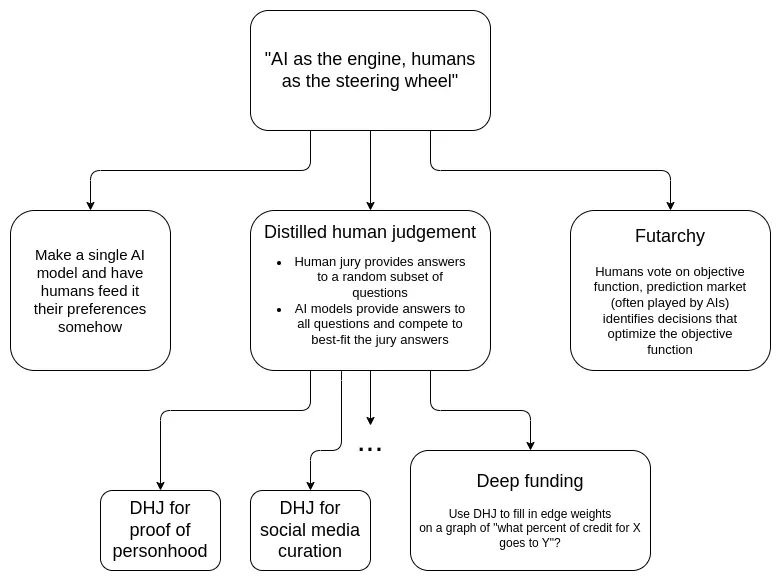 Source: Vitalik Buterin
AI Agents can automatically analyze proposals using on-chain data, historical governance records, and community feedback. For instance, a Proposal Agent can auto-generate a proposal abstract, enabling users to quickly grasp the governance content.
Meanwhile, a Risk Agent can detect potential governance risks such as abnormal fund management, permission conflicts, or logic flaws in proposal execution. This automated analysis enhances governance transparency and minimizes the risk of human oversight.
The goal of Governance Intelligence is not to replace community decision-making entirely but to help DAO members understand governance information more efficiently.
What Role Does Policy Engine Play in AI Governance?
The Policy Engine is a critical module in Quack AI's AI Governance Layer, designed to control AI Agent behavior.
Since AI Agents can participate in on-chain execution, a clear rule system is required to limit their permissions. For example, DAOs can use the Policy Engine to set fund transfer limits, execution time constraints, and multi-signature confirmation conditions.
This mechanism reduces the potential risks of automated governance, preventing AI Agents from executing operations beyond their authority without proper constraints.
The Policy Engine can also define the responsibility boundaries of different Agents. For instance, some Agents may only perform proposal analysis, while others have on-chain execution permissions.
How Do AI Agents Participate in the Governance Process?
In Quack AI's governance architecture, AI Agents can engage in multiple stages of the governance process.
During the proposal stage, AI Agents can assist in generating governance recommendations, organizing community discussions, and creating summary content.
In the risk analysis stage, Risk Agents automatically identify potential issues in proposals—such as permission anomalies, fund management risks, or logic vulnerabilities.
During the execution stage, Execution Agents can automatically invoke Smart Contracts based on preset DAO rules. For example, once a community votes to pass a treasury proposal, an AI Agent can autonomously complete fund allocation and on-chain execution.
This model reduces manual steps and improves governance execution efficiency.
How Does Quack AI Achieve Automated Governance?
Quack AI's automated governance relies on the synergy among AI Agents, the Policy Engine, and the on-chain execution framework.
In the governance process, AI Agents handle analysis and execution, while the Policy Engine enforces permission restrictions and rule verification. Only operations meeting preset conditions can proceed to execution.
Additionally, Quack AI supports cross-chain governance coordination, allowing AI Agents to synchronize governance actions across multiple blockchains. For example, after a DAO completes voting on the main chain, an AI Agent can automatically update parameters or coordinate funds on other chains.
This automated governance model helps reduce friction in multi-chain ecosystems.
Traditional DAO tools typically focus on voting and community management, whereas the AI Governance Layer emphasizes AI Agent participation and automated execution.
In the traditional model, most governance tasks must be done manually—including proposal review, risk assessment, and on-chain execution. In contrast, the AI Governance Layer can automate part of the analysis and execution through AI Agents.
The key difference lies in the degree of governance intelligence.
| Dimension |
Traditional DAO Tools |
AI Governance Layer |
| Proposal Analysis |
Manual reading |
AI automatic analysis |
| Risk Identification |
Manual review |
AI Risk Agent |
| Execution Method |
Manual |
Automated |
| Cross-Chain Governance |
Limited support |
Native synergy |
What Challenges Does the AI Governance Layer Face?
Although AI Governance is widely seen as a key direction for Web3 governance, it still faces several challenges.
First, the trustworthiness of AI Agents requires long-term verification. If the AI model has biases, it could affect governance analysis and execution logic.
Second, automated governance must balance efficiency with decentralization. Over-reliance on AI may reduce community engagement in governance.
Moreover, execution consistency, security verification, and permission management in multi-chain environments remain areas that the AI Governance Layer needs to improve.
Summary
Quack AI's AI Governance Layer is a Web3 governance infrastructure that integrates AI Agents, a Policy Engine, and automated execution mechanisms. It is designed to enhance governance efficiency and collaboration in DAOs and multi-chain ecosystems.
As the Agent Economy and AI Crypto ecosystem continue to grow, AI Agents are playing an increasingly active role in on-chain environments. Through Governance Intelligence, rule control, and automated execution frameworks, Quack AI provides a more intelligent governance model for Web3.
FAQs
What is the difference between AI Governance and traditional DAO Governance?
AI Governance emphasizes AI Agents, automated analysis, and automated execution, while traditional DAO Governance relies primarily on manual governance processes.
What is the role of the Policy Engine?
The Policy Engine restricts the permission scope of AI Agents and ensures that automated governance operations comply with preset rules.
Can AI Agents automatically execute on-chain operations?
Under preset rules and permission controls, AI Agents can automatically execute certain governance and on-chain coordination operations.
What functions does Governance Intelligence offer?
Governance Intelligence supports proposal analysis, risk identification, governance summary generation, and community information organization.
Does Quack AI support cross-chain governance?
Yes, Quack AI supports multi-chain governance coordination, enabling governance synchronization and automated execution across different blockchains.







