As the Ethereum ecosystem continues to evolve, on-chain data analysis tools, MEV systems, and address profiling platforms now extensively track user behavior. Wallet balances, transaction records, and fund flows are almost entirely public.
Against this backdrop, privacy protocols have evolved from niche anonymity tools into critical infrastructure within the open financial system. Railgun and Tornado Cash have thus become the two most representative solutions in the on-chain privacy landscape.
What Is Tornado Cash?
As an Ethereum-based on-chain mixer, Tornado Cash is primarily designed to break the link between funds across public addresses.
Users must first deposit fixed-denomination assets—such as 1 ETH, 10 ETH, or 100 ETH—into Tornado Cash’s anonymity pool. They can then withdraw the equivalent amount from a different address, thereby reducing the traceability between the sending and receiving addresses.
Tornado Cash’s core logic relies on multiple users entering the anonymity pool together to expand the anonymity set. Since all users’ assets are mixed within the same pool, external observers find it difficult to accurately determine the true flow of funds.
However, Tornado Cash is more of an anonymity transfer tool, focusing on severing address linkages rather than building a long-term private financial account system.
What Is Railgun?
As a Private DeFi protocol built on EVM networks, Railgun achieves persistent on-chain privacy through zk-SNARKs, a Private Balance, and 0zk addresses.
Unlike Tornado Cash, Railgun does not emphasize one-time anonymous withdrawals; instead, it establishes a long-term privacy account system. Users can deposit assets into Railgun’s Private Balance via the Shield operation, then continuously perform anonymous transfers, private swaps, liquidity management, and other on-chain financial operations.
Railgun’s goal is not merely to break fund linkages but to create a sustainable privacy finance layer within the native Ethereum ecosystem. Users do not need to frequently exit the privacy system; they can maintain a private account state over the long term.
What Are the Key Differences Between Railgun and Tornado Cash?
The biggest difference between Railgun and Tornado Cash lies in their distinct understanding of privacy.
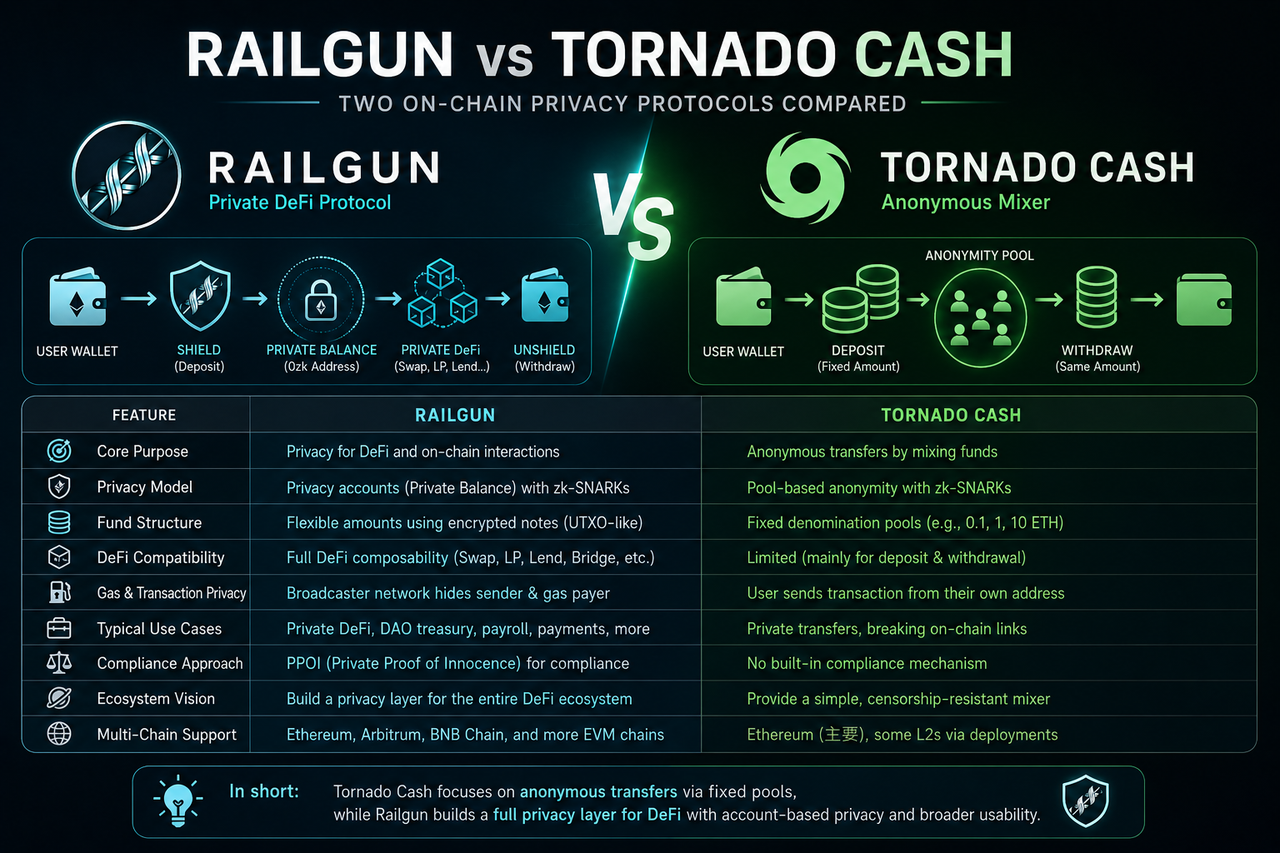
Tornado Cash is centered on the anonymity pool model. Users enter a fixed-denomination pool to conceal the source of funds and complete a one-time anonymous withdrawal. This model is better suited for simple anonymous transfers.
Railgun, in contrast, adopts a privacy account model. Once assets enter the Private Balance, they persist in the privacy system as encrypted notes, enabling users to conduct ongoing anonymous transactions and private DeFi interactions.
From a product logic perspective:
- Tornado Cash resembles an anonymous withdrawal tool
- Railgun functions as a complete private financial account system
This difference leads to entirely divergent ecosystem directions for the two protocols.
Why Does Railgun Support Private DeFi?
Tornado Cash’s primary function is anonymous transfers, so funds typically follow a pool-entry-wait-withdraw cycle.
Railgun, however, was designed from the start with DeFi composability in mind.
The Private Balance in Railgun can interact directly with external protocols, allowing users to invoke Uniswap, 1inch, SushiSwap, and other protocols for swaps or liquidity operations—all while maintaining privacy.
This means users can not only hide the source of their assets but also conceal their trading behavior.
For example, if a public address makes a large on-chain purchase of a token, it can easily be tracked by MEV bots or arbitrage systems. Railgun reduces exposure of the transaction path, thereby mitigating Alpha leakage.
This structure of privacy combined with DeFi composability is one of the clearest distinctions between Railgun and traditional mixers.
How Do Railgun and Tornado Cash Differ in Fund Structure?
Tornado Cash uses fixed-denomination anonymity pools.
For example:
- 1 ETH Pool
- 10 ETH Pool
- 100 ETH Pool
Fixed amounts enhance the anonymity set because all users deposit identical amounts, improving the mixing effect.
However, this structure has limitations—low flexibility in fund usage, fixed withdrawal amounts, and unsuitability for complex DeFi interactions.
Railgun, on the other hand, employs a Private Balance and encrypted notes structure. Users can flexibly manage assets of different amounts without relying on fixed-denomination pools.
As a result, Railgun is better suited for long-term asset management and continuous on-chain financial activities.
How Do Broadcasters Differ from Regular Transaction Broadcasts?
In Tornado Cash, users typically still need to pay gas using a public address. This means that while the transaction content is anonymized, the wallet address that broadcasts the transaction may still expose certain information.
Railgun introduces a Broadcaster and Relayer network.
The Broadcaster submits transactions to the blockchain on behalf of the user, so external observers cannot directly see the real transaction initiator. Meanwhile, the Relayer helps handle relay fees and reduces the link between the gas-paying address and the transaction activity.
This structure further expands privacy coverage, allowing Railgun to not only hide fund flows but also conceal the source of transaction broadcasts as much as possible.
Comparison Table: Railgun vs Tornado Cash
| Dimension |
Railgun |
Tornado Cash |
| Core Positioning |
Private DeFi Protocol |
Anonymous Mixer |
| Privacy Model |
Privacy Account System |
Fixed-Denomination Anonymity Pool |
| Long-Term Privacy Account |
Supported |
Not Supported |
| Private DeFi |
Supported |
Limited |
| Anonymous Swap |
Supported |
Not Supported |
| Asset Structure |
Private Balance + Notes |
Fixed-Amount Pool |
| Gas Privacy |
Broadcaster + Relayer |
Regular Wallet Broadcast |
| Primary Use Case |
Private DeFi & Privacy Asset Management |
Anonymous Transfers |
| Composability |
High |
Low |
| zk Technology |
zk-SNARK |
zk-SNARK |
How Do Railgun and Tornado Cash Differ from a Regulatory Perspective?
On-chain privacy protocols have long faced regulatory pressure, as anonymity mechanisms can be exploited for illicit fund flows.
Tornado Cash has historically sparked widespread regulatory debate due to its anonymous mixing function, with its “indistinguishable source of funds” structure becoming a key point of contention.
Railgun, in contrast, seeks a balance between privacy and compliance. For example, Railgun has introduced the PPOI (Private Proof of Innocence) mechanism, which helps users prove the legitimacy of their funds when necessary.
The core objectives of PPOI are:
- Preserving privacy capabilities
- Reducing the risk of illicit fund usage
- Providing partial compliance attestation
This indicates that Railgun leans toward a verifiable privacy approach rather than complete anonymity.
Which Scenarios Are Best Suited for Railgun and Tornado Cash?
Tornado Cash is better for one-time anonymous withdrawals and simple address separation.
If a user only wants to break the fund linkage between public wallets, the mixer model is sufficient.
Railgun is better suited for complex scenarios such as long-term privacy account management, Private DeFi, DAO treasury management, and anonymous trading strategies.
Because Railgun can continuously interact with DeFi protocols while maintaining privacy, it functions more like a complete on-chain privacy finance infrastructure.
Summary
Railgun and Tornado Cash are both on-chain privacy protocols, but their core logic differs fundamentally.
Tornado Cash is more of an anonymous fund mixer that breaks fund linkages through fixed-denomination pools; Railgun emphasizes long-term privacy accounts and a Private DeFi structure.
Compared to traditional mixers, Railgun extends privacy capabilities to the full spectrum of on-chain financial activities, enabling users to conduct ongoing anonymous transactions and private DeFi operations within open ecosystems like Ethereum.
FAQs
Why does Railgun support Private DeFi?
Railgun’s Private Balance can directly interact with external DeFi protocols, thereby supporting private swaps and anonymous smart contract calls.
Do both protocols use zk-SNARKs?
Yes. Both Railgun and Tornado Cash use zk-SNARK zero-knowledge proof technology.
What is a Private Balance?
The Private Balance is Railgun’s privacy account structure, designed to conceal user assets and transaction state.
Why does Tornado Cash use fixed-denomination pools?
Fixed denominations increase the size of the anonymity set, thereby enhancing the mixing effect.