In the tokenized stock ecosystem, risk management is just as important as technological innovation. Compared with mature traditional securities markets, tokenized stocks are still in an early stage of development, and their regulatory frameworks, market structures, and infrastructure have not yet been fully standardized. As a result, regulatory risk, custody risk, and liquidity risk have become some of the most important concerns for market participants.
Why Tokenized Stocks Face Unique Risks
Tokenized stocks have the dual nature of traditional securities and digital assets, so they face challenges from both market systems.
Traditional stock markets have mature regulatory regimes, clearing systems, and investor protection mechanisms, while blockchain markets emphasize decentralization, global circulation, and open access. When the two systems are combined, some traditional rules may be difficult to apply directly to an on-chain environment.
As a result, tokenized stocks need to solve not only technical problems, but also complex legal, regulatory, market, and operational issues.
Why Regulatory Risk Is the Biggest Challenge for Tokenized Stocks
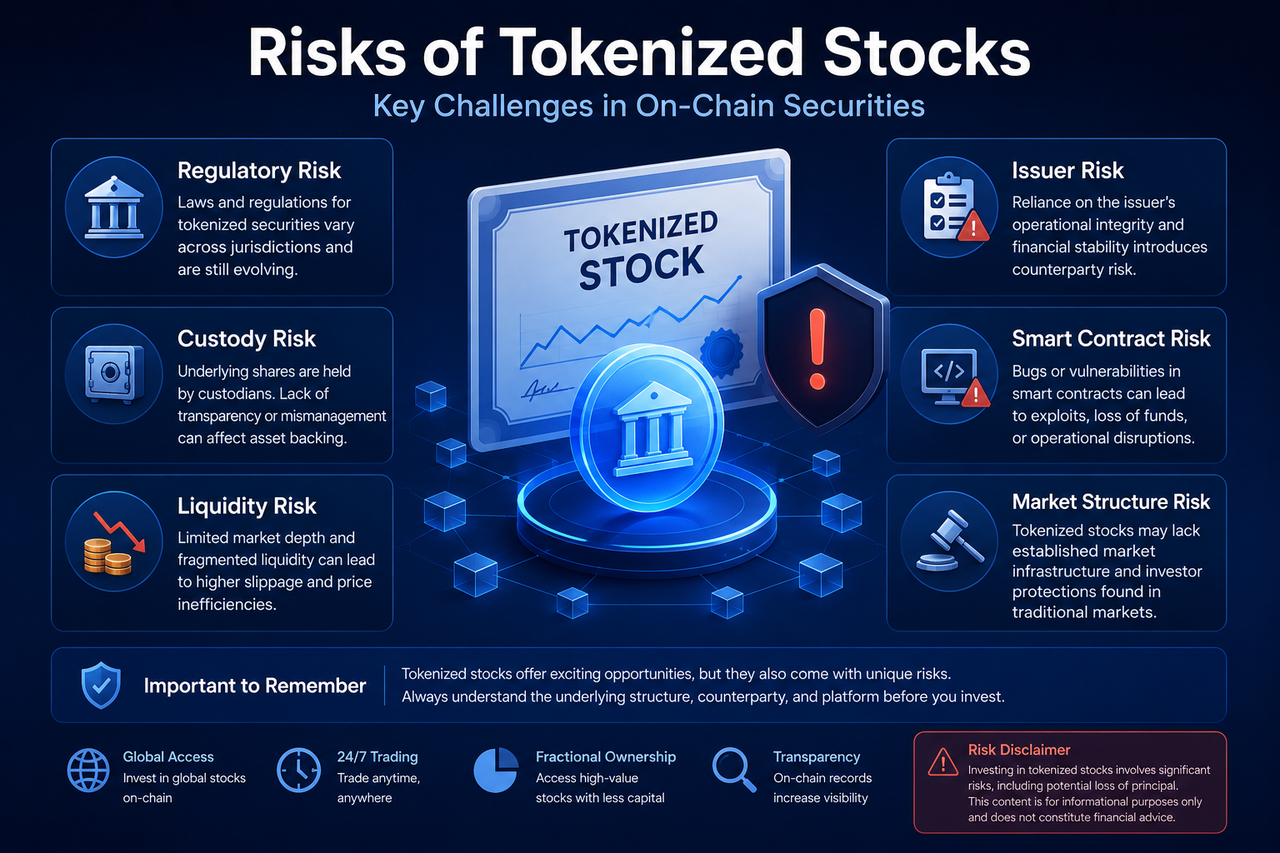
Regulatory risk is widely regarded as one of the core issues in the development of tokenized stocks.
Stocks themselves are regulated financial assets, and different countries and regions impose strict rules on securities issuance, trading, and custody. When stocks enter blockchain networks in token form, their legal status may create new room for interpretation.
Some jurisdictions treat tokenized stocks as digital securities and require them to comply with securities regulations, while others have not yet established a clear regulatory framework. Because global regulatory standards are not unified, the same tokenized stock product may face entirely different compliance requirements in different markets.
These regulatory differences directly affect product issuance, cross border circulation, and investor eligibility.
How Issuer Risk Affects Tokenized Stocks
Tokenized stocks usually rely on issuers to establish the mapping relationship between real stocks and on-chain tokens.
In most models, the issuer is responsible for buying the underlying shares, arranging asset custody, and issuing the corresponding number of tokens. As a result, investors rely on the issuer to fulfill these responsibilities.
If the issuer experiences operational problems, asset management errors, or legal disputes, the link between the tokenized stock and the underlying asset may be affected.
Unlike native crypto assets such as Bitcoin, tokenized stocks do not run entirely on blockchain. They require real world operating entities to maintain them continuously.
Where Custody Risk Comes From
Custody risk is an important feature that distinguishes the tokenized stock market from traditional crypto assets.
Most tokenized stocks use a structure of “real stock custody plus on-chain token issuance.” The underlying shares are usually held by professional custodians, while investors hold the corresponding digital certificates.
As a result, market operations depend on custodians truly holding the relevant assets and ensuring that the amount of assets matches the number of tokens issued on-chain.
If custody information is not disclosed sufficiently, audit mechanisms are incomplete, or asset management problems occur, investors may not be able to accurately verify the asset backing behind the tokens.
This is why the tokenized stock market continues to emphasize proof of reserves and third party audits.
What Impact Liquidity Risk Can Have
Liquidity risk is a common issue in the tokenized stock market.
Traditional stock markets have large numbers of institutional investors, market makers, and mature trading systems, allowing them to maintain relatively deep markets. By contrast, the tokenized stock market is still smaller in scale and has a more limited participant base.
When there are not enough buyers and sellers in the market, trades may become difficult to execute, or bid ask spreads may widen.
Insufficient liquidity can also reduce price discovery efficiency, causing short term deviations between token prices and the prices of the underlying stocks.
As the market grows and more liquidity providers enter, this issue may gradually improve, but it remains one of the key challenges in the current market structure.
What Are the Technical and Smart Contract Risks?
Tokenized stocks run on blockchain networks, so they also face technical risks.
Smart contracts are responsible for managing token issuance, transfers, and parts of the settlement process. If a smart contract has vulnerabilities, asset management and trade execution may be affected.
In addition, blockchain infrastructure itself may face network congestion, system failures, or cross chain bridge security issues.
Although mature blockchain networks usually have relatively strong security, technical risk remains a part of the tokenized stock ecosystem that cannot be ignored.
For this reason, code audits, security testing, and risk control mechanisms have become important parts of platform development.
How Investor Rights Risk Differs From Traditional Stocks
Tokenized stocks are not necessarily the same as directly holding shares of a listed company.
Some products provide economic rights linked to stock prices, but they do not grant full shareholder rights. For example, voting rights, participation in shareholder meetings, or certain corporate governance rights may not be fully mapped to on-chain tokens.
In addition, issuers may differ in how they handle dividend distribution, redemption mechanisms, and corporate actions.
Tokenized Stock Risks vs Traditional Stock Risks
| Risk Dimension |
Tokenized Stocks |
Traditional Stocks |
| Regulatory Framework |
Global standards are not yet unified |
Mature regulatory system |
| Custody Model |
Third party custody plus on-chain mapping |
Central securities depository system |
| Liquidity |
Relatively limited market size |
Deeper market depth |
| Technical Risk |
Smart contract risk exists |
Lower technical risk |
| Rights Structure |
Some rights may be limited |
Shareholder rights are clearly defined |
| Cross Border Compliance |
More complex |
Relatively mature |
| Asset Verification |
Relies on proof of reserves and audits |
Relies on regulatory disclosure systems |
How Risk Management Mechanisms Can Reduce Tokenized Stock Risks
The tokenized stock market is gradually building a more complete risk management system.
At the regulatory level, digital securities frameworks and RWA regulatory rules are continuing to improve, providing clearer compliance standards for market participants. At the custody level, third party audits, proof of reserves, and real time disclosure mechanisms are improving asset transparency.
At the market level, market maker mechanisms and liquidity support systems can help improve trading depth. At the technical level, smart contract audits and security testing are becoming standard industry processes.
Although these measures cannot completely eliminate risk, they can improve the transparency and stability of market operations.
Conclusion
Tokenized stocks use blockchain technology to bring traditional stock assets into the digital asset market, giving global investors a new way to access assets. However, tokenized stocks are not risk free. Their challenges mainly come from regulatory compliance, asset custody, market liquidity, issuer operations, and technical security.
Compared with traditional stocks, tokenized stocks add blockchain and digital asset infrastructure layers, making their risk structure more complex.
FAQs
What Is the Biggest Risk of Tokenized Stocks?
Regulatory risk is usually considered the biggest challenge facing tokenized stocks. Different countries and regions do not define digital securities in the same way, which may affect the issuance, trading, and circulation of tokenized stocks.
Are Tokenized Stocks Always Backed by Real Stocks?
Not all tokenized stocks use a real stock backed model. Some products use a 1:1 stock custody structure, while others only provide price tracking. Investors need to check the specific issuance rules.
Why Is Custody Risk Important?
Custody risk relates to whether the underlying shares truly exist and whether they correspond to the on-chain tokens. If asset custody lacks transparency, investors may not be able to verify the asset backing behind the tokens.
Why Do Tokenized Stocks Have Liquidity Risk?
The tokenized stock market is usually smaller than traditional securities markets, so there may be fewer buyers and sellers. Insufficient liquidity can make trades harder to execute and widen bid ask spreads.
Can Smart Contract Vulnerabilities Affect Tokenized Stocks?
Yes. Tokenized stocks rely on smart contracts to manage asset issuance and transfers. If a smart contract has security vulnerabilities, trade execution and asset management may be affected.
Are the Risks of Tokenized Stocks the Same as Traditional Stocks?
They share some common risks, such as market risk and company operating risk. However, tokenized stocks add risks related to regulation, custody, smart contracts, and digital asset infrastructure, making their overall risk structure more complex.