As RWA has emerged as one of the fastest-growing sectors in blockchain over the past two years, a growing number of real estate, fund, private equity, and fixed-income assets are exploring on-chain issuance. Asset tokenization is not just about a new way to issue traditional assets—it also demands new settlement systems, governance mechanisms, and incentive models. Against this backdrop, the RIZE economic model is designed to scale with asset issuance, creating a long-term link between token demand and ecosystem growth.
From a blockchain infrastructure perspective, token models relying solely on transaction fees can no longer sustain complex ecosystems over the long term. RIZE follows the logic of infrastructure tokens, driving value circulation through asset issuance, on-chain services, governance voting, and network incentives. This creates a mutually reinforcing loop between the digitization of real-world assets and the token economy, providing a sustainable economic foundation for the RWA market.
Core Functions and Use Cases of the RIZE Token
Within the T-RIZE ecosystem, RIZE is far more than a trading token—it is a critical component of network operations.
Currently, RIZE serves four primary functions:
1. Paying Asset Issuance Fees
When asset issuers create real estate, fund shares, or private assets on T-RIZE, they must pay issuance fees. Some of these fees are settled in RIZE, generating baseline demand.
2. Paying On-Chain Network Usage Fees
As asset transfers, income distributions, and on-chain management activities increase, users must pay network service fees in RIZE.
3. Ecosystem Incentives
Node operators, partner institutions, and ecosystem contributors receive RIZE incentives to sustain continuous network operation.
4. Governance Functions
RIZE holders can participate in ecosystem governance, voting on network upgrades, parameter adjustments, and major proposals.
This means RIZE derives its value not just from market trading, but from asset issuance volume and ecosystem activity levels.
RIZE Issuance Mechanism and Supply Structure
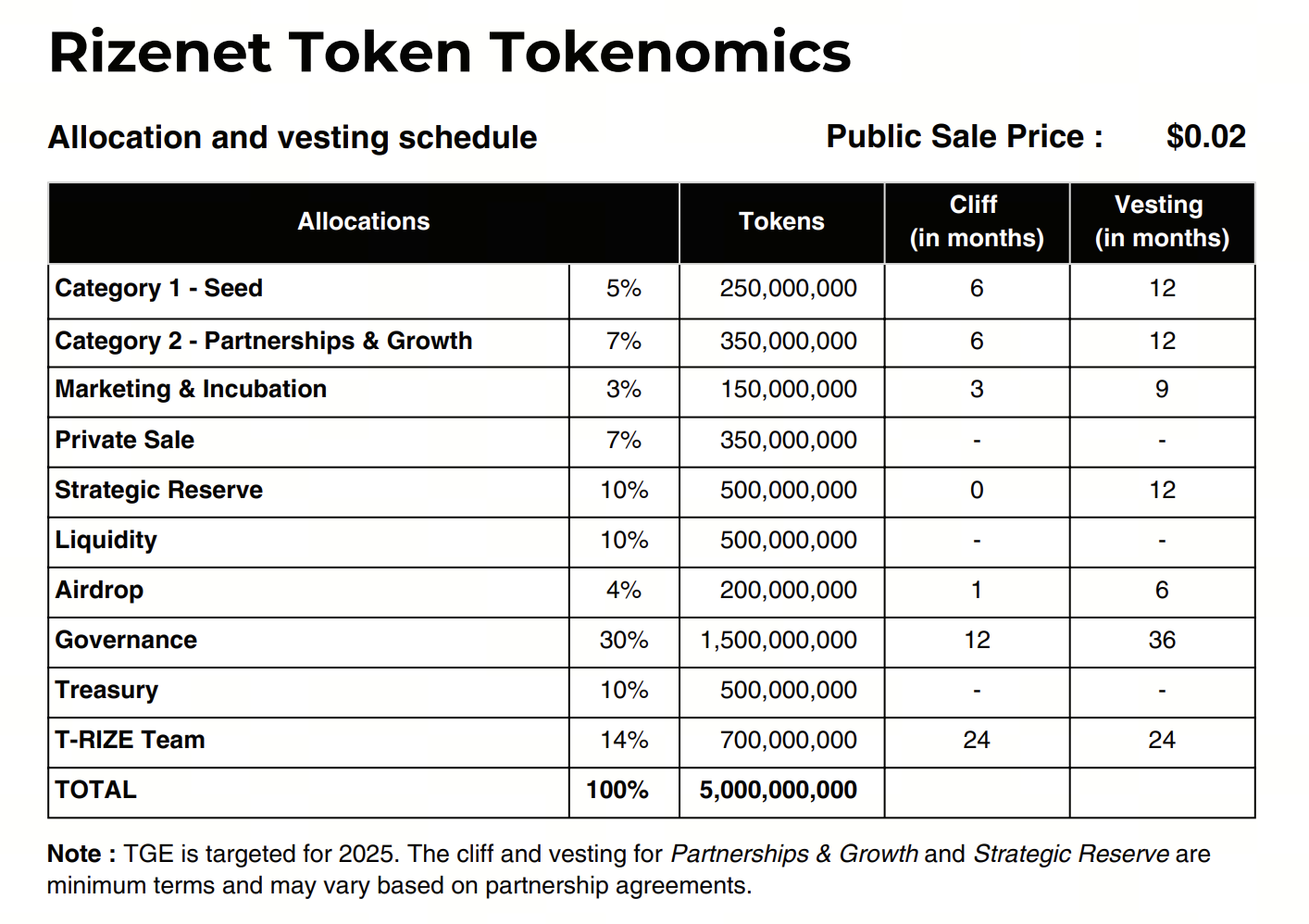
RIZE follows a fixed total supply model: 5 billion tokens (5,000,000,000 RIZE) with a public sale price of $0.02. The token allocation leans heavily toward long-term governance and ecosystem development rather than short-term circulation.
Governance receives the largest share at 30% (1.5 billion tokens), dedicated to community governance and ecosystem decision-making. The T-RIZE Team holds 14% (700 million tokens) with a 24-month cliff and 24-month vesting, reflecting a long-term commitment to ecosystem growth.
Strategic Reserve, Liquidity, and Treasury each receive 10% (500 million tokens each), allocated to strategic partnerships, market liquidity, and ecosystem reserves respectively. Partnerships & Growth and Private Sale each account for 7% (350 million tokens each) for ecosystem expansion and early-stage funding. Seed gets 5% (250 million tokens), Airdrop 4% (200 million tokens), and Marketing & Incubation 3% (150 million tokens).
The release schedule uses phased unlocking. The Governance portion has a 12-month cliff and 36-month linear vesting, while the Team portion has a full 4-year lock-up and release cycle. Longer vesting periods help reduce short-term selling pressure, aligning token release with T-RIZE ecosystem development.
Overall, RIZE's supply structure shows clear infrastructure token characteristics: a high governance allocation, significant long-term lock-ups, and substantial tokens reserved for ecosystem building and strategic reserves. This ties token value to RWA asset issuance scale and ecosystem growth over the long term.
Why Asset Issuers Need to Hold and Lock RIZE
One of the most important design features of the RIZE economic model is the direct link between asset issuers and token demand.
In traditional blockchain projects, tokens often serve only as fee payment tools. In the T-RIZE system, however, asset issuers may need to hold or lock a certain amount of RIZE to unlock higher-level issuance permissions.
This design serves three purposes:
1. Establishing Long-Term Interest Alignment
When issuers hold RIZE, their interests are aligned with ecosystem growth. The larger the asset issuance scale and the higher the network activity, the greater the value growth potential for the entire ecosystem.
2. Reducing Malicious Issuance Risk
The lock-up mechanism raises the barrier to entry, helping to filter out low-quality projects.
3. Increasing Token Demand
As more assets enter T-RIZE, market demand for RIZE grows synchronously, creating a virtuous cycle of ecosystem expansion and token demand.
This model has been widely adopted in infrastructure projects, and RIZE applies it to the real-world asset tokenization space.
How RIZE Captures Protocol Value
A key question in any token economic model is how ecosystem growth benefits token holders. RIZE's value capture mechanism comes from several sources.
Asset Issuance Revenue
When new real estate, funds, or private assets enter the network, issuance fees are paid. As asset scale grows, protocol revenue is expected to increase accordingly.
On-Chain Transaction Activity
Network fees from asset transfers, income distributions, and settlements also become ecosystem revenue. The more active asset trading, the higher the value captured by the protocol.
Ecosystem Service Revenue
Beyond issuance and trading, RIZE plans to expand into:
- Data analysis services
- AI risk assessment
- Portfolio management
- Asset rating
- Compliance review tools
These services may also require payment in RIZE.
Lock-Up and Governance Demand
Governance voting and ecosystem participation drive some tokens into long-term lock-ups, reducing market circulation. For infrastructure projects, value capture capability often determines whether a token can sustain long-term demand—a key focus of the RIZE economic model.
RIZE's Role in Governance
The governance function is a major differentiator between RIZE and traditional payment tokens.
RIZE holders can participate in key ecosystem decisions, such as:
- Network upgrades
- Fee adjustments
- Opening new asset classes
- Modifying incentive policies
- Partner admissions
- Risk management rule setting
As the ecosystem grows, the importance of governance increases. In the RWA market, where assets involve legal, regulatory, and risk control issues, community governance affects not only technology but also the operational direction of the entire asset ecosystem.
Through on-chain governance, RIZE aims to create a more open and transparent decision-making framework.
The Relationship Between RIZE and RWA Tokenization Demand
RIZE's long-term value is strongly tied to the growth of the real-world asset tokenization market. In recent years, RWA has become a major growth driver in blockchain. The asset types attracting market attention continue to expand, including:
- U.S. Treasury bonds
- Real estate
- Corporate bonds
- Private equity funds
- Yield-bearing assets
- Infrastructure investment products
As more assets move on-chain, new needs emerge: unified issuance standards, on-chain identity verification, automated income distribution, asset risk analysis, and global settlement networks.
These are precisely the challenges T-RIZE and RizeNet aim to solve. As the ecosystem token, RIZE demand grows with the number of assets. Logically, asset scale growth, increased network activity, and expanded ecosystem services are the key drivers of RIZE's long-term development.
What Risks Should You Consider When Investing in RIZE?
Although RWA is a promising blockchain direction, investing in RIZE comes with certain risks.
Regulatory Risk
Real-world assets involve securities regulation, tax systems, and investor protection rules. Regulatory frameworks vary significantly across countries, and policy changes can affect asset issuance and circulation.
Market Competition Risk
The RWA sector is attracting many participants. Large financial institutions, stablecoin issuers, and blockchain projects are all actively building in asset tokenization. Competition may impact ecosystem growth speed.
Liquidity Risk
On-chain asset value ultimately depends on market trading. If trading volume is insufficient, liquidity may suffer.
Technical Risk
Smart contract vulnerabilities, cross-chain security, and system upgrade risks need ongoing attention—especially when real-world assets are involved, as technical security is as critical as asset security.
Long-Term Development Potential of the RIZE Ecosystem
From an industry perspective, real-world asset digitization has moved from proof-of-concept to infrastructure building. More institutions are focusing on: on-chain asset issuance, real estate securitization, fund digitization, on-chain bond markets, and global asset settlement networks.
At the same time, AI is entering asset management. In the future, assets can not only be digitized but also analyzed intelligently for:
- Risk analysis
- Yield prediction
- Portfolio optimization
- Automated management
The RIZE ecosystem seeks to combine asset tokenization, on-chain settlement, and intelligent analysis. If the RWA market continues to grow, platforms with asset issuance, network infrastructure, and smart service capabilities have the potential to play a major role in the digital financial system. For RIZE, long-term potential depends not only on the token itself but also on the speed of real-world asset migration to blockchain and the overall size of the RWA market.
Summary
RIZE is the core economic engine of the T-RIZE RWA tokenization ecosystem, connecting real-world assets and blockchain through asset issuance, on-chain services, governance, and incentives. Unlike tokens that rely on trading scenarios, RIZE demand comes primarily from asset issuance and infrastructure usage, making its long-term value closely tied to RWA market growth.
As real estate, funds, bonds, and more real-world assets gradually move on-chain, RWA is evolving from an emerging sector into a core infrastructure direction for blockchain. The RIZE economic model represents a new value distribution logic for the asset digitization era—using a token to connect asset growth, network usage, and ecosystem governance within a unified framework, providing a sustainable economic foundation for the future of on-chain financial markets.







