Samsung stock on Gate gives eligible users a way to access Samsung Electronics through Gate Korean Stocks using USDT, while following Gate Stocks rules, Korean market hours, and platform-level rights handling.
Samsung Electronics is one of the most widely followed companies in the Korean stock market. Traditionally, foreign investors who want direct access to Samsung shares may need a Korean securities account, Korean won funding, or an eligible international brokerage route. Gate Korean Stocks changes the access path by letting eligible users use USDT inside a Gate Stocks account to trade supported Korea Exchange listed stocks.
Buying Samsung stock on Gate refers to using the Gate Korean Stocks section to trade Samsung Electronics with USDT settlement, while stock price, market value, and profit or loss are displayed in KRW. Users should understand that economic benefits and shareholder rights are not always the same as holding shares through a traditional Korean brokerage account.
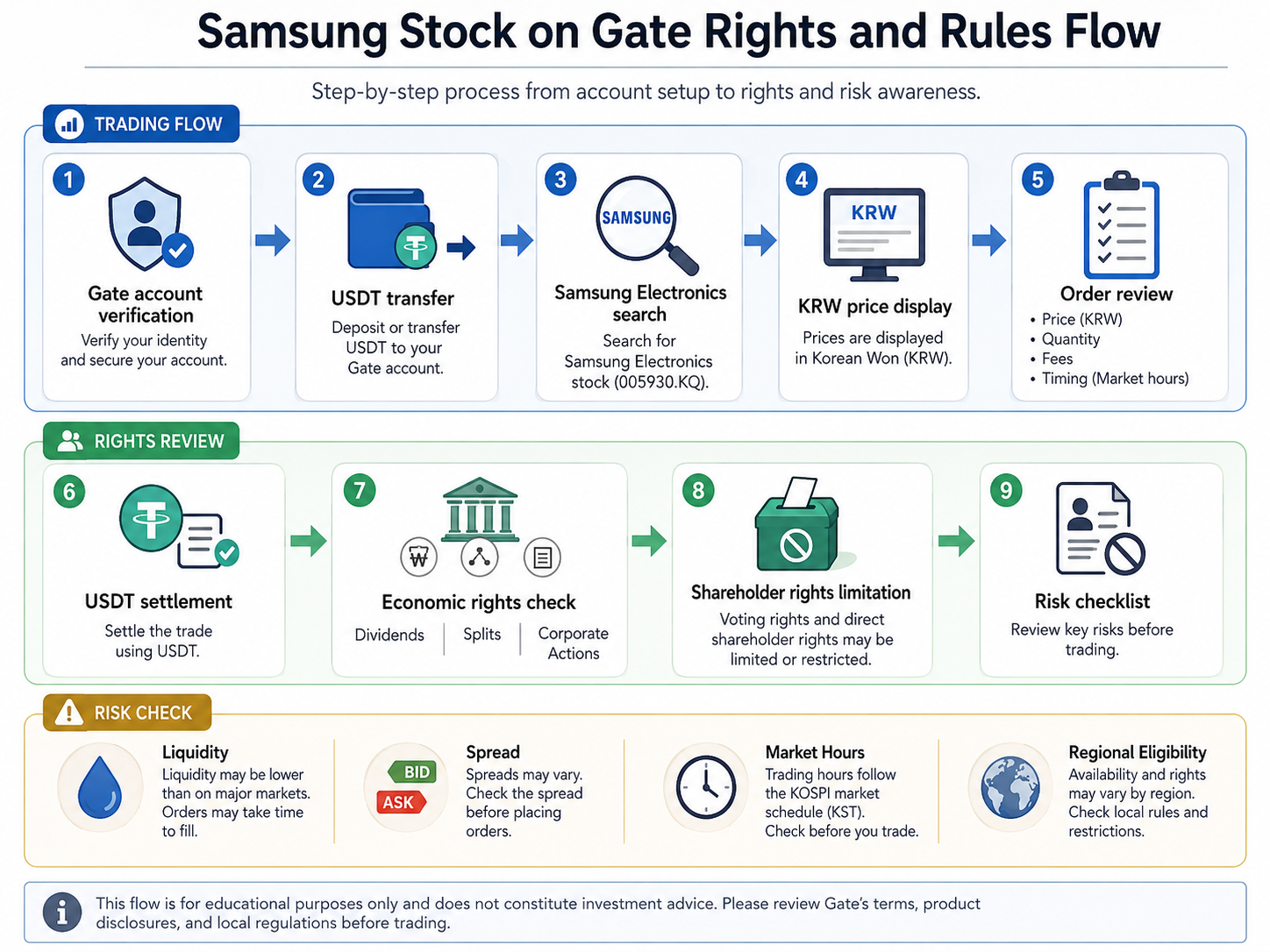
What Does Buying Samsung Stock on Gate Mean?
Buying Samsung stock on Gate means using Gate Stocks to access Samsung Electronics through the Korean stock trading section. Instead of opening a traditional Korean brokerage account or manually converting funds into Korean won, eligible users can prepare USDT, transfer it into the stock account, and place orders through the Gate interface.
This structure matters because Samsung Electronics is listed in Korea, and direct access to Korean stocks can involve extra steps for international investors. Samsung’s own investor information notes that foreign investors may buy Samsung Electronics shares directly on the Korea Exchange by registering, opening a Korean securities account, transferring funds, and trading shares, or indirectly through eligible local institutions. Gate offers a different user path by connecting a digital asset account with a stock trading interface.
Users comparing this route with a general Korean stock workflow can read more about how to buy Korean stocks with USDT on Gate. The key point is not only the buying process, but also the rule structure behind the trade.
A useful analogy is a travel card used in another country. The shop may price goods in the local currency, but your card settles the payment through your account currency. In Gate Korean Stocks, Samsung stock prices are shown in KRW, while fees and settlement are handled through USDT conversion according to platform rules.
How Does Samsung Stock Trading on Gate Work?
Samsung stock trading on Gate begins with account eligibility. Users generally need to register, complete identity verification, open a Gate Stocks account, and access the Korean Stocks section if available in their region. The stock account is separate from the spot account and is used for stock-related funds, positions, transaction records, and settlement details.
A typical flow looks like this:
| Step |
User Action |
Practical Check |
| 1 |
Complete Gate account verification |
Confirm regional eligibility and stock account access |
| 2 |
Open or activate Gate Stocks |
Check whether Korean Stocks is available |
| 3 |
Transfer USDT to the stock account |
Confirm amount, source account, and available balance |
| 4 |
Search for Samsung Electronics |
Check stock name, market, and displayed KRW information |
| 5 |
Review the order |
Check quantity, price, fee, settlement estimate, and timing |
| 6 |
Submit the order |
Confirm execution record and updated position |
| 7 |
Manage the holding |
Review profit or loss, transaction history, and corporate action records |
This table shows that the Samsung stock buying process is not only a search-and-click action. Each step has a rule attached to it. Account eligibility, transfer status, market session, quote display, exchange-rate conversion, and corporate action handling can all affect the final user experience.
For users new to the product structure, the broader Gate Stocks trading overview is useful because it explains how stock trading connects digital asset accounts with traditional securities markets.
What Rights Do Users Get When Holding Samsung Stock on Gate?
Samsung stock on Gate should be understood through the difference between economic rights and shareholder rights. Economic rights relate to financial outcomes connected to a stock position. Shareholder rights usually refer to governance participation, such as voting at shareholder meetings.
Gate’s rights-focused stock content describes supported economic benefits for Gate Stocks as including cash dividends, stock dividends, stock splits, reverse splits, and certain cash-based corporate actions, subject to platform rules. For Samsung stock, the practical takeaway is that users should review how Gate processes any Samsung-related corporate action when it occurs, rather than assuming the process will be identical to a traditional Korean broker.
| Rights or Event Type |
What It Means |
How Users Should Read It on Gate |
| Cash dividend |
Company distributes cash to eligible holders |
May be processed according to Gate rules and reflected in account records |
| Stock dividend |
Company distributes additional shares |
Account adjustment depends on supported processing rules |
| Stock split |
Share count increases while per-share price adjusts |
Position display may change after platform processing |
| Reverse split |
Share count decreases while per-share price adjusts |
Position display may change after platform processing |
| Corporate action record |
Event history tied to the holding |
Users should check stock account records |
| Voting right |
Governance participation |
May not be available in the same way as direct registered ownership |
The comparison matters because many users focus only on whether they can buy and sell Samsung stock. Long-term holders also need to understand how dividends, splits, and shareholder events are handled. Economic exposure and governance participation are related, but they are not the same.
For a deeper rights-focused background, users can review Gate Stocks economic rights and shareholder rights.
What Rights Are Not the Same as a Traditional Broker?
Samsung stock on Gate may not provide the same shareholder experience as holding Samsung shares directly through a Korean securities account in the investor’s own name. This is the most important rights distinction in the article.
Traditional broker access usually sits closer to the conventional shareholder registration and securities account system. Depending on the broker, market, and account type, investors may receive broader shareholder services, including meeting notices, voting instructions, corporate action elections, and other formal shareholder communications.
Gate Stocks is designed as a stock trading service connected to a digital asset account. The platform may support economic benefits, position management, and corporate action records, but users should not assume they receive every shareholder right that might exist under a direct Korean brokerage route.
The difference is easier to see in a comparison:
| Area |
Samsung Stock on Gate |
Traditional Korean Broker Route |
| Funding asset |
USDT transfer into stock account |
KRW or broker-supported funding route |
| Price display |
KRW display with USDT settlement |
Usually local market currency |
| Account path |
Gate Stocks account |
Securities account at eligible broker |
| Economic benefits |
Processed according to Gate rules |
Processed through broker and market systems |
| Registered shareholder status |
May differ from direct registration |
More likely to follow traditional shareholder framework |
| Voting and governance |
May be limited or unavailable |
Often more comprehensive, depending on broker |
| Stock transfer or withdrawal |
Subject to Gate rules |
Depends on broker and market infrastructure |
This does not mean one structure is automatically better. It means users should choose based on what they need. A user who mainly wants USDT-based Samsung price exposure may focus on access, settlement, and order records. A user who needs full shareholder governance participation may prefer to study the traditional brokerage route.
The difference between Gate Stocks, traditional brokers, and stock CFDs is especially important here because similar interfaces can lead to very different rights and risk outcomes.
What Trading Rules Apply to Samsung Stock on Gate?
Samsung stock on Gate follows Korean stock product rules inside Gate Stocks. Korean stock prices, market capitalization, and profit or loss are displayed in Korean won. Trading fees and fund settlement are converted and settled in USDT according to real-time exchange rates and platform rules.
Gate’s Korean stock launch information describes the current Korean stock trading session as aligned with the regular Korea Exchange session, with support for continuous intraday auction trading from 09:00 to 15:20 Korean time. Users should always check the live Gate interface because trading availability can change based on market holidays, product status, liquidity, platform notices, and regional rules.
Key trading rules include:
| Rule Area |
Samsung Stock on Gate |
| Market |
Korea Exchange listed stock through Gate Korean Stocks |
| Funding and settlement |
USDT-based stock account settlement |
| Display currency |
KRW for price, market value, and profit or loss |
| Trading session |
Current Korean stock session shown by Gate, described as 09:00 to 15:20 Korean time |
| Order execution |
Subject to market session, liquidity, order type, and platform rules |
| Fees |
Charged according to Gate stock fee and VIP rules where applicable |
| Fractional trading |
Subject to supported product rules and minimum size shown in the interface |
| Eligibility |
Depends on identity verification, region, and current platform restrictions |
This rule set is different from crypto spot trading. Crypto markets often operate continuously, while Korean stock trading depends on stock market sessions and exchange calendars. A Samsung order submitted outside the active session may not behave like a crypto order submitted at any hour.
Users familiar with broader traditional-asset access through crypto can also compare this structure with crypto access to gold, silver, and oil markets, where the main educational theme is similar: the funding asset may be crypto-native, but the underlying market still follows its own rules.
What Should Users Check Before Placing a Samsung Stock Order?
Before placing a Samsung stock order on Gate, users should check eligibility, market timing, price display, settlement estimate, and rights treatment. These checks help avoid confusion between what appears in the trading interface and what actually happens after execution.
A practical pre-order checklist:
-
Confirm Samsung Electronics is the intended Korean stock and not a different Samsung-related instrument.
-
Confirm the Korean Stocks section is available in the user’s region.
-
Check whether the current time is inside the supported Korean stock trading session.
-
Review the KRW price, estimated USDT cost, fee, and exchange-rate conversion.
-
Check order quantity, minimum order size, and whether fractional trading applies.
-
Review spread, liquidity, and possible execution difference between displayed quote and final fill.
-
Confirm whether the purpose is short-term trading access or longer-term economic exposure.
-
Review dividend, split, and corporate action handling rules.
-
Understand that voting and direct shareholder rights may be limited.
-
Save or review the transaction record after the order is executed.
Here is a simple example.
A user has USDT in a Gate account and wants Samsung Electronics exposure. The user completes verification, opens Gate Stocks, transfers USDT to the stock account, enters the Korean Stocks section, searches for Samsung Electronics, and checks the KRW price. Before placing the order, the user reviews the quantity, fee, estimated USDT settlement amount, and whether the market is open. After execution, the user checks the transaction record and confirms that the Samsung position appears in the stock account.
This example shows why Samsung stock on Gate is not the same as buying a crypto token. The user is accessing a stock market product through a digital asset account. That means both stock market rules and Gate account rules matter.
For users comparing USDT-based stock access across markets, USDT stock trading on Gate without a brokerage account provides helpful context on account structure, settlement, position records, and product limitations.
Summary
Samsung stock on Gate gives eligible users a USDT-based way to access Samsung Electronics through Gate Korean Stocks. The product simplifies the funding path compared with many traditional cross-border brokerage workflows, because users can manage stock activity through a Gate Stocks account rather than manually opening a Korean brokerage account or converting funds into Korean won.
The core rules are straightforward but important. Samsung stock information is displayed in KRW, while trading fees and settlement are handled in USDT according to platform conversion rules. Korean stock trading follows the supported Korean market session shown by Gate, and order execution depends on market hours, liquidity, quotes, and platform status.
Rights are the main area where users should be careful. Gate Stocks may support economic benefits such as dividends, stock dividends, stock splits, reverse splits, and certain corporate action adjustments according to platform rules. However, traditional shareholder rights such as voting or direct registered shareholder participation may not apply in the same way as a traditional Korean securities account.
Stock investing involves market risk, and prices may fluctuate significantly. Please make decisions carefully based on your own risk tolerance. This article does not constitute investment advice.
FAQs
What is Samsung stock on Gate?
Samsung stock on Gate refers to Samsung Electronics trading access through the Gate Korean Stocks section, using USDT as the settlement asset. Users can search for Samsung Electronics, review KRW-denominated market information, place orders during supported trading hours, and manage positions in the Gate Stocks account.
Can I buy Samsung stock on Gate with USDT?
Samsung stock on Gate can be accessed with USDT if the user is eligible and the stock is available in the Korean Stocks section. The user generally needs to complete verification, open a stock account, transfer USDT into that account, and place an order after reviewing the displayed price, quantity, fees, and settlement estimate.
Does Samsung stock on Gate give voting rights?
Samsung stock on Gate may not provide voting rights in the same way as direct registered shareholder ownership through a traditional Korean brokerage account. Users should separate economic benefits, such as supported dividend or split handling, from governance rights such as shareholder voting.
Are dividends supported for Samsung stock on Gate?
Samsung stock on Gate may be subject to Gate Stocks corporate action processing rules if Samsung Electronics announces a dividend or other supported event. Users should check account records and Gate’s current rules because dividend handling, timing, currency conversion, and eligibility may depend on platform procedures.
What trading hours apply to Samsung stock on Gate?
Samsung stock on Gate follows the Korean stock trading availability shown in Gate Korean Stocks. Gate’s Korean stock launch information describes the current supported Korean stock session as 09:00 to 15:20 Korean time for continuous intraday auction trading, but users should always verify the live session in the interface.
Is Samsung stock on Gate the same as a stock CFD or tokenized stock?
Samsung stock on Gate should not be confused with a stock CFD or a tokenized stock product. Gate Stocks is structured as stock trading access through a stock account, while CFDs are derivatives and tokenized stocks are blockchain-based representations that may have different ownership, rights, settlement, and risk structures.







