As the blockchain ecosystem and decentralized applications continue to evolve, zero-knowledge proofs (ZK Proof) have become a vital technology for verifying off-chain computation and Smart Contract execution results.
Different types of zkVMs serve distinct roles in real-world applications, with SP1 zkVM and zkEVM being the two most closely watched implementations. SP1 zkVM offers general-purpose, cross-ecosystem verifiable computing, while zkEVM focuses on verifying Smart Contracts compatible with the Ethereum EVM. In practice, some developers may conflate the two, but they differ significantly in underlying mechanics, use cases, and economic incentives.
What Is SP1 zkVM?
As a general-purpose zero-knowledge virtual machine from Succinct, SP1 zkVM enables Proof generation for any Rust program. Its core features include:
- Support for writing verifiable programs in general-purpose languages
- Automatic STARK/SNARK Proof generation
- Recursive proof and modular extension capabilities
- Suitability for cross-chain verification, Rollup scaling, and AI verifiable computing
Through a decentralized Prover Network, SP1 zkVM separates Proof generation from on-chain verification, creating an open hashrate market with closed-loop economic incentives. (succinct.xyz)
What Is zkEVM?
Designed for the Ethereum ecosystem, zkEVM is a zero-knowledge virtual machine compatible with the EVM instruction set. It allows Smart Contracts and transactions to generate Proofs off-chain for rapid verification on the Ethereum main chain. Its features include:
- Full compatibility with Ethereum Smart Contracts
- Proof generation primarily for Rollup or Layer2 scaling
- Emphasis on on-chain verification efficiency and EVM equivalence
- A community ecosystem deeply tied to Ethereum
zkEVM is best suited for transaction and contract verification within the Ethereum ecosystem and lacks the cross-ecosystem programmability of a general-purpose zkVM.
Core Differences Between SP1 zkVM and zkEVM
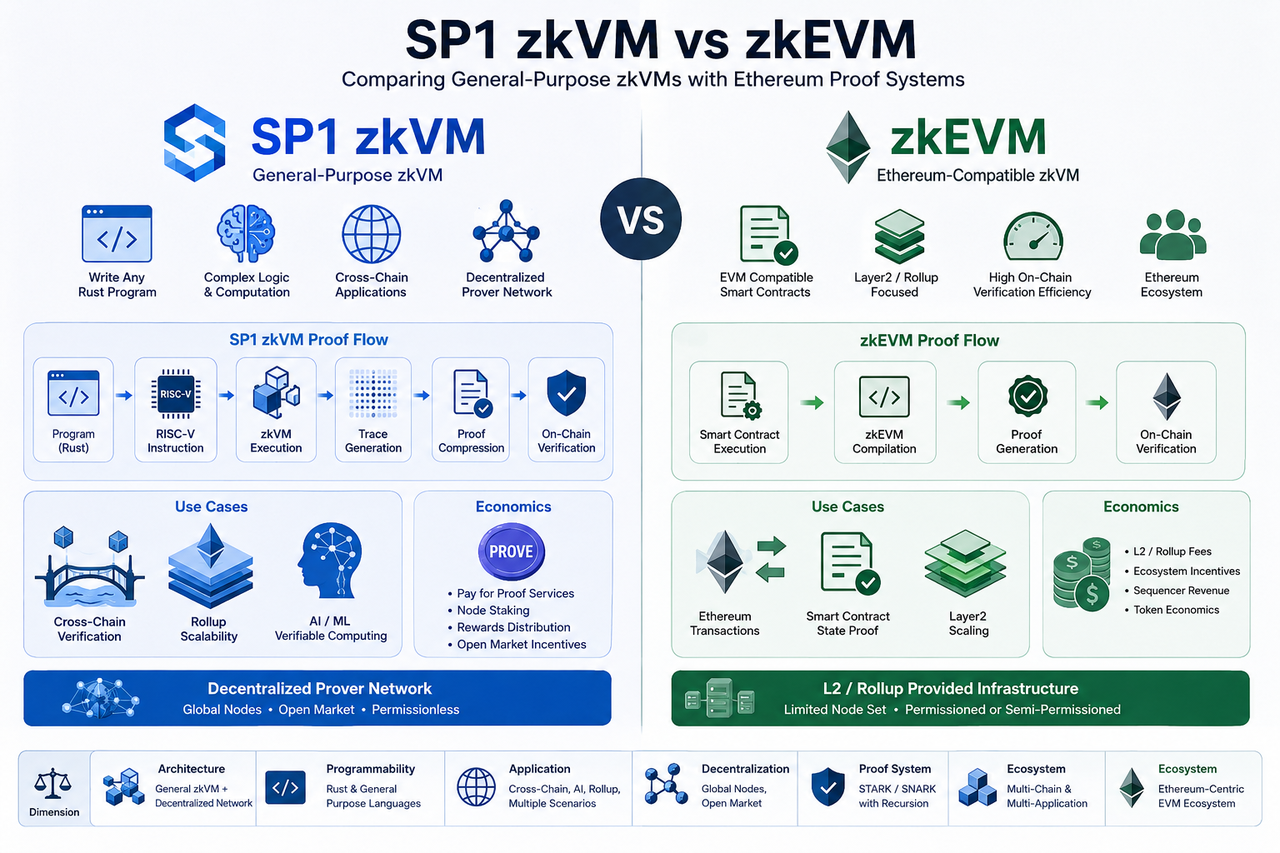
SP1 zkVM vs zkEVM: Architecture
Both SP1 zkVM and zkEVM are zero-knowledge proof infrastructure, but they target different goals.
SP1 zkVM prioritizes general verifiable computing. Its core consists of the SP1 zkVM and a decentralized Prover Network, allowing developers to write programs in Rust or other general-purpose languages and complete proof generation and verification via a global Proof network. This design frees SP1 zkVM from a single chain ecosystem, enabling complex scenarios like cross-chain verification, off-chain computing, and AI inference verification.
In contrast, zkEVM focuses on Ethereum ecosystem compatibility. Its underlying logic revolves around EVM instructions and Solidity Smart Contracts, aiming to enhance transaction verification efficiency and Layer2 scaling via ZK Proofs while preserving the Ethereum development experience.
SP1 zkVM vs zkEVM: Proof Generation
The two differ notably in how Proofs are generated.
The SP1 zkVM process typically begins with a developer writing a program. The program is converted to RISC-V instructions and executed in the zkVM to produce a Trace. The system then performs Proof compression and recursive verification before submitting for on-chain verification. Because the underlying system supports general-purpose computing, the entire flow is better suited for complex logic and large-scale verifiable computation.
The zkEVM process more closely mirrors the Ethereum execution environment. When a user initiates a transaction, the Smart Contract executes in the zkEVM, generating both an execution Trace and the corresponding Proof. Since zkEVM is natively EVM-compatible, the generated Proof can be directly used for Layer2 state verification and on-chain settlement. This model is ideal for high-frequency transaction verification and Rollup scaling.
SP1 zkVM vs zkEVM: Programmability
In terms of development flexibility, SP1 zkVM offers greater generality. Developers can write complex logic in general-purpose languages like Rust—including AI inference, cross-chain state verification, and off-chain data processing—without being constrained by Smart Contract frameworks.
zkEVM, on the other hand, revolves around Solidity and the EVM instruction set. While this compatibility reduces migration costs for Ethereum developers, it also restricts the execution environment to Smart Contract logic, making it unsuitable for complex general-purpose computing.
SP1 zkVM vs zkEVM: Use Cases
SP1 zkVM is better suited for scenarios requiring complex computation and cross-ecosystem verification. Examples include cross-chain bridges that need to continuously verify other chain states, AI systems that must validate model outputs, and Rollup networks handling large volumes of recursive Proofs. These all demand strong general verification capabilities.
zkEVM primarily serves Ethereum ecosystem scaling. Typical use cases include Layer2 Rollups, Smart Contract state verification, and Ethereum transaction compression. Because its design is explicitly EVM-focused, it has a clear advantage in Ethereum compatibility and on-chain integration efficiency.
SP1 zkVM vs zkEVM: Economic Models and Hashrate Networks
The Succinct network behind SP1 zkVM introduces a decentralized Prover Network with the PROVE incentive mechanism. When a developer submits a Proof request, global nodes can participate in Proof generation and receive settlement and rewards via the token mechanism. This model gradually fosters an open hashrate market for Proof generation.
zkEVM, by contrast, typically relies on the node infrastructure of Layer2 or Rollup projects. Its hashrate resources are mostly provided by project teams or verification nodes, resulting in relatively limited decentralization.
Multi-Dimensional Comparison Table: SP1 zkVM vs zkEVM
| Comparison Dimension |
SP1 zkVM |
zkEVM |
| Core Positioning |
General-purpose zkVM and verifiable computing layer |
Ethereum-compatible ZK scaling solution |
| Programming Language |
General-purpose languages (Rust, etc.) |
Solidity / EVM |
| Underlying Architecture |
RISC-V + Prover Network |
EVM-compatible execution environment |
| Proof Generation |
General-purpose program generates Proof |
Smart Contract execution generates Proof |
| Application Focus |
AI, cross-chain, complex computation |
Rollup, transaction verification |
| Expansion Capability |
Supports complex logic and recursive Proofs |
Emphasizes Ethereum compatibility |
| Hashrate Structure |
Decentralized Prover Network |
Layer2 node network |
| Incentive Mechanism |
PROVE token incentives |
Rollup Trading Fee model |
Summary
SP1 zkVM and zkEVM represent two different directions in ZK infrastructure. SP1 zkVM emphasizes general verifiable computing, using a decentralized Prover Network to support complex logic, cross-chain verification, and AI inference. zkEVM focuses on Ethereum compatibility, primarily addressing transaction verification and Layer2 scaling.
For projects needing complex off-chain computation and cross-ecosystem collaboration, SP1 zkVM offers greater expansion potential. For Rollups and Smart Contract applications built within the Ethereum ecosystem, zkEVM is often easier to integrate and deploy. The two are not simple substitutes; they serve different ZK application needs.
FAQs
Which solution is better for cross-chain verification?
SP1 zkVM is better for cross-chain verification because it supports complex logic execution and benefits from a decentralized Prover Network.
Which solution is better for Ethereum rollups?
zkEVM is better for Ethereum Layer2 and Rollup scaling due to its native compatibility with EVM and Solidity.
Does SP1 zkVM support recursive proofs?
Yes. SP1 zkVM can compress large-scale computation results using recursive Proofs, making it ideal for complex verification scenarios.
Can zkEVM execute arbitrary programs?
No. zkEVM primarily supports Solidity and the EVM instruction set, so its application scope is generally limited to Smart Contract logic.