SpaceX is a private company specializing in commercial aerospace, satellite internet, and rocket launch services — and one of the most closely watched unlisted tech firms globally. Because retail investors lack direct access to SpaceX equity, tokenized stock products built around its valuation have emerged as a key application of real-world asset (RWA) tokenization.
As blockchain technology continues to penetrate traditional finance, a growing number of institutions are exploring on-chain representations of assets such as stocks, bonds, and funds. SPCX is one prominent asset code that has emerged in this trend. Different platforms use distinct legal frameworks and technical architectures to offer on-chain exposure to SpaceX.
What Is SPCX Tokenized Stock?
SPCX generally refers to a tokenized stock product pegged to SpaceX equity value. Tokenized stocks use blockchain networks to represent traditional financial assets as digital tokens, allowing them to be held, transferred, or traded on-chain.
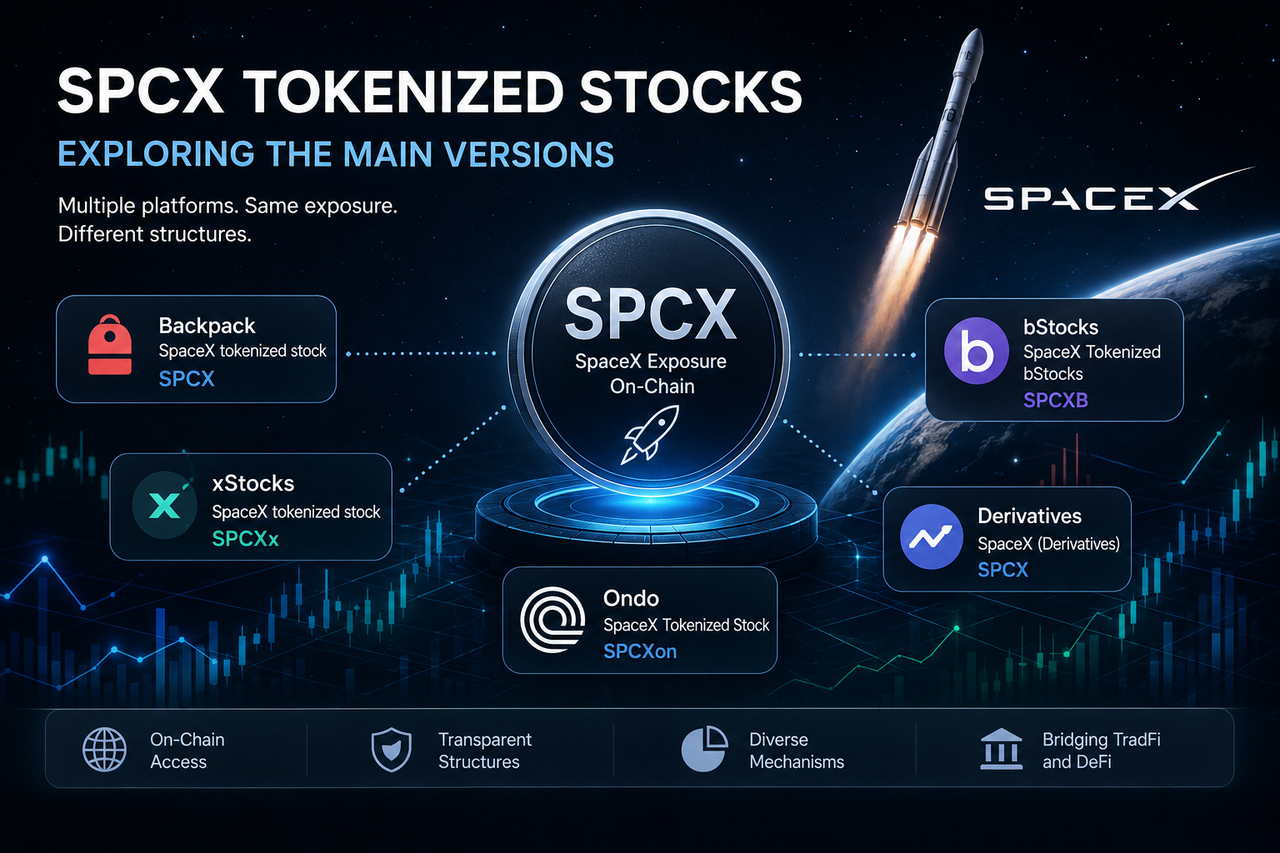
Importantly, SPCX is not a single asset under one standard. Different issuing platforms may construct products using real asset custody, special purpose vehicles (SPVs), synthetic assets, or derivative contracts. As a result, even similarly named products can have fundamentally different underlying structures and investor rights.
SpaceX Tokenized Stock (Backpack)
The Backpack SpaceX tokenized stock is part of its broader tokenized asset suite, designed to provide market exposure to SpaceX equity value through blockchain infrastructure. This product seeks to combine traditional private equity assets with an on-chain trading environment, enabling users to gain exposure to SpaceX’s value performance within a digital asset ecosystem.
The Backpack version of SPCX emphasizes a native on-chain experience. Blockchain-based settlement improves asset transfer efficiency and enables seamless integration with the Backpack ecosystem. To maintain the token’s correlation with the reference asset, the product is typically built with corresponding custody arrangements and compliance frameworks.
SpaceX (Derivatives) SPCX
SPCX (Derivatives) is a derivative-style SpaceX asset product whose core objective is to track changes in SpaceX’s market valuation, rather than directly representing actual equity.
Unlike tokenized stocks backed by real assets, the derivative version relies on contract mechanisms for price tracking. Holders gain market risk exposure related to SpaceX’s valuation, but this may not correspond to actual equity ownership.
Because price sources may depend on valuation models, reference markets, or third-party quotes, tracking errors may occur during operation. Additionally, when market liquidity is thin, the trading price may deviate from the reference value. Issuer credit risk and settlement mechanism design also affect product performance.
SpaceX Tokenized bStocks (SPCXB)
SPCXB is a SpaceX tokenized stock product within the bStocks framework. This model typically uses a regulated custodian to hold the underlying asset, then issues corresponding digital tokens on the blockchain to establish a mapping between on-chain and real-world assets.
Compared to pure price tracking products, SPCXB places greater emphasis on asset backing. Its core objective is to enhance transparency and credibility, enabling market participants to understand the asset structure behind the token. For private company equity, issuers often rely on special legal entities to hold shares and manage entitlements, so the specific rights of the product must be reviewed in the issuer’s documentation.
SpaceX Tokenized Stock (xStocks) SPCXx
SPCXx is the SpaceX tokenized stock version within the xStocks ecosystem. xStocks aims to bring traditional financial assets onto the blockchain, enabling stock-like assets to be managed and circulated like digital assets.
A key feature of SPCXx is on-chain composability. As a blockchain-native asset, it can interact with lending protocols, liquidity pools, and asset management tools, and integrate into automated strategy systems. This design gives tokenized stocks not only trading functionality but also the ability to serve as a foundational asset component in the DeFi ecosystem.
Unlike the fixed trading hours of traditional securities markets, on-chain assets typically offer more flexible trading environments and can be deployed across different blockchain networks based on protocol design, thereby expanding liquidity sources and use cases.
SpaceX Tokenized Stock (Ondo) SPCXon
SPCXon is a SpaceX tokenized stock product within the Ondo ecosystem. Ondo has long focused on real-world asset tokenization infrastructure, so its product design is typically geared toward institutional-grade market demands.
Within Ondo’s framework, SPCXon goes beyond simple asset mapping to emphasize the synergy among legal entities, custody arrangements, and audit processes. Its design priorities center on custody security, audit transparency, and legal enforceability, while reducing operational risk through asset isolation mechanisms.
This model shares certain similarities with securitized products in traditional finance and is often regarded as one of the more representative infrastructure solutions in the RWA development landscape.
What Are the Differences Between SPCX Products?
Although all the above products use SpaceX as the reference asset, their legal structures and asset backing methods vary. Some products emphasize real asset support, while others focus on price tracking; some are better suited for on-chain finance, while others prioritize institutional compliance.
| Product |
Type |
Underlying Asset Relationship |
Main Features |
| Backpack SPCX |
Tokenized Stock |
Maps equity exposure |
On-chain trading experience |
| SPCX (Derivatives) |
Derivative |
Price tracking |
Does not directly correspond to stock |
| SPCXB |
bStocks |
Asset-backed model |
Emphasis on custody structure |
| SPCXx |
xStocks |
Tokenized stock |
DeFi composability |
| SPCXon |
Ondo |
RWA model |
Institutional-grade infrastructure |
When comparing different SPCX products, the key focus should be on their underlying asset structures and legal relationships. Some products hold real assets as backing, while others provide only price tracking; some may hold equity through special purpose vehicles, while others use derivative models for value mapping. Additionally, the issuer, custody arrangements, redemption mechanisms, and applicable regulatory frameworks all affect the risk profile and use cases of each product.
What Is the Difference Between SPCX and Directly Holding SpaceX Equity?
SPCX products provide on-chain value exposure related to SpaceX, whereas directly holding SpaceX equity means owning shares in the company itself — the two have fundamentally different legal attributes.
Direct shareholders typically enjoy rights such as shareholder registration, information access, and specific governance rights. Tokenized stock products, in contrast, operate according to the legal structure set by the issuer. Some products may offer economic rights tied to equity value, while others only provide price tracking. Therefore, tokenized stocks should not be viewed as a direct equivalent to traditional shares.
Conclusion
SPCX is not a single asset but rather a collection of tokenized stock products from multiple platforms, all linked to SpaceX equity value. Current representative versions on the market include Backpack SPCX, SPCX (Derivatives), SPCXB, SPCXx, and SPCXon.
FAQs
Is SPCX issued by SpaceX?
No. SPCX is typically issued by third-party platforms to provide market exposure to SpaceX’s value. Different SPCX products correspond to different issuers, so their legal structures and rights arrangements may vary.
Do all SPCX products represent real SpaceX stock?
Not necessarily. Some SPCX products use a real asset-backed model, while others are derivatives or price tracking instruments. The specifics depend on the product structure disclosed by each issuer.
Does holding SPCX mean I'm a SpaceX shareholder?
Not necessarily. Whether you gain shareholder status depends on the product’s legal arrangement. Most tokenized stock products primarily offer value exposure and do not automatically confer traditional shareholder rights.
Why are there multiple versions of SPCX on the market?
Different platforms adopt different asset custody methods, legal structures, and technical solutions, leading them to issue their own versions of SpaceX tokenized stock products. Even with the same reference asset, product designs can differ significantly.
Is SPCX considered an RWA asset?
SPCX is generally regarded as a typical example of real-world asset (RWA) tokenization. Its core objective is to map traditional equity assets onto the blockchain, thereby improving asset accessibility and composability.
What risks do SPCX products carry?
SPCX products may involve custody risk, legal risk, liquidity risk, smart contract risk, and price tracking errors. Because different products use different structures, the sources and degrees of risk also vary.