As AI Agent technology increasingly enters the Web3 space, more projects are exploring how to combine automated decision-making, asset management, and on-chain execution to lower the barriers to complex financial systems.
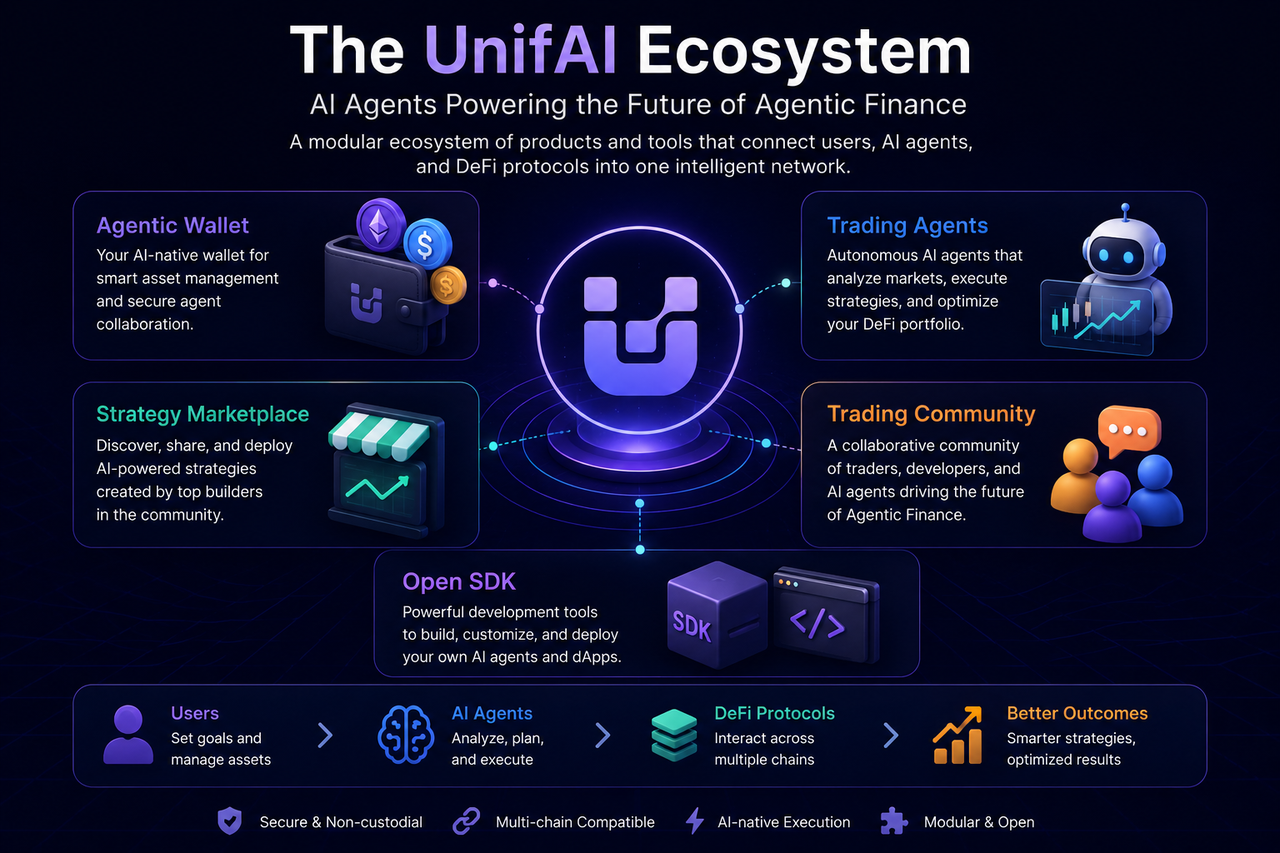
Against this backdrop, UnifAI positions itself not as a standalone app but as a full ecosystem for creating, deploying, running, and collaborating with AI Agents. Its product suite covers the user side, developer side, and Agent execution layer, forming a comprehensive infrastructure network spanning asset management, strategy execution, tool development, and community collaboration.
What Role Does Agentic Wallet Play in the UnifAI Ecosystem?
Agentic Wallet serves as the key gateway to the UnifAI ecosystem, bridging user assets with AI Agents. Unlike traditional wallets that focus mainly on asset storage and transaction signing, Agentic Wallet combines asset management capabilities with intelligent agent collaboration, enabling users to authorize Agents for specific tasks while retaining full control over their assets.
In the Agentic Finance environment, the wallet evolves from a mere storage tool into a pivotal hub connecting user goals with AI Agent execution. Through Agentic Wallet, users can more easily manage automated strategies and engage in AI-driven financial services.
How Is Agentic Wallet Different From a Traditional Wallet?
The biggest difference lies in automation and intelligent agent support.
Traditional wallets are designed for storing digital assets, sending transactions, and interacting with dApps—nearly all actions require manual user input. Agentic Wallet, however, allows AI Agents to execute tasks within authorized limits, including asset allocation, strategy execution, and protocol interactions.
| Comparison Dimension |
Agentic Wallet |
Traditional Wallet |
| Core Function |
Asset management & Agent collaboration |
Asset management |
| Automated Execution |
Supported |
Not supported |
| Strategy Management |
Supported |
Manual |
| AI Integration Level |
High |
Low |
| Automation Level |
High |
Low |
This distinction makes Agentic Wallet a critical component of the Agentic Finance ecosystem.
How Do Trading Agents Work?
Trading Agents are the core execution units within UnifAI, transforming user goals into concrete actions.
When users set objectives like yield optimization, asset management, or market monitoring, Trading Agents analyze relevant data and devise execution plans based on the on-chain environment. They then call tool layers to connect with various protocols, executing trades, rebalancing assets, or managing risk.
Compared to traditional automated trading programs, Trading Agents emphasize autonomous planning and dynamic decision-making, allowing them to handle more complex and volatile financial scenarios.
Trading Agents cover a wide range of on-chain financial use cases. Beyond automated trade execution, they can optimize yields, manage multi-chain assets, adjust portfolios, and monitor risk. After users define specific goals, AI Agents autonomously select execution paths by combining on-chain data with protocol information and continuously track strategy performance.
Unlike conventional automation tools, Trading Agents are not limited to a single task—they can flexibly switch between different financial scenarios. As Agent technology evolves, the scope of executable tasks continues to expand.
Why Is the Strategy Marketplace Important?
The Strategy Marketplace is the strategy circulation hub of the UnifAI ecosystem, providing a unified platform for developers and users to share strategies.
In traditional DeFi, investment strategies are often scattered across community discussions, research reports, or personal notes, making standardized reuse difficult. The Strategy Marketplace offers a unified mechanism that enables strategies to be discovered, deployed, and continuously optimized.
Developers can publish their self-designed Agent strategies to the marketplace, and users can select suitable strategies based on their needs, significantly improving strategy resource efficiency.
How Does the Strategy Marketplace Foster Ecosystem Collaboration?
The value of the Strategy Marketplace goes beyond strategy sharing—it facilitates collaboration among ecosystem participants. Developers can publicly release their Agent strategies to attract more users and earn ecosystem incentives, while everyday users gain access to a richer set of automated strategy resources that they can deploy as needed.
In this process, AI Agents act as the bridge connecting developers and users. Developers provide the strategies, Agents execute them, and users benefit from the services. This collaborative model creates a complete value flow system and helps drive the continuous growth of the Agentic Finance ecosystem.
The Trading Community is a vital platform connecting users, developers, and Agent creators. AI Agent improvement heavily relies on community feedback, accumulated experience, and ongoing optimization, making community building essential for ecosystem development.
Within the community, users can share their experiences with Agents and strategy results, while developers gather feedback to continuously enhance their tools. Members also engage in discussions around market research, strategy design, and Agent applications, fostering knowledge sharing and collaborative innovation. A vibrant community is often a key metric of Agent ecosystem maturity.
How Does the Open SDK Support Developers?
The Open SDK is the core development framework UnifAI provides for developers. With the SDK, developers can quickly create new AI Agent applications without building the underlying architecture from scratch.
The Open SDK integrates basic components such as an Agent creation framework, protocol connection interfaces, data access capabilities, and execution management modules, allowing developers to focus on business logic and innovation rather than reinventing infrastructure. This modular approach significantly reduces development costs and accelerates product iteration.
How Can Developers Create an Agent Using the Open SDK?
Creating an Agent with the Open SDK typically involves several stages: requirement definition, capability configuration, protocol integration, and deployment testing. Developers first clarify the Agent’s goals and task logic, then integrate on-chain tools and protocol interfaces via the SDK, and set execution permissions and operating rules.
After testing, the Agent can be deployed and run within the ecosystem. Since the underlying execution environment and tool framework are already provided by UnifAI, developers can devote more resources to optimizing Agent capabilities and driving product innovation.
Conclusion
The UnifAI ecosystem, centered around Agentic Finance, comprises a product matrix of Agentic Wallet, Trading Agents, Strategy Marketplace, Trading Community, and Open SDK. Each component handles asset management, task execution, strategy circulation, community collaboration, or development support, collectively providing a complete operating environment for AI Agents.
Unlike traditional DeFi platforms that primarily focus on protocol services, UnifAI emphasizes the full lifecycle management of AI Agents—from creation and strategy deployment to asset authorization and automated execution. The various products form a collaborative network, transforming Agentic Finance from a concept into a practical infrastructure system.
FAQs
How Do Trading Agents Differ From Regular Trading Bots?
Trading Agents possess task planning, reasoning, and dynamic decision-making capabilities, whereas regular trading bots typically follow fixed rules to execute preset strategies, making them less adaptable to complex environments.
What Is the Main Purpose of the Strategy Marketplace?
The Strategy Marketplace provides a unified platform for strategy developers and users to publish and share strategies, enabling AI Agent strategies to be discovered, deployed, optimized, and reused, thereby improving the circulation efficiency of strategy resources.
What Can the Open SDK Help Developers Do?
The Open SDK provides an Agent creation framework, protocol connection interfaces, data access capabilities, and execution tools, helping developers quickly build AI Agent applications and plug them into the UnifAI ecosystem.
How Do Products in the UnifAI Ecosystem Work Together?
Agentic Wallet serves as the asset gateway, Trading Agents execute tasks, the Strategy Marketplace supplies strategy resources, the Open SDK supports development, and the Trading Community fosters collaboration. Each module interconnects to form a complete Agentic Finance ecosystem.