As unified account systems and digital asset participation models continue to expand, investors are increasingly focusing not only on how to access the market, but also on how to allocate assets after entering it. Choosing between ETFs and stocks is not about which is better—it depends on investment objectives, portfolio habits, and risk preferences.
Through Gate Stocks, users can participate in stock and ETF markets using USDT and complete trading and asset management within a unified account system. Understanding the differences between these two approaches is therefore more important than simply choosing a trading entry point.
The Difference Between ETFs and Buying Individual Stocks
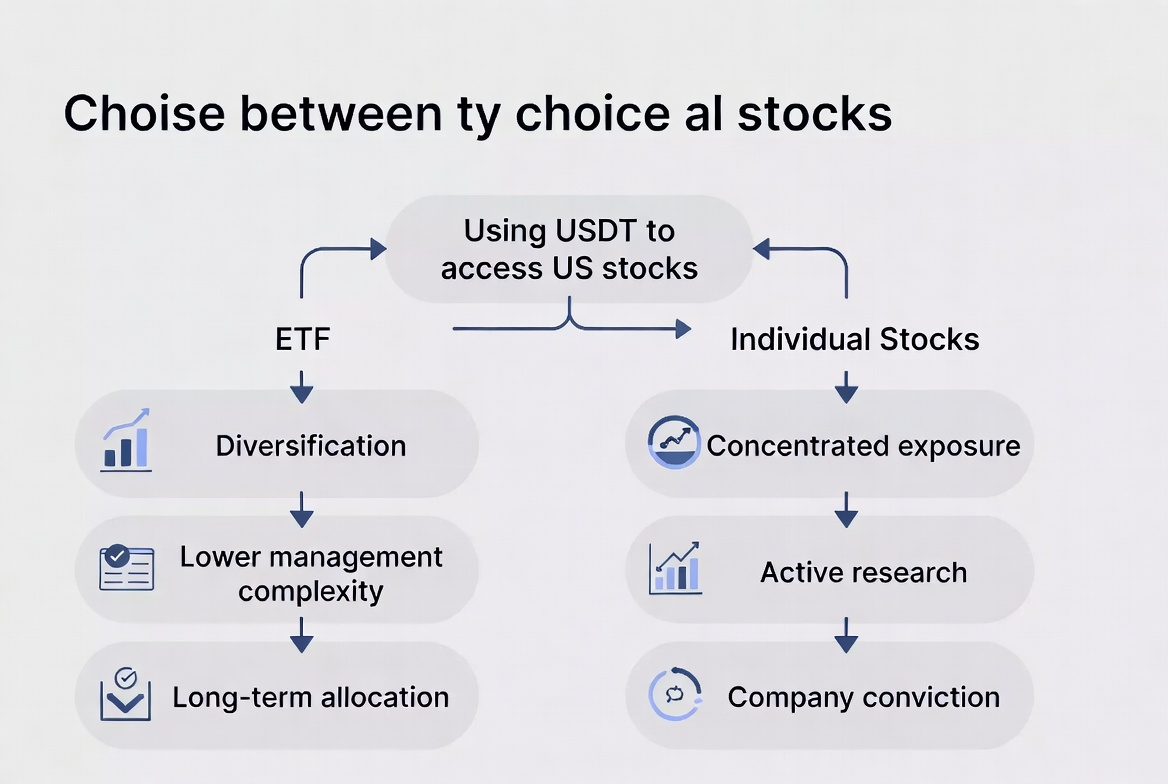
When participating in the U.S. stock market with USDT, ETFs and individual stocks represent two fundamentally different allocation frameworks. Stocks typically reflect the performance of a single listed company, while ETFs create portfolio exposure by holding multiple assets, allowing investors to access broader market coverage through one tradable product.
Buying individual stocks means investment results are more directly influenced by company operations, financial performance, industry competition, and market sentiment. Investors usually need to continuously follow company updates, earnings reports, and industry cycles while adjusting positions according to market developments. Therefore, stock trading emphasizes active decision-making and ongoing portfolio management.
ETFs follow a more portfolio-oriented approach. They generally operate according to index methodologies or asset allocation strategies and reduce dependence on individual company performance through diversified holdings. Even if some constituents experience significant volatility, the overall portfolio may remain relatively stable. As a result, ETFs are more commonly used as market participation and long-term allocation tools rather than concentrated opportunity-driven instruments.
From an asset management perspective, the biggest difference between the two approaches lies not in return potential, but in return sources, volatility structure, and ongoing management requirements.
Why More Investors Choose ETFs
The popularity of ETFs is not driven only by trading convenience—the larger reason is that ETFs reduce market participation complexity. Compared with building portfolios manually, ETFs integrate stock selection, weighting adjustments, and portfolio maintenance within the product structure.
For users who want exposure to U.S. markets but do not want to continuously research company fundamentals, ETFs offer a more standardized way to participate. Investors can allocate capital around indices, sectors, or themes without frequently adjusting holdings.
Another characteristic of ETFs is portfolio transparency. Most ETFs disclose their benchmark and holdings, making it easier for investors to understand actual capital allocation. Even within the same sector, different ETFs may have significantly different concentration levels and industry coverage.
As long-term allocation demand increases, ETFs have become an increasingly important bridge between index investing, asset allocation, and market participation.
Why Individual Stocks Still Remain Attractive
Although ETFs provide stronger diversification, stock investing continues to offer unique advantages. Stocks allow investors to form views around specific companies and directly benefit from corporate growth.
Owning individual stocks means investors can actively determine allocation direction. For example, if an investor is optimistic about a particular industry trend, capital can be concentrated into selected companies instead of accepting the full composition of an index.
Stocks are also more suitable for users who prefer active management. Investors can adjust positions independently and create more personalized portfolios.
However, this flexibility usually comes with higher management requirements. Stock investing requires more than placing trades—it involves continuously understanding company developments, industry competition, and market cycles, making it more suitable for users willing to dedicate time to ongoing research and management.
How Using USDT Changes ETF and Stock Investing
Traditionally, participating in U.S. markets often required opening brokerage accounts, preparing USD funding, and handling cross-border transfers. As unified account systems emerge, users are increasingly looking for ways to reduce account switching and fund conversion steps.
Through Gate Stocks, users can use USDT as trading capital and participate in both stock and ETF trading within a unified account structure. Fund preparation, trade execution, and position management can all be completed in one system.
This model does not change stock or ETF market rules. ETFs continue to operate according to index methodologies, and stocks still reflect real market pricing. The change primarily affects trading pathways and account experience.
For users already familiar with digital asset management, this approach improves capital continuity and reduces management costs associated with operating across multiple platforms.
From a Trading Experience Perspective: How ETFs and Stocks Differ
Beyond structural differences, trading experience also shapes long-term usage habits.
ETFs are generally better suited for investors seeking lower trading frequency. After establishing positions, users can participate in market performance through diversified exposure without constantly adjusting multiple holdings.
Stock investing, by comparison, typically involves more decisions, including stock selection, position sizing, and portfolio updates, resulting in more active interaction.
If improving allocation efficiency and maintaining long-term positions are priorities, ETFs generally provide a more streamlined experience. If actively participating in market movements is more important, stocks offer stronger control and flexibility.
Which Approach Fits Different Investment Needs
Users who want to reduce management complexity, lower single-asset volatility, and participate through a long-term framework are generally more likely to benefit from ETFs.
Investors who focus on specific companies, are willing to continuously study markets, and prefer building investment logic around corporate growth may lean more toward individual stocks.
These two approaches are not mutually exclusive. In practice, a common strategy is to use ETFs as the foundation for market exposure while adding individual stocks to increase targeted exposure to industries or companies.
For users already comfortable with digital asset ecosystems, participating in stocks and ETFs with USDT through Gate Stocks can also create a more seamless cross-market account experience.
How to Participate in Stocks and ETFs Through Gate Stocks Using USDT
Once account setup is complete, users can begin participating in stock and ETF markets.
Step 1: Download the Gate App or update to a version that supports stock trading, then complete registration and KYC verification.
Step 2: Transfer USDT into the stock account without preparing USD separately.
Step 3: Enter the TradFi section, search for the target stock or ETF, confirm the quantity, and place the order.
After trading, users can centrally view positions, order history, asset changes, and corporate action updates, creating a complete workflow from funding to portfolio management.
Conclusion
Buying ETFs with USDT versus buying individual stocks is not about choosing the superior option—it is about selecting different investment approaches. ETFs emphasize diversification, long-term management, and broad market exposure, while stocks emphasize active judgment and company selection.
Participating in stocks and ETFs through Gate Stocks with USDT further reduces account and funding complexity, allowing users to manage cross-market assets within one account structure and build more flexible allocation strategies based on individual needs.
FAQ
Which carries higher risk, ETFs or stocks?
Stocks are generally more affected by the performance of individual companies, while ETFs emphasize diversified exposure.
Do I need to convert USDT into USD before buying ETFs?
No. Platforms supporting this model allow users to prepare trading funds without independently converting into USD.
Are ETFs suitable for long-term holding?
Different ETF products follow different rules and should be evaluated based on their specific structures.
Can I hold both ETFs and stocks?
Yes. Combining both approaches can create different layers of asset allocation.
Does Gate Stocks support both ETF and stock trading?
Yes. Gate Stocks supports stock and ETF trading within a unified account management experience.