Understanding the use cases of the IO network is essentially about understanding why the AI industry needs a new model for compute supply. As large language models, AI Agents, and real-time inference services grow rapidly, GPUs have become critical infrastructure in the AI industry chain, while distributed GPU networks are becoming an important complement to traditional cloud computing.
What Are the Use Cases of IO?
IO is not positioned as a general-purpose cloud computing platform. It focuses on GPU-intensive computing tasks.
GPUs were originally used mainly for graphics rendering and gaming, but with the development of deep learning, they have become important hardware resources for training neural networks and running AI models. Today, many AI projects require far more GPU power than traditional internet applications, making stable and cost-efficient access to computing resources a major challenge for many teams.
IO aims to integrate globally distributed GPU resources into a unified compute market, allowing developers to call computing resources on demand without purchasing expensive hardware themselves or renting cloud services over the long term.
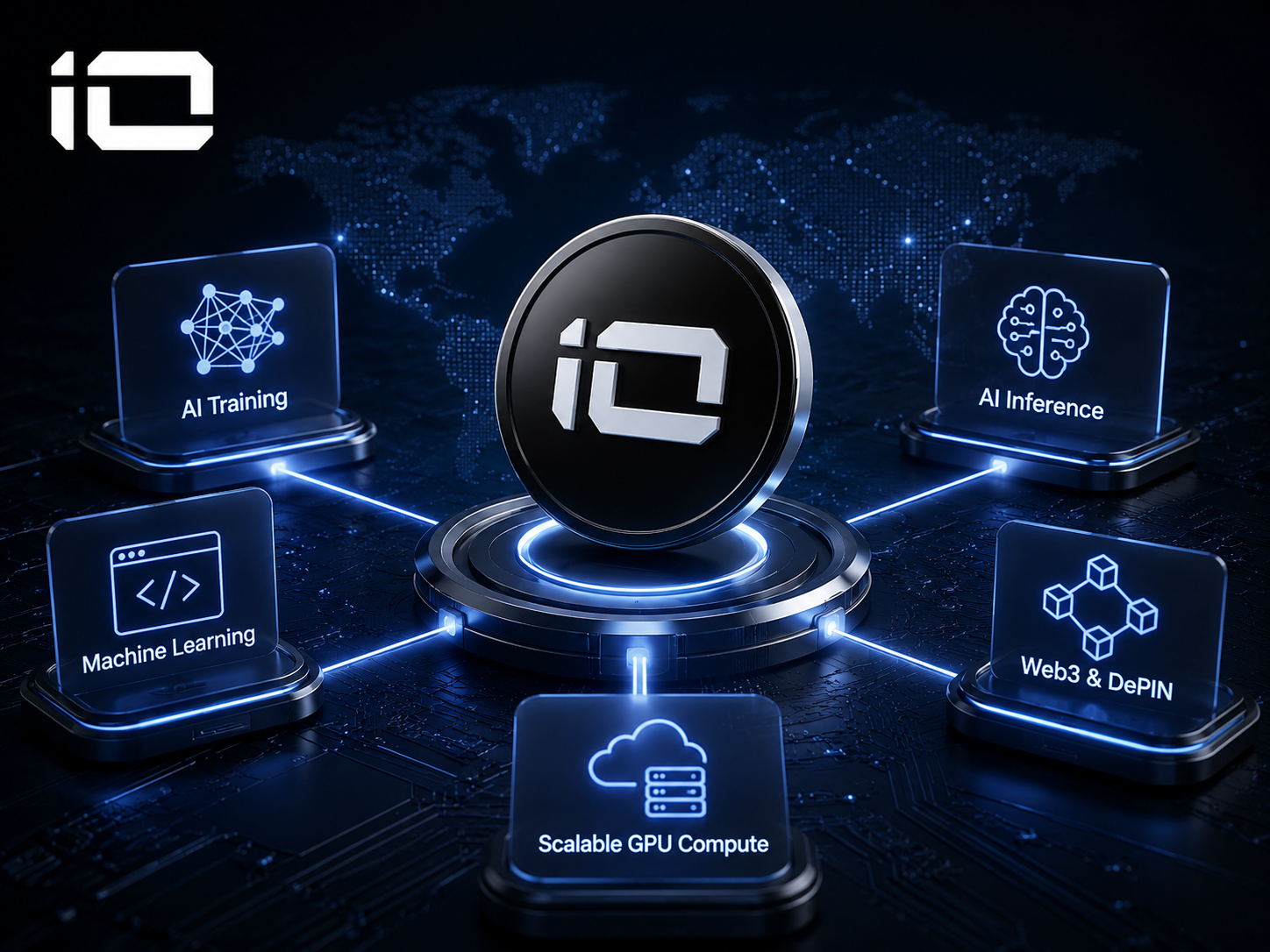
Based on currently available public information, IO’s main application areas can be summarized as follows:
| Application Area |
GPU Demand Characteristics |
| AI model training |
Long-running, highly parallel computing |
| AI inference services |
Real-time response and high stability |
| Machine learning R&D |
Elastic resource demand |
| Web3 infrastructure |
Distributed computing demand |
| DePIN ecosystem |
Node resource coordination |
| Scientific computing |
High-performance computing tasks |
These scenarios all require large amounts of GPU resources, and both resource utilization and cost control often directly affect operational efficiency.
How IO Supports AI Model Training
AI model training is one of the largest sources of GPU demand today.
Whether for large language models, image generation models, or multimodal AI systems, model training requires massive matrix operations and long-running computation. As model parameter sizes continue to grow, training costs are also rising.
Traditionally, development teams have relied on major cloud service providers to rent GPU clusters for training tasks. However, as competition in the AI industry intensifies, high-end GPU resources have remained in short supply, making both price and availability major challenges.
The value of IO lies in providing an additional source of computing power for training tasks.
For small and mid-sized AI teams, buying GPU clusters often means heavy upfront capital investment. Accessing resources through a distributed GPU network can reduce that early cost burden. For teams that need temporary scaling, an elastic resource pool can also improve training efficiency.
From a technical demand perspective, AI model training places more emphasis on GPU performance, VRAM capacity, and cluster scalability, making it one of the use cases that best demonstrates the value of distributed computing power.
How IO Meets AI Inference Demand
If model training drove the first wave of GPU demand growth, AI inference is driving the second wave of compute expansion.
Inference refers to the process in which a trained model provides services to users. For example, ChatGPT-style question answering, AI search result generation, image generation, and AI Agent task execution all involve inference computing.
Compared with model training, inference is not defined by extreme compute demand, but by continuous operation and real-time response.
As more AI products enter commercialization, inference services are gradually becoming a major source of demand in the GPU market. Many AI companies have already found that long-term inference costs may even exceed one-time model training costs.
The IO network can provide elastic GPU resources for inference services.
For inference businesses, resource demand fluctuates with user traffic. A distributed GPU network can provide additional computing support during traffic peaks without requiring companies to maintain excess resource reserves over the long term.
The growth of AI inference demand is also one of the important drivers behind the continued expansion of the GPU market.
IO’s Role in Machine Learning Projects
Machine learning is not the same as large model training.
Many enterprise machine learning projects are smaller than GPT-style models, but they still need GPU resources for data processing, model training, and experiment validation.
In real development workflows, machine learning teams often face unstable resource utilization.
Some stages require large amounts of GPU power for training tasks, while resource usage drops significantly during model optimization or testing. For these projects, renting fixed GPU clusters over the long term often leads to resource waste.
IO’s elastic resource model can better match the real needs of machine learning projects.
Development teams can dynamically adjust resource usage based on the project cycle, improving resource efficiency.
This is especially important for startups, research institutions, and independent developer teams, which usually pay closer attention to cost control and resource flexibility.
As barriers to AI development continue to fall and the number of machine learning projects keeps growing, the potential market for distributed GPU networks is also expanding.
How IO Serves Web3 and DePIN Projects
Beyond the AI industry, the Web3 ecosystem is also an important application direction for IO.
In recent years, more blockchain projects have begun introducing AI capabilities, including AI Agents, on-chain data analysis, automated trading systems, and intelligent content generation. These functions also require GPU computing support behind the scenes.
For Web3 projects, fully relying on traditional centralized cloud service providers can create certain risks.
Some teams want to maintain a higher degree of decentralization at the infrastructure layer to reduce potential problems caused by single-point dependency. As a result, decentralized GPU networks are gradually becoming an important part of Web3 infrastructure.
IO also has another layer of positioning as a DePIN network.
DePIN projects emphasize the use of distributed hardware resources to build open infrastructure, and GPU networks are one of the important branches of the DePIN sector.
Within this framework, IO is not only a compute service provider, but also an infrastructure market that connects resource providers with resource demand.
As the convergence of AI and Web3 continues to strengthen, the role of GPU networks in on-chain ecosystems is also gradually increasing.
Which Industries Are Using Distributed GPU Computing Power?
The application scope of distributed GPU computing power has already extended far beyond the crypto industry.
The main demand today still comes from the AI industry, but more traditional industries are also beginning to use high-performance computing resources.
Financial institutions use GPUs for risk modeling and quantitative analysis. Biotech companies use GPUs for drug discovery and genomic computing. Autonomous driving companies use GPUs to train perception models. Film and media production teams use GPUs for rendering and visual effects.
These industries share several common characteristics: large data volumes, high computational complexity, and a continuous need to improve computing efficiency.
| Industry |
Main GPU Applications |
| Artificial intelligence |
Model training and inference |
| Autonomous driving |
Perception model training |
| Biotechnology |
Drug discovery and genomic analysis |
| Fintech |
Risk modeling and quantitative computing |
| Gaming and film |
Rendering and content generation |
| Scientific research |
High-performance computing tasks |
As AI technology gradually becomes an important tool for digital transformation across industries, GPU resources are evolving from a specialized technical requirement into a general productivity resource.
This is also one of the key reasons why distributed GPU networks continue to attract attention.
How IO’s Token Economy Relates to Its Use Cases
Growth in IO’s use cases will ultimately affect token demand within the network.
According to publicly disclosed information, the IO token has a genesis supply of 500 million tokens and a maximum supply of 800 million tokens. Around 50% is allocated to the community ecosystem, 16% to R&D and ecosystem development, and the rest to core contributors and early investors.
| Allocation Category |
Percentage |
| Community |
50.00% |
| R&D and ecosystem |
16.00% |
| Core contributors |
11.30% |
| Early Backers, Seed |
12.50% |
| Early Backers, Series A |
10.20% |
From a use case perspective, the community allocation plays an important role in driving network expansion. GPU node rewards, developer incentives, and ecosystem partnership programs all rely on community reserves.
As more AI projects use network resources, demand for compute settlement, node rewards, and staking may grow at the same time. Therefore, there is a direct connection between use case expansion and the token economic model.
For an infrastructure project, what truly determines long-term value is not the token itself, but whether the network can continue generating real usage demand.
Conclusion
IO’s core use cases are concentrated in AI model training, AI inference services, machine learning R&D, Web3 infrastructure, and DePIN network building. As large language models, AI Agents, and real-time inference services grow rapidly, GPUs have become an important foundational resource in the digital economy.
Compared with traditional cloud computing platforms, IO aims to build an open compute market by aggregating idle GPU resources around the world, giving developers a more flexible way to access computing resources. As more industries enter the AI era, distributed GPU networks are becoming an important complement to traditional cloud computing systems, while AI training and inference demand will remain the core force driving growth in this market.
FAQs
What Are the Main Use Cases of IO?
IO is mainly used for AI model training, AI inference services, machine learning R&D, Web3 infrastructure development, and computing tasks related to DePIN networks.
Why Does AI Model Training Require Large Amounts of GPU Power?
AI model training involves large-scale matrix operations and parameter optimization. GPUs are much stronger than traditional CPUs in parallel computing, making them important hardware resources for deep learning training.
What Is the Difference Between AI Inference and AI Training?
AI training is used to build and optimize models and usually requires large amounts of computing resources. AI inference provides services after a model has been trained, emphasizing real-time response and continuous operation.
Why Is IO Suitable for Machine Learning Projects?
IO provides on-demand GPU resources, helping machine learning teams flexibly adjust computing scale based on project cycles and improve resource utilization.
What Is the Relationship Between IO and DePIN?
IO belongs to the DePIN, decentralized physical infrastructure network, sector. It builds an open compute market by integrating globally distributed GPU resources and provides infrastructure support for AI and Web3 projects.
Will Growth in IO’s Use Cases Affect the IO Token?
Growth in IO network use cases can bring more demand for compute settlement, node incentives, and staking. Therefore, network usage scale is directly connected to the economic activity of the IO Token.