Gate’s list of ETFs for purchase is a concept used to understand ETF-related products that can be accessed through Gate using USDT, including Gate Stocks ETFs, tokenized ETF exposure, and Gate ETF leveraged tokens. ETF access matters because crypto users increasingly seek ways to connect stablecoin balances with traditional-market instruments, and Gate introduced stock trading services on June 1, 2026, stating that users can trade stocks and ETFs using USDT across major U.S. markets such as NYSE, Nasdaq, NYSE Arca, NYSE American, and BATS. The value of this model comes from USDT settlement, platform-level access, and the connection between crypto balances and traditional financial assets, but these features do not remove market volatility, product-structure risk, stablecoin risk, execution risk, or regional restrictions.
What Gate’s List of ETFs for Purchase Means
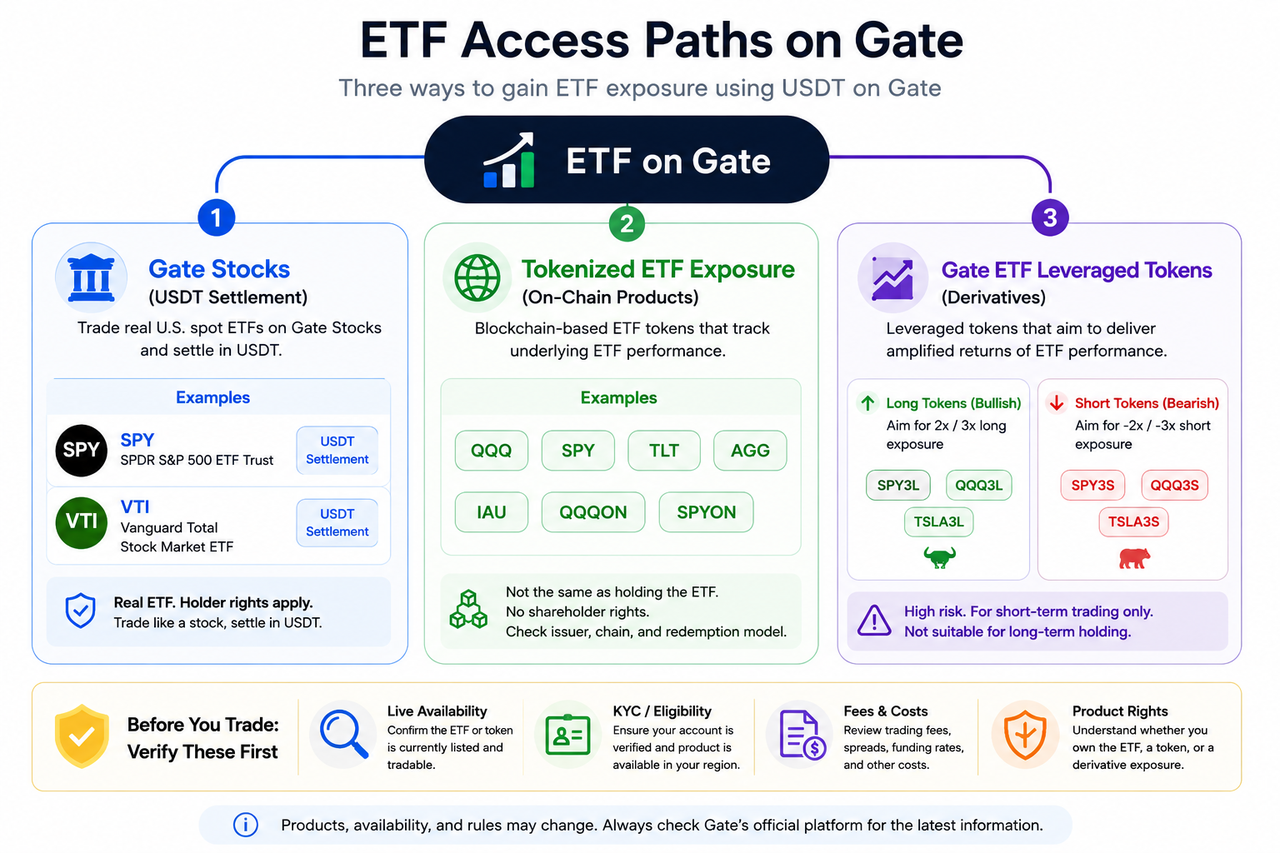
Gate’s list of ETFs for purchase does not refer to one single product category. It is better understood as a practical map of ETF-related access paths, because the same word, “ETF,” can appear in different parts of Gate with different meanings.
The first category is Gate Stocks, where eligible users can access supported stocks and ETFs using USDT. Gate’s stock trading page describes direct access to global stock assets, 10,000+ tradable stocks and ETFs, a 0.01-share minimum purchase, USDT settlement, and a lowest fee rate of 0.023%.
The second category is tokenized stock and ETF products. These products may reference ETF tickers or ETF-like exposure, but they should not be treated as identical to directly holding listed ETF shares. Tokenized products depend on their own issuance, custody, redemption, trading, and rights framework.
The third category is Gate ETF leveraged tokens. Gate describes ETF tokens as products with leveraged exposure and automatic rebalancing. They are not traditional securities ETFs, even though the product name uses the word “ETF.”
| Product type |
What it represents |
Uses USDT? |
Verified examples |
Key limitation |
| Gate Stocks ETFs |
Access to supported stock and ETF trading |
Yes |
SPY, VTI |
Availability depends on region, KYC, account status, and live market list |
| Tokenized ETF products |
Tokenized exposure to ETF-related assets |
Usually yes |
QQQ, SPY, TLT, AGG, IAU, QQQON, SPYON |
Not the same as directly holding listed ETF shares |
| Gate ETF leveraged tokens |
Leveraged and rebalanced trading tokens |
Usually through crypto pairs |
Long and short leveraged token categories |
Rebalancing and compounding can affect performance over time |
The table separates product names from product mechanics. A familiar ETF ticker can represent different exposure depending on whether it appears in Gate Stocks, stock-token markets, or ETF leveraged token markets.
Can Gate’s List of ETFs for Purchase Be Used with USDT?
Gate’s list of ETFs for purchase can include products settled or traded with USDT, but users need to confirm the specific Gate product area first. Gate states that its stock trading service allows eligible users to trade supported stocks and ETFs using USDT.
In Gate Stocks, USDT is the settlement route for supported stock and ETF transactions. Gate’s stock trading page lists USDT as the settlement method and 0.01 shares as the minimum purchase size. This may be easier to understand for users who already hold stablecoins, but USDT settlement only describes how the transaction is funded and settled. It does not define the product’s rights, market risk, or execution rules.
Fractional ETF access also needs careful interpretation. Investor.gov explains that fractional share investing means buying less than one full share, and it notes that brokerage firms may apply different rules around available securities, order types, transfers, voting rights, liquidity, and fees. (Investor.gov)
Understanding USDT-based stock trading helps separate the funding method from the instrument itself. USDT settlement explains the payment and settlement layer, while the product interface and terms explain what the user is actually accessing.
Gate’s List of ETFs for Purchase Through Gate Stocks
Gate’s list of ETFs for purchase through Gate Stocks is the clearest category for users looking for ETF access with USDT settlement. Gate’s stock service announcement states that the service supports over 10,000 stocks and ETF assets and covers major U.S. securities venues and liquidity networks.
Verified ETF examples visible on the Gate Stocks market preview include SPY, identified as State Street SPDR S&P 500 ETF Trust, and VTI, identified as Vanguard Total Stock Market ETF. These examples are useful for orientation, but they should not be described as a complete live ETF list.
Gate Stocks should also be distinguished from tokenized stocks, stock CFDs, and futures. A useful comparison is Gate Stocks versus traditional brokers and stock CFDs, because ETF exposure, CFD exposure, and tokenized exposure may reference similar market names while creating different rights and risks.
Gate also states that its market access is powered by Alpaca’s regulated brokerage infrastructure. This detail helps explain why Gate Stocks should be treated separately from crypto-native tokenized products, but users should still review the live product terms, account eligibility, and available markets before placing any order.
Tokenized ETF Products and Gate’s List of ETFs for Purchase
Tokenized ETF products may appear in searches for Gate’s list of ETFs for purchase, but they are separate from Gate Stocks. A tokenized ETF-related product generally provides exposure through a token structure rather than conventional ETF share ownership.
Official Gate stock-token content mentions ETF-related examples such as IAU, TLT, AGG, QQQON, and SPYON, and also discusses ETF-related stock-token support in its FAQ. These examples should be described as tokenized ETF-related products, not as proof that users directly hold the same listed ETF shares.
The distinction matters because tokenized ETF products may involve different rules for custody, redemption, economic rights, trading hours, issuer structure, liquidity, and corporate-action handling. A user seeing a familiar ticker in one product area should not assume it has the same structure as the same ticker in Gate Stocks.
Tokenized ETF exposure belongs to the broader discussion around real-world asset access. Concepts such as crypto-based stock trading models show how familiar assets can be represented or accessed through digital-asset systems, but each product still needs to be checked on its own terms.
Gate ETF Tokens vs Gate’s List of ETFs for Purchase
Gate ETF tokens are not the same as traditional ETFs in Gate’s list of ETFs for purchase. Gate describes ETF tokens as leveraged products that use automatic rebalancing and support long and short exposure categories.
The term “ETF” can be confusing because it means different things in different contexts. In traditional finance, an ETF is an exchange-traded investment product that may hold stocks, bonds, commodities, or other assets. Investor.gov explains that ETF shares generally represent a proportional interest in a fund portfolio and usually trade on an exchange throughout the day. (Investor.gov) Gate ETF leveraged tokens, by contrast, are crypto trading products tied to leverage, net asset value, and rebalancing mechanics.
Investor.gov warns that leveraged and inverse ETFs are often designed around daily objectives and that performance over periods longer than one day can differ significantly from stated daily objectives, especially in volatile markets. (Investor.gov) This principle is relevant when explaining leveraged or inverse structures, even though Gate ETF leveraged tokens are not the same as registered U.S. leveraged ETFs.
Fees, Minimum Purchase, Eligibility, and Live Verification
Gate’s list of ETFs for purchase should always be checked together with current fees, minimum order rules, settlement details, and eligibility requirements. Gate’s stock trading page lists 0.01 shares as the minimum purchase, USDT as the settlement method, and 0.023% as the lowest fee rate.
These figures should be framed carefully. “Lowest fee rate” does not mean every ETF trade will have the same cost. Users should review the live order preview, fee schedule, account level, product type, spread, execution price, and any settlement or platform rules before confirming an order.
Eligibility is also not universal. Gate’s stock service announcement states that users must complete KYC and meet jurisdictional accessibility requirements before accessing the Stocks section under TradFi in the Gate App. Product availability may vary by country or region, account status, app version, regulatory limits, and asset-list updates.
The cost comparison becomes clearer when users understand US stock trading commissions with USDT. Fees should be evaluated by exact product type rather than by one headline number.
Risks and Limitations of Gate’s List of ETFs for Purchase
Gate’s list of ETFs for purchase can help users organize available product types, but it should not be treated as an investment recommendation. ETF prices can move up or down, USDT settlement can introduce stablecoin and settlement considerations, and product rights may differ across Gate Stocks, tokenized ETF products, and Gate ETF leveraged tokens.
Key risks include market volatility, liquidity constraints, execution slippage, product-structure misunderstanding, regional restrictions, KYC limits, fee changes, corporate-action handling, fractional-share limitations, and issuer or platform dependency. Fractional shares may also have limits around transferability, voting rights, order types, liquidity, and fees depending on how the broker or platform handles them. (Investor.gov)
Leveraged products require extra caution. Gate ETF leveraged tokens use automatic rebalancing, while Investor.gov notes that leveraged and inverse ETF performance over longer periods can differ significantly from daily objectives. Users comparing U.S. stock spot and futures structures should separate spot ETF exposure from derivative or leveraged exposure.
This content is for educational purposes only and does not provide financial, investment, legal, or tax advice. ETF availability, fees, rights, settlement rules, and access requirements may vary by jurisdiction, account status, product type, and publication date. Users should check Gate’s official product pages and account interface before making any transaction.
How to Check Gate’s List of ETFs for Purchase Before Trading
Gate’s list of ETFs for purchase should be verified inside the live Gate interface before any transaction. A static article can provide verified examples and product-category guidance, but it cannot guarantee the live ETF list on a later date.
A practical verification process starts with the product area. Users should confirm whether they are viewing Gate Stocks, tokenized stock or ETF products, stock CFDs, futures, or Gate ETF leveraged tokens. Then they should confirm the ticker, asset name, settlement currency, fee estimate, minimum order size, order type, market hours, liquidity, and any product rights or restrictions.
For Gate Stocks, the market preview currently shows SPY and VTI among visible ETF examples. For leveraged ETF tokens, the ETF token page shows leveraged long and short categories and rebalancing-related information. These pages can change, so the live app or market list should be treated as the final reference point.
Summary
Gate’s list of ETFs for purchase is best understood as an ETF-access map, not a fixed universal list. Gate Stocks supports eligible users trading supported stocks and ETFs with USDT, while tokenized ETF products and Gate ETF leveraged tokens represent separate structures.
Verified Gate Stocks examples include SPY and VTI from the visible stock market preview. Official Gate stock-token content also mentions ETF-related examples such as IAU, TLT, AGG, QQQON, and SPYON, but these should be described separately from direct ETF access.
The safest way to understand ETF access on Gate is to identify the product category, confirm live availability, review fees and settlement rules, check account eligibility, and understand the risks before trading.
FAQs
What is Gate’s list of ETFs for purchase?
Gate’s list of ETFs for purchase refers to ETF-related products that may be available through Gate Stocks, tokenized ETF products, and Gate ETF leveraged tokens. These categories have different structures, rights, settlement rules, and risks. A static article should use verified examples and direct users to check the live Gate interface.
Which ETFs can be bought with USDT on Gate?
Gate’s list of ETFs for purchase includes verified Gate Stocks examples such as SPY and VTI from the visible market preview. Official Gate stock-token content also mentions tokenized ETF-related examples such as IAU, TLT, AGG, QQQON, and SPYON. These examples are not a complete live list.
Is Gate’s list of ETFs for purchase the same as Gate ETF tokens?
Gate’s list of ETFs for purchase is not the same as Gate ETF tokens. Gate ETF tokens are leveraged crypto-style trading products with automatic rebalancing, while Gate Stocks ETFs refer to supported stock and ETF trading with USDT settlement. Users should check the exact product area before trading.
Does Gate’s list of ETFs for purchase include real ETFs?
Gate’s list of ETFs for purchase can include real ETF access through Gate Stocks for eligible users. Gate’s stock trading page states that users can access global stocks and ETFs with USDT, with market access powered by Alpaca’s brokerage infrastructure. Tokenized ETF products and ETF leveraged tokens should be treated as separate categories.
What is the minimum ETF purchase on Gate Stocks?
Gate’s stock trading page lists 0.01 shares as the minimum purchase size. Fractional-share trading can involve special rules for order execution, transferability, voting rights, liquidity, and fees, so users should check the current product and account terms before placing an order.
Are Gate ETF leveraged tokens suitable for long-term holding?
Gate ETF leveraged tokens should be evaluated as leveraged and rebalanced products rather than traditional ETFs. Leveraged and inverse structures can diverge from expected longer-term performance because of daily objectives, compounding, volatility, and rebalancing effects. This is not investment advice.







