The blockchain industry is entering a new era of computation. Over the past decade, Bitcoin has established a decentralized security model through Proof-of-Work, or PoW, but traditional PoW has always faced one core problem: miners consume large amounts of energy simply to perform meaningless hash calculations. At the same time, the rapid development of AI, Zero-Knowledge Proofs, or ZK, and Verifiable Computation has led the market to reconsider whether blockchain computing power can truly serve real-world computational needs.
Against this backdrop, Nockchain introduces the concept of “ZK Proof-of-Work,” or ZKPoW. It aims to replace the hash competition found in traditional PoW with zero-knowledge proof generation, so miners no longer just repeat hash calculations, but directly participate in the production of verifiable proofs.
What Is Nockchain?
As a blockchain network based on Zero-Knowledge Proof-of-Work, or ZKPoW, Nockchain aims to build a new type of decentralized infrastructure centered on verifiable computation. In traditional blockchain networks, miners must continuously perform hash calculations to compete for the right to produce blocks. Although these hash operations help secure the network, they have no practical computational value in themselves. In Nockchain, the work performed by miners is replaced with the generation of zero-knowledge proofs, or ZK Proofs. These proofs can be used to verify AI inference, application execution, or the results of complex computations.

In other words, Nockchain connects blockchain security mechanisms with real-world computational demand, turning “mining” itself into a valuable computational activity.
What Is ZK Proof-of-Work, or ZKPoW?
ZK Proof-of-Work, or ZKPoW, is the core mechanism of Nockchain. Traditional PoW networks rely on hash collision competition. Miners continuously try random numbers until they find a hash that meets the difficulty requirement and then receive a new block reward. ZKPoW follows a completely different logic: miners compete for block validation rights by generating Zero-Knowledge Proofs, while the network verifies whether those proofs are valid.
This mechanism means that miners’ computing power is no longer wasted, but can instead contribute to meaningful verifiable computation. From an industry perspective, ZKPoW represents a new direction in the evolution of PoW, namely “Proof of Useful Work.”
Nockchain’s Core Architecture
Nockchain’s technical architecture is built around verifiable computation. Its core components include NockVM, NockApp, and Proofpower.
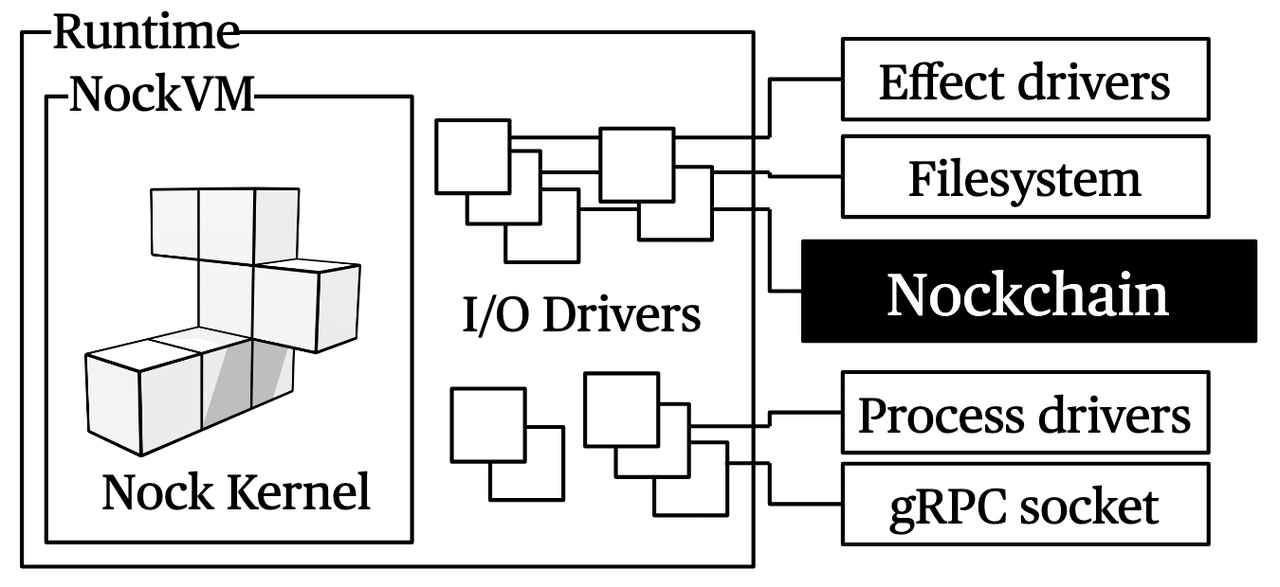
NockVM is Nockchain’s core virtual machine, designed with a focus on improving proving efficiency and verifiable execution capabilities.
NockApp is the application model that runs on Nockchain. Developers can use this architecture to build AI Agents, privacy applications, decentralized proving services, and verifiable computation applications.
Proofpower can be understood as the “effective computing power” within Nockchain. In Bitcoin, miners compete through hashpower; in Nockchain, they compete through proof generation capability.
In addition, Nockchain introduces a Global Consensus SNARKs model to reduce verification costs and improve network scalability. Compared with traditional on-chain execution, proof verification is more lightweight and better suited to AI and complex computation scenarios.
What Is the NOCK Token?
NOCK is the native asset of Nockchain. Its main uses include paying proof fees, settling network transactions, rewarding miners, and supporting the operation of on-chain applications.
In terms of its economic model, Nockchain is closer to a classic PoW network. The project emphasizes fair launch, no premine, and issuance through mining. Since network security depends on proof generation capability, the value of NOCK is also closely tied to the development of the proving economy.
How Is Nockchain Different from Bitcoin?
Although both Nockchain and Bitcoin follow the logic of PoW, their goals are fundamentally different.
Bitcoin’s core goal is to build a decentralized monetary system, and its computing power is mainly used to secure the network. Nockchain, by contrast, seeks to use computing power directly for verifiable computation and proof generation.
In the Bitcoin network, miners perform hash competition. In Nockchain, miners generate Zero-Knowledge Proofs. Bitcoin is closer to digital gold, while Nockchain is more like a Proof Network built for AI and verifiable computation.
In addition, Nockchain is a blockchain architecture with native ZK support. Its design focuses on proving efficiency, AI infrastructure, and verifiable computation, rather than smart contract scaling in the traditional sense.
What Challenges Does Nockchain Face?
Although Nockchain has a broad narrative outlook, it is still at a relatively early stage.
At present, the cost of generating Zero-Knowledge Proofs remains high, and the requirements for GPU resources and proving efficiency are also demanding. At the same time, the AI proving market has not yet fully matured, and the developer ecosystem is still in the early stages of development.
In addition, whether “Useful Proof of Work” can truly form a sustainable long-term economic loop still needs time and market validation.
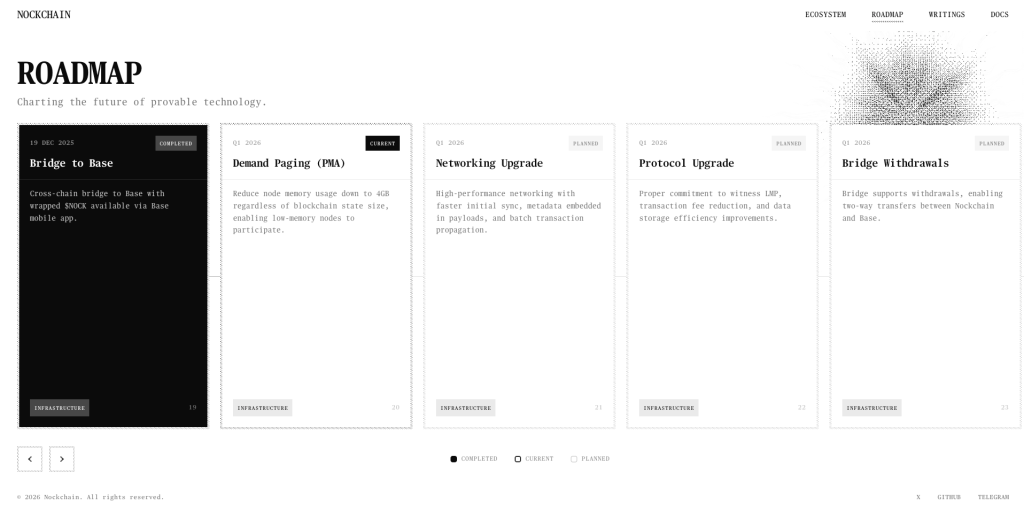
Nockchain Roadmap
Conclusion
Nockchain represents a new direction in blockchain design: upgrading traditional Proof-of-Work from meaningless hash computation into verifiable proof generation with real-world value.
Through ZK Proof-of-Work, or ZKPoW, verifiable computation, and AI proving infrastructure, Nockchain aims to build a new blockchain network for AI and privacy applications. As AI and ZK infrastructure continue to expand, Nockchain’s “Useful Proof of Work” model may become one of the important exploratory paths for future blockchain computation networks.
FAQs
What Is NOCK?
NOCK is Nockchain’s native token, used to pay proof fees, support network transactions, reward miners, and run on-chain applications.
How Is ZKPoW Different from Traditional PoW?
Traditional PoW relies on competition through hash calculations, while ZKPoW earns block rewards by generating Zero-Knowledge Proofs, allowing computing power to be used for real computational tasks.
Nockchain focuses on verifiable computation and proving infrastructure. It can be used to verify AI inference and AI Agent execution, which is why it is regarded as part of AI-native blockchain infrastructure.
Is Nockchain Layer 1?
Yes. Nockchain is essentially a Layer 1 blockchain network with ZKPoW as its core consensus mechanism.
What Is Nockchain’s Core Narrative?
Its core narrative includes Useful Proof of Work, ZK Proof-of-Work, Verifiable Computation, AI Infrastructure, Decentralized Proving Network, and Programmable Money.







