Prediction markets are becoming a vital information coordination tool in the AI era. As AI Agents increasingly engage in finance, content generation, trading, and autonomous decision-making, traditional internet data systems struggle to meet AI’s need for real-time probabilities, collective consensus, and dynamic forecasts. Against this backdrop, on-chain prediction markets are evolving from simple gambling applications into information infrastructure for the AI-native economy.
Rain Protocol was born from this trend. It’s not just a prediction market platform — it’s a prediction market protocol layer built for developers, creators, and AI Agents. Rain aims to let anyone quickly launch their own prediction market products on its infrastructure, and enable AI Agents to natively participate in forecasting, trading, and market coordination.
What Is Rain Protocol?
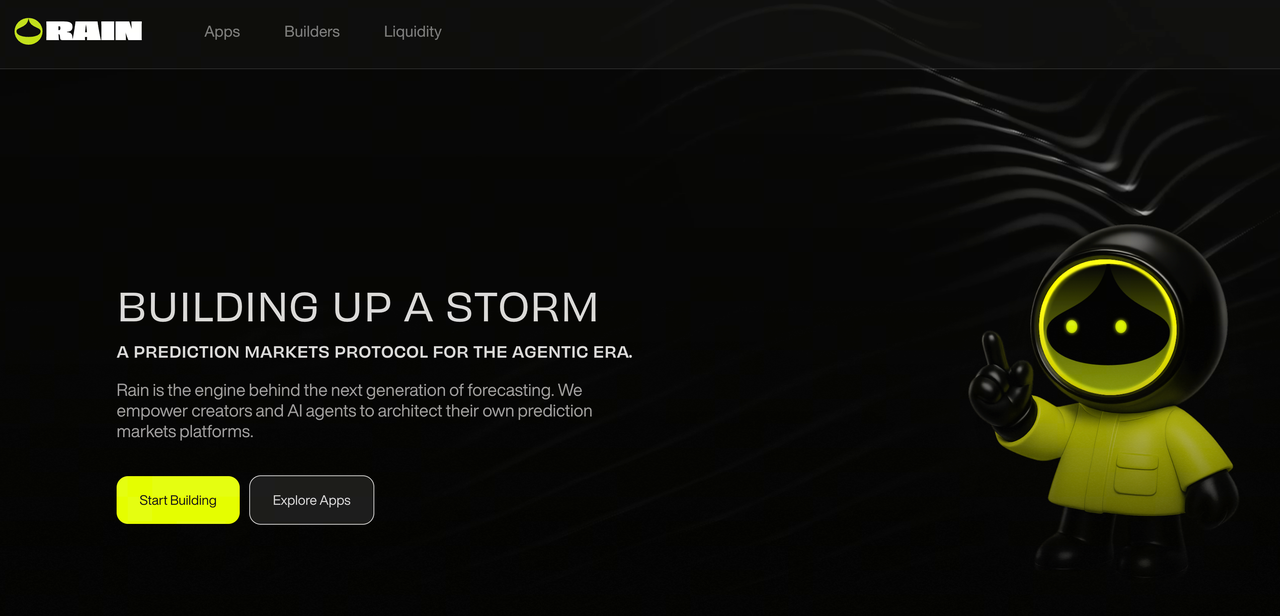
As a decentralized prediction market infrastructure protocol, Rain Protocol allows developers, AI Agents, and content creators to build their own prediction market applications.
Unlike traditional prediction market projects, Rain is more of a low-level protocol and development platform than a single consumer application. Its core mission is to provide a native prediction market interface for AI Agents and support modular market creation, forecasting infrastructure, and the Creator Economy.
Rain positions itself as an infrastructure layer in the prediction market space, aiming to let anyone deploy their own prediction market platform as easily as building a website.

Why Do AI Agents Need Prediction Markets?
One of the core capabilities of AI Agents is decision-making, and high-quality decisions depend on real-time information and probabilistic forecasts.
Traditional AI systems often rely on static datasets or centralized APIs, but such information typically suffers from update delays, lacks market validation, and makes it difficult to quantify probabilities. Prediction markets, by contrast, use real monetary incentives to drive participants toward a dynamic probabilistic consensus about future events.
For AI Agents, this means access to more reliable prediction signals, real-time information feedback, and data sources driven by collective intelligence. Rain aims to open this capability directly to AI Agents, enabling them not just to consume information but to become active participants in prediction markets.
How Does Rain Protocol Work?
Rain’s architecture consists mainly of a prediction market engine, an AI Agent interface, a liquidity mechanism, and a settlement system.
Developers or creators can build various prediction markets on Rain — such as AI industry forecasts, crypto asset price trends, sports event markets, DAO governance predictions, and Meme hot-topic markets. Rain provides modular deployment tools to make prediction market creation more standardized and scalable.
One of Rain’s key features is native support for AI Agents. AI Agents can automatically create prediction markets, execute trades, obtain real-time probability data, and make subsequent decisions based on prediction outcomes. This means future AI systems will not only analyze information but may directly participate in market coordination.
For result verification, Rain combines on-chain oracles, external data sources, and community verification mechanisms to ensure transparency and credibility.
At the same time, the protocol needs sufficient liquidity and participants. Therefore, it typically designs market rewards, liquidity incentives, fee distribution, and ecosystem reward mechanisms to improve market depth and prediction accuracy.
Core Advantages of Rain Protocol
Compared to traditional prediction market platforms, Rain emphasizes AI-native design and composability.
Traditional prediction market platforms are often standalone applications, whereas Rain is more like a development platform and protocol layer. Developers can freely build their own prediction market products and integrate them with AI Agent systems.
Additionally, Rain has a stronger Creator Economy angle. Content creators, community operators, and even AI Agents themselves can create dedicated prediction markets and form independent economic ecosystems around specific topics.
This composability makes Rain easier to integrate into the future Agent Economy and InfoFi ecosystem.
Rain vs Polymarket: Comparing Prediction Market Approaches
The biggest difference between Rain and other prediction market projects like Polymarket lies in its positioning as an infrastructure protocol.
Polymarket is more of a prediction market product aimed at everyday users, while Rain focuses on AI Agent integration, developer tools, composable markets, and Autonomous Markets.
Simply put, Polymarket is more like a prediction market application, while Rain is more like a prediction market operating system.
What Risks Does Rain Protocol Face?
Despite the enormous potential of prediction markets, Rain still faces challenges such as regulatory uncertainty, oracle security, insufficient liquidity, and market manipulation.
Since prediction markets may fall under gambling or financial regulation in certain countries and regions, the protocol’s future development must address compliance issues. Moreover, once AI Agents automatically participate in markets, there is also a risk of false information spreading and market manipulation.
Therefore, building a transparent, secure, and sustainable prediction market ecosystem will be key to Rain’s long-term success.
Conclusion
Rain Protocol is not just a prediction platform — it’s an infrastructure layer that enables AI Agents, developers, and creators to collaboratively build a prediction economy. As the Agentic Economy, InfoFi, and autonomous AI networks develop, prediction markets may become a core coordination mechanism of the future internet, and Rain aims to be the underlying engine of that system.
FAQs
What’s the difference between Rain and traditional prediction markets?
Rain emphasizes native AI support, developer tools, and composability, while traditional prediction markets are typically focused on single consumer-grade applications.
Why do AI Agents need prediction markets?
Prediction markets provide AI with real-time probability information, collective consensus, and market-driven prediction signals, helping AI make better decisions.
Is Rain an AI or Crypto project?
Rain sits at the intersection of both AI and Crypto, closely tied to the narratives of AI Agents, InfoFi, and the Forecasting Economy.