Unlike the traditional "one chain, one native asset" model, XAN's value derives from the cross-chain economic flows coordinated by Anoma. Users attach execution fees to their intents; Solvers earn fees for matching, proving, and routing; the consensus layer charges for ordering and confirmation. These value streams can theoretically be distributed across Ethereum, L2s, BNB Chain, and even Anoma's native Fractal Instances — positioning XAN more as an "operating-system-level settlement and coordination currency" than a single-chain token.
From a blockchain and digital asset industry perspective, XAN's tokenomics is a critical lever for scaling the intent-centric architecture: the allocation structure balances early support with market liquidity, the unlock schedule influences supply shocks, governance design shapes protocol evolution, and the 2.5 billion XAN Intents Initiates grant pool plus multi-season airdrops (roughly 10% of supply) directly drive developer and user growth. Below is a systematic breakdown of XAN's functions, allocation, governance, Solver incentives, value drivers, community programs, risks, and long-term potential.
Core Functions and Use Cases of XAN
According to the Anoma whitepaper and official mainnet announcements, XAN serves four core functions:
(1) Global Economic Coordination
XAN connects users, Solvers, consensus providers, and deployers. When submitting an intent, users can attach a conditional fee paid only on successful settlement; Solvers are rewarded for matching intents and generating valid state transitions (transactions); consensus nodes charge for ordering and confirmation. Each Anoma instance can independently determine fee distribution, buyback, or burn strategies.
(2) Fees and Payments
After the Phase 1 mainnet launch in September 2025, XAN is already usable for paying network activity fees. Applications like AnomaPay on BNB Chain and other networks support private payments with ETH, USDC, USDT, and XAN, with fees and settlement gradually tied to the XAN economy.
(3) Governance
Token holders lock XAN to vote on protocol upgrades. Voting weight is proportional to the amount locked, and tokens unlock after a proposal passes, incentivizing long-term alignment.
(4) Future Expansion
The team has explicitly stated that mainnet features will roll out in phases. Industry expectations include: Solver staking and slashing, Fractal Instance validator staking, cross-deployment upgrade signaling, and more. Currently, governance and payments are live; the Solver staking economy remains on the roadmap and is subject to official updates.
Unlike the NAM token on the Namada chain, XAN is exclusive to the Anoma DOS ecosystem. Both fall under the Anoma Foundation but operate on separate chains with distinct use cases, avoiding confusion.
XAN Token Allocation and Unlock Mechanism
In September 2025, the Anoma Foundation published XAN's tokenomics, with the core allocation as follows:
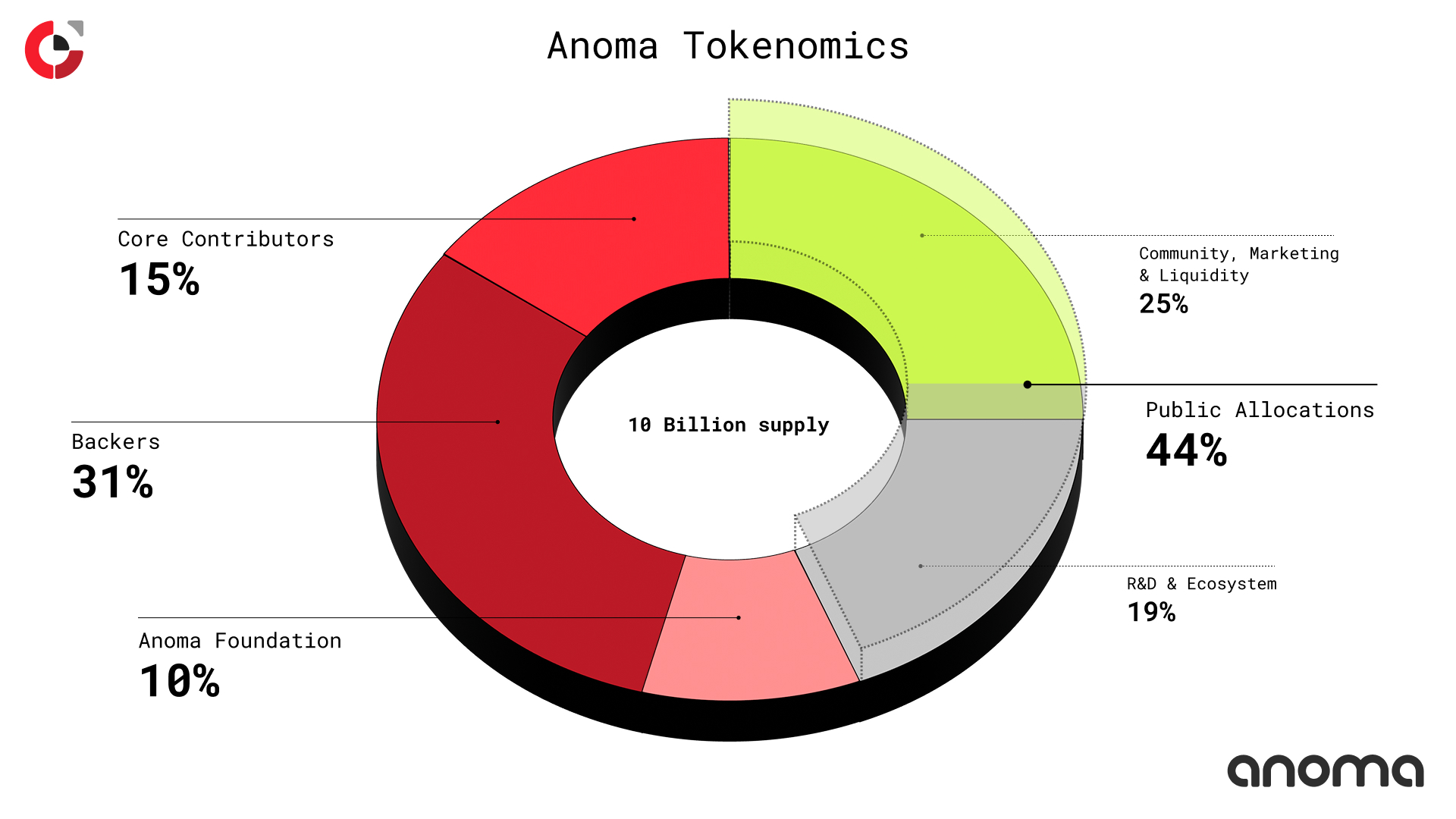
Supply Rules: Maximum total supply of 10 billion tokens with no inflationary design; initial circulating supply at launch is approximately 2 billion to 2.5 billion tokens (exact figures vary by data source; refer to on-chain data).
Unlock Rules: Except for community-related shares, tokens allocated to the foundation, R&D, investors, and core contributors are typically locked for 12 months, followed by a linear release over 36 months. This design aims to reduce sell pressure at the TGE (Token Generation Event), but the period from H2 2026 to 2027 will see a concentrated unlock phase, requiring the market to price in supply expectations in advance.
Airdrop Allocation: The team plans to allocate approximately 10% of total supply for multi-season airdrops (Season 1 has already been distributed to Kaito contributors, active Discord members, testnet participants, etc.; Season 2 expands to Shrimpers NFT holders, ongoing builders, etc.), emphasizing long-term contributions post-TGE rather than one-time farming.
XAN's Role in Governance
Anoma employs a bicameral governance system:
- Voter Body: Any XAN holder can vote by locking tokens, with weight proportional to the locked amount; they can veto proposals from the Governance Council.
- Governance Council: Initially composed of a multisig of core contributors, it can proactively propose when voter turnout is low; its proposals are also subject to community veto.
Proposals require a minimum review period of about two weeks before they can be executed. This structure balances efficiency with decentralization: it prevents protocol stagnation due to low participation while avoiding unilateral control.
Governance impacts XAN's value through decisions on Fractal Instance parameters, fee distribution, Solver incentive rules, treasury fund usage, and more — all tied to token holder interests. Some sources suggest that tokens not yet fully unlocked may also have voting rights under certain governance designs, so retail investors should monitor the actual influence of early holders and the foundation.
Participation is available through the Anoma Portal and ERC-20-compatible wallets (MetaMask, Rabby, etc.). XAN currently exists as an ERC-20 token on the Ethereum mainnet.
How XAN Drives the Solver Network and Ecosystem Incentives
Anoma's technical core is intent-centric: users declare a target state, and the Solver Network listens on the Intent Gossip layer, matches composable intents, and submits transactions to the settlement layer (via ARM deployed through Protocol Adapters).
The economic relationship between XAN and Solvers (whitepaper design + roadmap expectations):
- Intent Fees: Users embed an execution fee in their intent, paid only after the intent is satisfied and confirmed, reducing the risk of paying for failed solves.
- Solver Competition: Solvers are permissionless and can specialize in DEX matching, cross-chain bridging, ZK proofs, etc. Competition via fees and spreads drives execution quality.
- Fee Splitting: Gossip nodes and the final Solver can share the intent fee; the consensus layer charges a separate ordering fee.
- Future Staking: A Solver staking + slashing mechanism is under community discussion to deter malicious or lazy solving. Specific parameters will be announced in later mainnet phases.
As the DOS deploys Protocol Adapters on Ethereum, Base, Arbitrum, BNB Chain, Optimism, Aurora, and others, increased cross-chain intent settlement volume will directly expand the XAN fee pool and Solver revenue — this is the core fundamental driver of token demand, not just speculative narrative.
Key Factors Influencing XAN's Value
Demand Side
- Intent Settlement Volume: The more real-world scenarios (DeFi swaps, private payments via AnomaPay, institutional treasuries, AI agent payments), the stronger the fee and coordination demand.
- Deployment Breadth: Each new chain adapter extends potential economic flow to that chain's ecosystem.
- Solver Network Maturity: The number and specialization of competitors affect user experience and fee levels.
Supply Side
- Circulation and Unlocks: 31% allocated to investors and 15% to contributors will be continuously released after lockups end.
- Subsequent Airdrop Seasons: Approximately 10% of supply is released over multiple seasons; Season 2 and beyond may bring phased supply.
Valuation Metrics
- FDV = Current price × 10 billion; if circulating market cap is far below FDV, it implies a large amount of tokens have not entered the market, creating long-term dilution expectations.
- Fee Income and XAN Relationship: Needs observation to see if fees are denominated in XAN and whether buyback/burn mechanisms exist, as strategies may differ across Fractal Instances.
External Factors
- Macro liquidity, CEX listings, and market-making depth.
- Competition in the intent sector (UniswapX, CoW Protocol, Across, etc.) for standards and traffic.
Anoma's Community and Developer Incentive Model
Multi-Season Airdrops (Approx. 10% of Supply)
Season 1 rewarded Kaito ecosystem contributors, Discord "Anomages," testnet participants, etc. Season 2 focuses on post-TGE ongoing contributors, long-term Shrimpers NFT holders, application testers, etc. The phased design aims to reduce short-term speculative selling and lengthen the community alignment cycle.
Intents Initiates (formerly Builders Program)
Targets intent application and infrastructure teams, providing technical guidance, investor introductions, and a grant pool of up to 25 million XAN (token incentives, not pure cash). The first cohort selected approximately 15 projects covering areas like privacy DEXs, DeFAI, cross-chain gateways, and liquidity layers.
Application Layer Pull
- AnomaPay: A privacy stablecoin router in public beta on BNB Chain, driving tangible XAN use cases.
- Anoma App SDK: Lowers the barrier for integrating intent and privacy capabilities on chains like Base and Ethereum.
- Kaito and Other Social Mining: Multi-season continuation, linking content contributions to XAN allocations.
Together, these mechanisms form a growth flywheel: "Developers build apps → Users submit intents → Solvers solve → Fees and governance flow back to XAN." The flywheel's speed depends on the pace of mainnet feature releases, not token-focused marketing alone.
Risks to Consider When Investing in XAN
- Feature Delivery Risk: Solver staking, full Fractal mainnet, and full-chain privacy settlement are still rolling out in phases; delays or shortfalls could weaken the demand narrative.
- Unlock Sell Pressure: Institutional and team shares will be released linearly from 2026 to 2029; monitor the on-chain unlock calendar.
- Governance Centralization: The council and early holders may wield excessive influence, potentially diverging from community interests.
- Solver Market Structure Risk: Solving monopolies, MEV extraction, or opaque execution could undermine user trust.
- Regulatory Risk: Privacy payments and cross-border stablecoin routing face varying compliance requirements across jurisdictions.
- Competition and Substitution: Other intent infrastructure may capture developer and user mindshare.
- Price and Liquidity Risk: Crypto assets are highly volatile; XAN is not equity and carries no guaranteed returns.
The above is for research reference only and does not constitute investment advice.
Long-Term Development Potential of the XAN Ecosystem
If intents become the mainstream Web3 interaction paradigm, XAN has the opportunity to serve as the value anchor of the cross-chain coordination layer. The whitepaper positions it as a medium capturing all coordination value on the DOS — not a single-chain gas token. The theoretical ceiling is higher than traditional L1 native assets, but only if real economic flows reach sufficient scale.
Favorable Factors
- Multi-chain adapters are already live; applications like AnomaPay are in public beta.
- $60 million+ in funding with backing from Polychain, Electric Capital, and others.
- 25 million XAN developer grants + 10% airdrops for continuous user acquisition.
- The combination of privacy, cross-chain, and intents aligns with institutional and payment use cases.
Challenges
- Mainnet capabilities are being released in phases; short-term fundamentals may lag behind narratives.
- Long-term dilution from the gap between FDV and circulating supply.
- Requires adaptation to non-EVM ecosystems like Solana and Bitcoin to truly realize the "full-chain OS" vision.
In the long run, XAN's ability to drive ecosystem growth ultimately depends on three verifiable metrics: intent settlement volume, number of active Solvers, and application revenue based on ARM — not social media hype alone.
Summary
XAN is the linchpin of Anoma's effort to turn its intent-centric architecture into a sustainable economic system. A fixed supply of 10 billion, a long-termist allocation and unlock schedule, bicameral governance, and incentives tailored for Solvers and developers all point to a "coordination layer token" positioning. Currently, payments and governance are live, while Solver staking and the fully functional DOS are still evolving. Investors and builders should track on-chain intent volume, unlock progress, and official mainnet upgrade announcements.
For users looking to participate in the ecosystem, beyond the secondary market, more sustainable paths include: testing Anoma applications, participating in governance by locking tokens, applying for Intents Initiates, or monitoring Season 2 airdrop rules — these actions themselves serve as stress tests for XAN's long-term value.