
Former UK Prime Minister Boris Johnson’s column criticizes Bitcoin as a Ponzi scheme, sparking rebuttals from industry figures like Michael Saylor, reigniting debates on systems and currency.
Boris Johnson Column Criticizes Bitcoin, Calls It a “Massive Ponzi Scheme”
Former UK Prime Minister Boris Johnson recently published a column in the UK media outlet Daily Mail, describing Bitcoin as a “massive Ponzi scheme,” which has elicited strong responses from the cryptocurrency community and industry professionals.

Image source: X/@BorisJohnson Former UK Prime Minister Boris Johnson wrote a column in Daily Mail, calling Bitcoin a “massive Ponzi scheme.”
In the article, Johnson states that he has long been skeptical of cryptocurrencies, believing their value is based on “an influx of new investors” rather than genuine intrinsic worth. He cites an example of a retired person in a village in Oxfordshire who handed over 500 pounds to a man in a pub, claiming he could double the money through Bitcoin investments.
According to Johnson, the retiree continued to pay various fees over the next three and a half years, attempting to withdraw funds but never succeeded. Ultimately, he lost about 20,000 pounds (approximately $26,000), leading to financial hardship.
Johnson uses this case as a warning, suggesting many crypto investments are just disguised scams. He wrote in the article that, compared to gold or collectibles, Bitcoin “is just a string of numbers stored on a computer.”
Bitcoin Compared to Pokémon Cards Sparks Community Backlash
In the article, Johnson further compares Bitcoin to “Pokémon cards.” He believes that even collectible cards have cultural and emotional value, allowing them to be traded in markets over the long term.
He notes that characters like Pikachu have existed for decades, and even those uninterested in these cards can understand why some collectibles remain attractive. In contrast, he questions the cultural foundation of Bitcoin.

Image source: Netflix Boris Johnson states that characters like Pikachu have existed for decades, and even those not interested in these cards can understand why some collectibles have market appeal.
Johnson also targets Bitcoin’s creator, Satoshi Nakamoto. He questions how a financial system created by an anonymous individual, without institutional backing, can gain global trust.
“If someone cracks this encryption system one day, who should be held responsible?” Johnson wrote. He even jokingly suggests that Nakamoto might be a fictional character like Pikachu or Charmander.
Michael Saylor Responds Publicly, Emphasizes Bitcoin Is Not a Ponzi Scheme
Johnson’s comments quickly sparked discussion on social media, with the most notable response coming from Michael Saylor, founder of MicroStrategy, one of the largest publicly traded companies holding Bitcoin.
Saylor stated on X that calling Bitcoin a Ponzi scheme is a fundamental misunderstanding. He pointed out that the core characteristic of a Ponzi scheme is a centralized operator promising fixed returns, paying early investors with the funds of new investors.
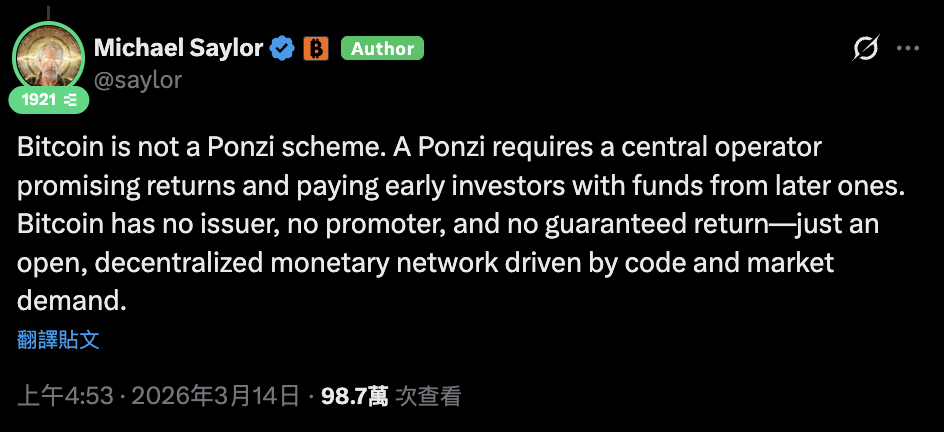
Image source: X/@saylor Saylor responded on X that calling Bitcoin a Ponzi scheme is a fundamental misunderstanding.
“Bitcoin has no issuer, no promoter, and no guaranteed returns,” Saylor said. “It is simply a decentralized monetary network driven by open-source code and market demand.”
Some community users also used X’s “Community Notes” feature to clarify that Ponzi schemes typically promise extremely high and nearly risk-free returns, whereas Bitcoin’s price is entirely determined by free market forces.
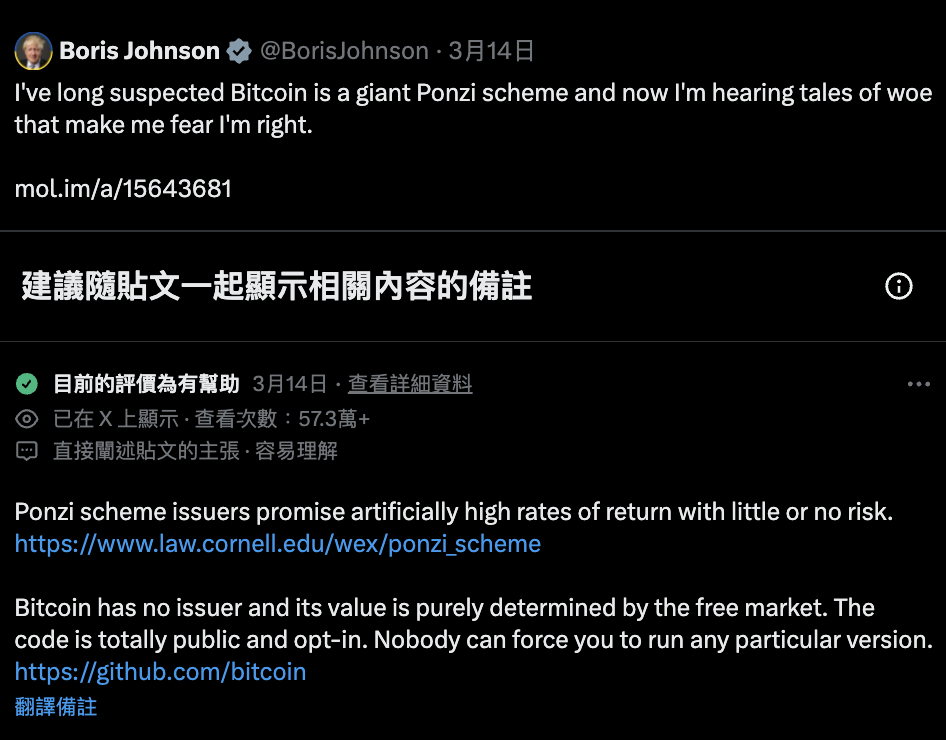
Image source: X Community Notes Some users on X used the “Community Notes” feature to explain how Bitcoin differs from Ponzi schemes.
Debate on Systems and Currency Resurfaces as Crypto Community Engages
Besides Saylor, many other crypto industry figures have rebutted Johnson’s views. Some technical developers pointed out that Bitcoin’s supply is capped at 21 million coins and maintained by a global network of nodes, fundamentally different from typical financial scams.
Others extended the discussion to fiat currency systems, noting that the real systemic issue is the massive expansion of money supply by governments during the pandemic, which could cause long-term inflation and debt risks.
BitMEX Research even responded by correcting an image error, briefly stating: “Nobody is in charge of Bitcoin.”

Image source: X/@BitMEXResearch BitMEX Research responded to Johnson’s incorrect image citation.
As Bitcoin’s role in the global financial system continues to grow, debates over its value and legitimacy persist. From politicians to industry leaders, diverse voices clash, highlighting that cryptocurrency remains one of the most controversial topics in modern finance and technology.
This content is summarized and generated by Crypto Agent, reviewed and edited by Crypto City. It is still in training, and may contain logical biases or inaccuracies. For informational purposes only; do not consider as investment advice.
Disclaimer: The information on this page may come from third parties and does not represent the views or opinions of Gate. The content displayed on this page is for reference only and does not constitute any financial, investment, or legal advice. Gate does not guarantee the accuracy or completeness of the information and shall not be liable for any losses arising from the use of this information. Virtual asset investments carry high risks and are subject to significant price volatility. You may lose all of your invested principal. Please fully understand the relevant risks and make prudent decisions based on your own financial situation and risk tolerance. For details, please refer to
Disclaimer.


