
The Financial Supervisory Commission plans to authorize regulations under the Financial Consumer Protection Act to oversee behaviors such as bringing orders and KOL recruitment in the crypto space, closing regulatory gaps and strengthening investor protection mechanisms.
Eliminating chaos in order placement, the FSC intends to use subsidiary regulations under the Financial Consumer Protection Act to enhance supervision
As cryptocurrency investment enthusiasm continues to rise in Taiwan, a large number of so-called “crypto teachers” acting as KOLs have emerged in the market. They build order-placing groups on social media platforms to provide teaching, shouting, or investment advice. These “pump-and-dump” activities influence market prices and mislead investors, drawing high regulatory attention.
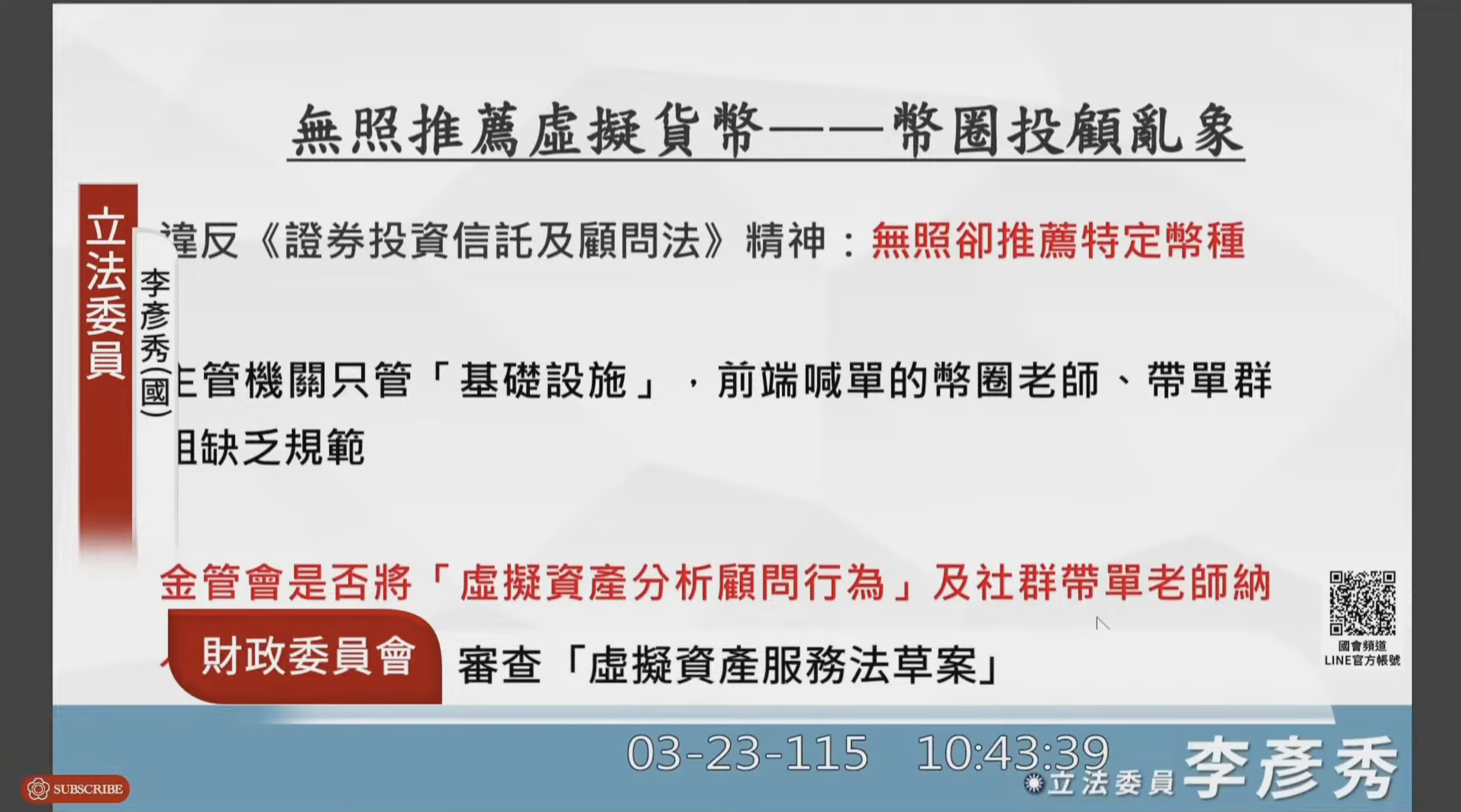
Image source: Legislative Yuan. KMT legislator Li Yanshou calls for clear regulation of crypto KOLs amid chaos
Recently, during a financial committee inquiry, KMT legislator Li Yanshou pointed out that although current regulations prohibit activities aimed at influencing prices, the market is flooded with behaviors that essentially provide investment advice. He urged the FSC to clarify regulation. FSC Chair Peng Jinlong responded that, in the future, they plan to regulate activities such as advertising, recruitment, and promotion conducted by KOLs in the financial services industry through subsidiary regulations authorized by the Financial Consumer Protection Act, aiming to establish an orderly virtual asset market.
Peng Jinlong emphasized that similar behaviors are already regulated in traditional financial markets, and influencers promoting financial products must adhere to specific restrictions. Currently, the focus of regulation is on bringing virtual asset analysis and advisory activities into the scope of management to ensure investors receive adequate protection when accessing information.
According to the FSC’s plan, future measures will reference self-regulatory mechanisms in traditional financial markets for fund and advisory firms collaborating with online influencers. It may require virtual asset service providers (VASPs) and KOLs to sign formal cooperation agreements and incorporate them into internal control systems. This means that in the future, crypto teachers who want to publicly promote or offer order-placing services must operate within a compliant framework, avoiding continued regulatory vacuum.
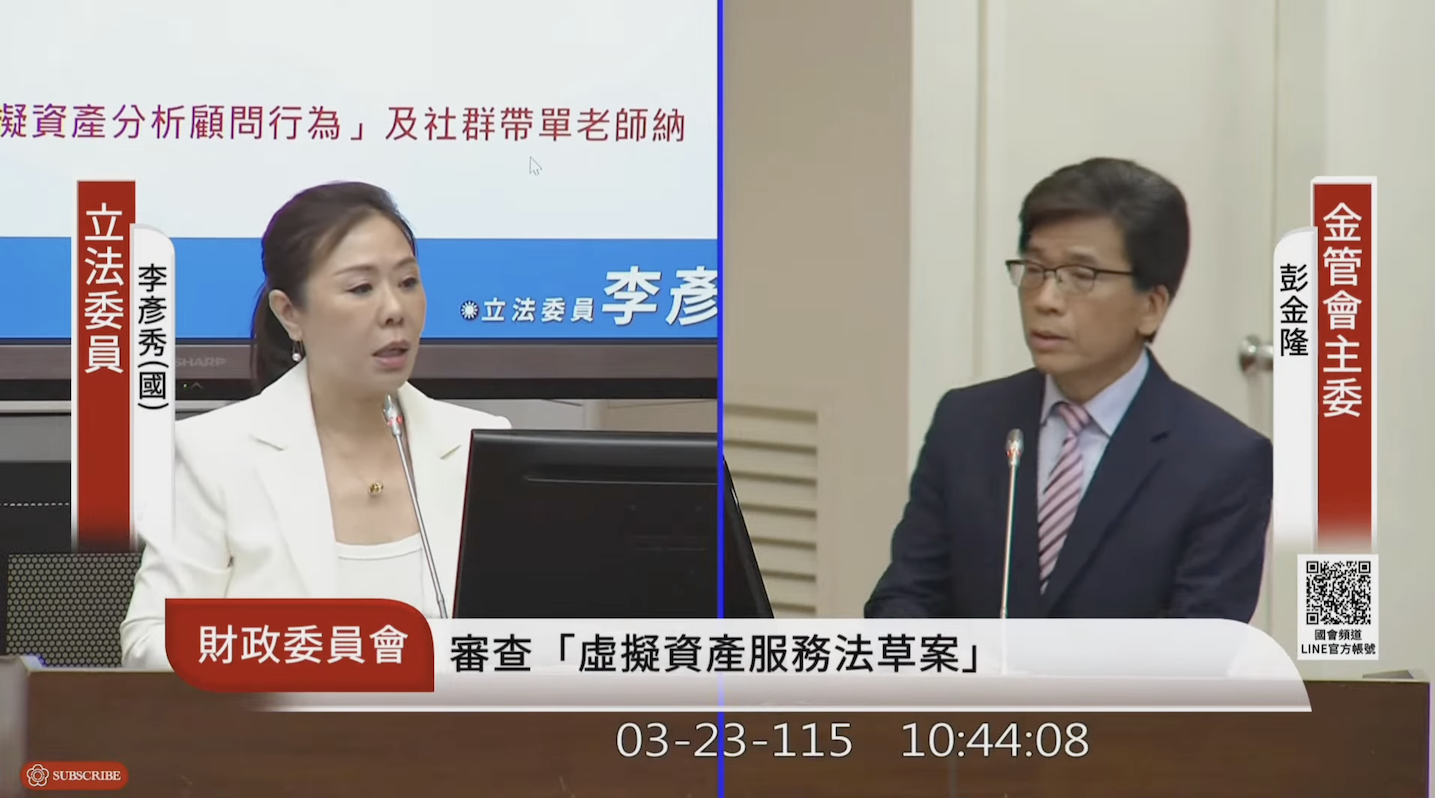
Image source: Legislative Yuan. Peng Jinlong emphasizes that similar behaviors are regulated in traditional financial markets, and influencer promotion of financial products must adhere to specific restrictions
Where is the red line? Risks of illegal recruitment seen in cases like Crypto Hu Shi and BitMart
Recent cases have clarified the regulatory boundaries. Previously, well-known crypto influencer “Crypto Hu Shi” and his company Yang Ji Co., Ltd., were warned by the Securities and Futures Institute for not registering under the Anti-Money Laundering Law for Virtual Asset Service Providers and not declaring compliance with AML regulations to the FSC.
This notice explicitly prohibits their activities related to virtual currency recruitment, marking the first time a KOL has been officially named since the implementation of the virtual asset registration system. Although Crypto Hu Shi responded that the industry association has no legal authority, FSC legal personnel pointed out that operators who have not registered but engage in platform business activities, including recruitment, are already approaching legal boundaries. When such activities are viewed as extensions of exchange operations, the risk of illegality is high.
Further reading
Trouble for Taiwan’s crypto KOLs? Crypto Hu Shi warned for illegal recruitment; lawyers suggest two ways to avoid crossing the line
Another notable case involves the offshore exchange BitMart. The FSC’s Securities and Futures Bureau officially designated the platform as an unapproved operator, specifically mentioning certain KOLs recruiting “order-placing teams” on the Threads social platform, requiring participants to use designated invitation codes to register. The bureau clearly stated that BitMart has not completed AML registration and is prohibited from providing services or advertising recruitment within Taiwan.
Further reading
BitMart exchange named! KOL recruitment groups posting invitation codes, FSC warns the public to be cautious
The FSC reminds the public to refuse unapproved offshore platforms and avoid transferring funds to related accounts. These cases reflect that whether individual KOLs or offshore exchanges, any illegal recruitment targeting Taiwanese citizens will face public censure, warnings, and potentially criminal investigations.
Unveiling the fake performance generator—investors should beware of false results and investment traps
When the market is bullish, scammers often exploit investors’ FOMO (Fear of Missing Out) by using sophisticated tools to create illusions. The crypto scene has popularized a “report screenshot generator” that, with input of coin type, leverage, opening price, and name, can produce seemingly impressive profit statements with a single click. These “fake teachers” typically create groups on Facebook, Instagram, LINE, or Telegram, using fake accounts and conversations to foster an atmosphere of earning big with their guidance. Their tactics often start with free trial trades, allowing investors to make small profits and build trust, then demanding additional deposits into fake wallets or unknown exchanges. Once funds are transferred, the teachers and groups vanish overnight, leaving investors with losses.
Beyond technical fakes, these pump-and-dump groups often promote so-called “arbitrage formulas” or “professional training” to attract followers. For example, some KOLs on Threads claim that with just 1,000 USDT, they can generate hundreds of thousands of USDT in trading volume, emphasizing that all techniques are taught by the teacher and students can copy them. However, such exaggerated profit guarantees and requirements for using specific offshore platform invitation codes pose significant compliance and safety risks. The FSC and police repeatedly remind that crypto investments should not rely blindly on word-of-mouth groups. Any “teacher” asking for private transfers or guiding to unregulated platforms is highly risky. Genuine market participants should develop independent risk awareness rather than be blinded by fake profit screenshots.
Read more about “crypto chaos” news
Deposit interactions with Border Law? Star Vaults exchange suspected of multiple issues, recruiting in Taiwan without VASP listing
Not recognizing me? Idol worship, kneeling culture—how the crypto scene has become a traffic scam
Report screenshot generators emerge! Crypto chaos: everyone is a pump-and-dump teacher, scamming you into fake investment groups
Regulatory implementation and practical challenges—VASP-specific laws and self-regulation mechanisms as future key points
Currently, Taiwan’s regulation of crypto KOLs is at a critical turning point. The version proposed by the Taiwan People’s Party explicitly recommends regulating key opinion leaders, requiring VASPs to disclose company names and licenses in advertising and marketing, prohibiting false or misleading promotions, and setting qualification criteria for KOLs.
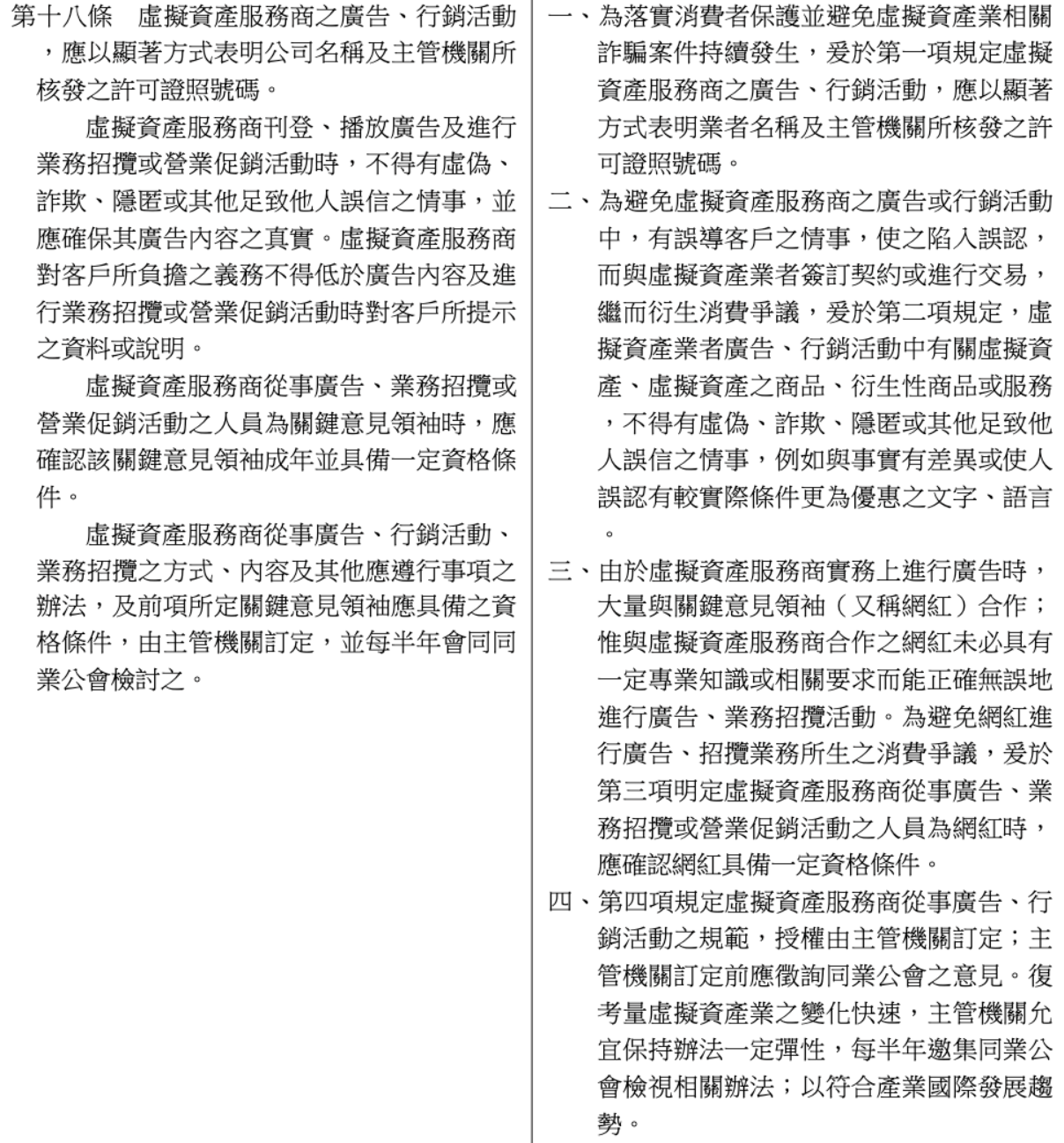
Image source: Legislative Yuan. The Taiwan People’s Party version of the “Virtual Asset Service Law Draft” requires VASPs to disclose company name and license information in advertising, prohibiting false or misleading promotions
However, industry insiders admit that requiring all KOLs to hold specific financial qualifications is highly difficult. Therefore, a compromise approach is leaning toward a model similar to the fund and advisory industry associations, where operators conduct regular reviews and compliance controls over collaborating influencers through contractual obligations to enforce supervision.
This crackdown on “crypto teachers” is part of the overall process of Taiwan’s draft Virtual Asset Service Law. As the VASP registration system is gradually implemented, regulations on order-placing activities will fill a crucial gap in the supervisory framework.
Currently, only the following VASP providers are registered domestically, listed in order of strokes:
- Hoya Digital Technology (HOYA BIT)
- TuoHuang Digital Technology (ZONE Wallet)
- Modern Wealth Technology (MaiCoin, MAX Exchange)
- Zhongliang Technology (KryptoGO)
- Fusheng Digital Technology (TWEX)
- Cross-Chain Technology (Chainss)
- BitoTech (BitoPro)
- LianKe Co., Ltd. (XREX Exchange)
FSC Chair Peng Jinlong stated that the government’s draft law will be prioritized, with guidelines for custody to be established within six months. In the future, investors should prioritize using legally registered platforms and remain cautious of any unlicensed recruitment activities to protect their rights.


