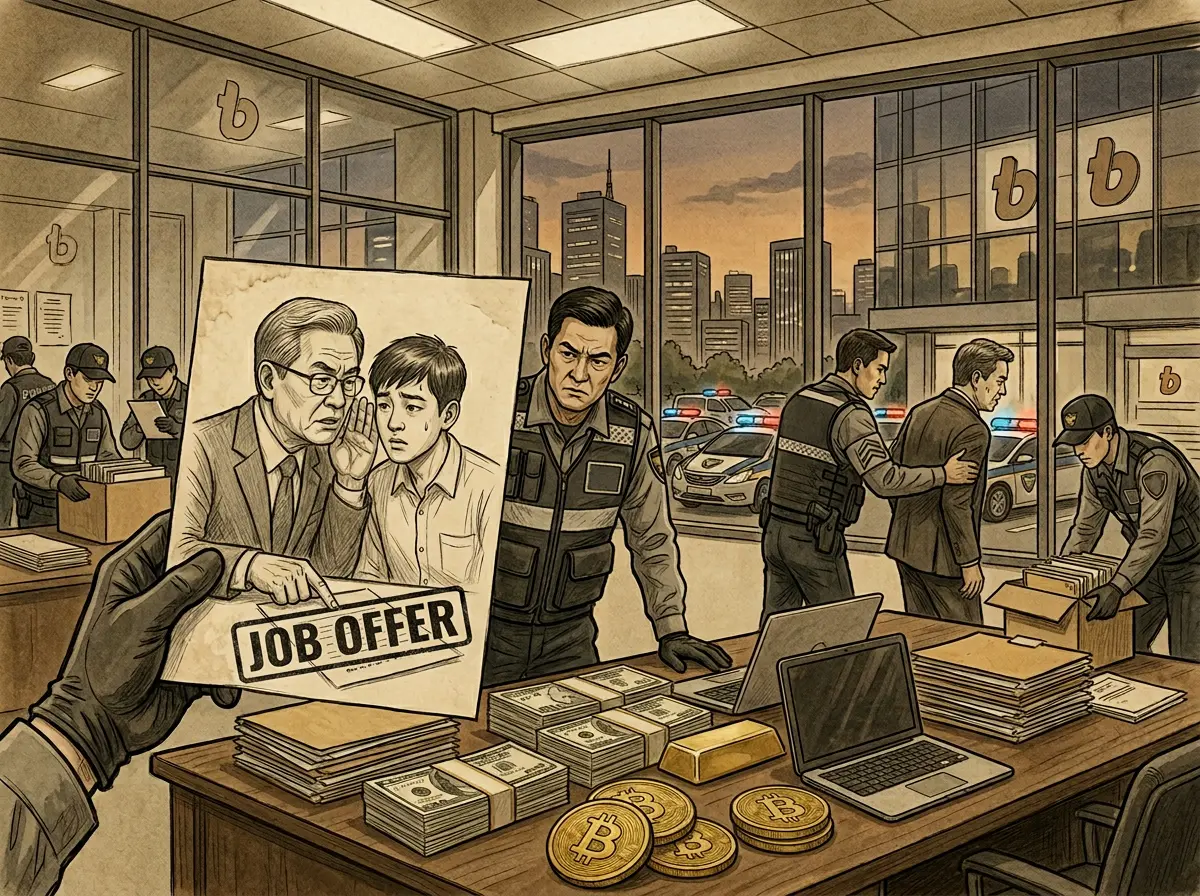
According to a report by Korean media outlet News1 on June 8, Korean police have launched a search and seizure operation targeting Bithumb, one of the country’s major cryptocurrency exchanges, investigating a case involving nonpartisan National Assembly member Kim Byung-ki, who is suspected of using political influence to secure jobs for his son at multiple cryptocurrency companies. Kim Byung-ki’s son began working at Bithumb in January 2025 and served for about six months.
Allegations Involving Kim Byung-ki and Investigation Updates
Based on the confirmed timelines reported by Korean media outlet News1 and others, the key events are as follows:
In February 2026, police summoned executives from multiple cryptocurrency exchanges as witnesses;
In March 2026, police conducted separate search and seizure operations at Bithumb’s headquarters and at Bithumb Financial Tower;
In April 2026, investigators continued interviewing relevant individuals, and Kim Byung-ki made his sixth appearance for questioning;
Recently, Korean media revealed that Kim Byung-ki repeatedly questioned executives of Dunamu during meetings of the National Assembly’s Special Committee on Public Affairs, raising doubts about whether he was using committee questioning to shield the party under investigation. Police have not yet announced whether there will be further summons.
Bithumb’s 2026 AML Fine: Confirmed Regulatory Sanctions
According to an official enforcement action by South Korea’s financial regulators, in March 2026 Bithumb received a fine of $24.5 million (some sources reportedly translate it to about 33.5 billion KRW) and a sanction of a six-month suspension of some business operations. The reason was that a 2025 regulatory inspection found major deficiencies in KYC (Know Your Customer) and AML (anti-money laundering) procedures. Specific restrictions included pausing new user registrations. After Bithumb filed for legal relief, a South Korean court in late April 2026 temporarily suspended the enforcement of the shutdown order, pending the outcome of the lawsuit.
Frequently Asked Questions
How did Kim Byung-ki’s role in the National Assembly Special Committee on Public Affairs raise conflict-of-interest concerns?
South Korea’s National Assembly Special Committee on Public Affairs directly oversees financial regulatory agencies, serving as a key committee that formulates and reviews financial regulatory policies. Kim Byung-ki also serves as a member of the Special Committee on Public Affairs, while his son previously worked at a crypto exchange that is under regulation by financial regulatory agencies—creating a dual identity involving both a regulator and an interested party tied to the regulated company. Korean media further noted that during committee questioning, Kim Byung-ki repeatedly asked Dunamu questions, sparking shielding allegations. Investigators are still confirming whether any specific exchange of interests occurred.
What is the current execution status of Bithumb’s AML fine?
Based on the confirmed legal process, in March 2026 South Korea’s financial regulators issued sanctions including a $24.5 million fine and a six-month suspension of part of the business operations. After Bithumb sought legal relief, in late April 2026 a South Korean court temporarily suspended the enforcement of the shutdown order while waiting for the subsequent lawsuit outcome. As of the time of the report, the execution status of the fine portion and the final lawsuit result had not been determined.
How could amendments to South Korea’s “Act on the Protection of Virtual Asset Users” affect compliance requirements for exchanges such as Bithumb?
According to existing reporting, South Korea’s National Assembly is considering amendments to the “Act on the Protection of Virtual Asset Users,” which may further require exchanges to assume unconditional liability for compensating users for losses. Under existing regulations in effect since 2024, since the five major exchanges implemented the rules over the past six years, there have been 57 incidents and compensation amounts totaling 7 billion KRW. As of the time of the report, the final amendment wording and the passage timeline were not yet confirmed.


