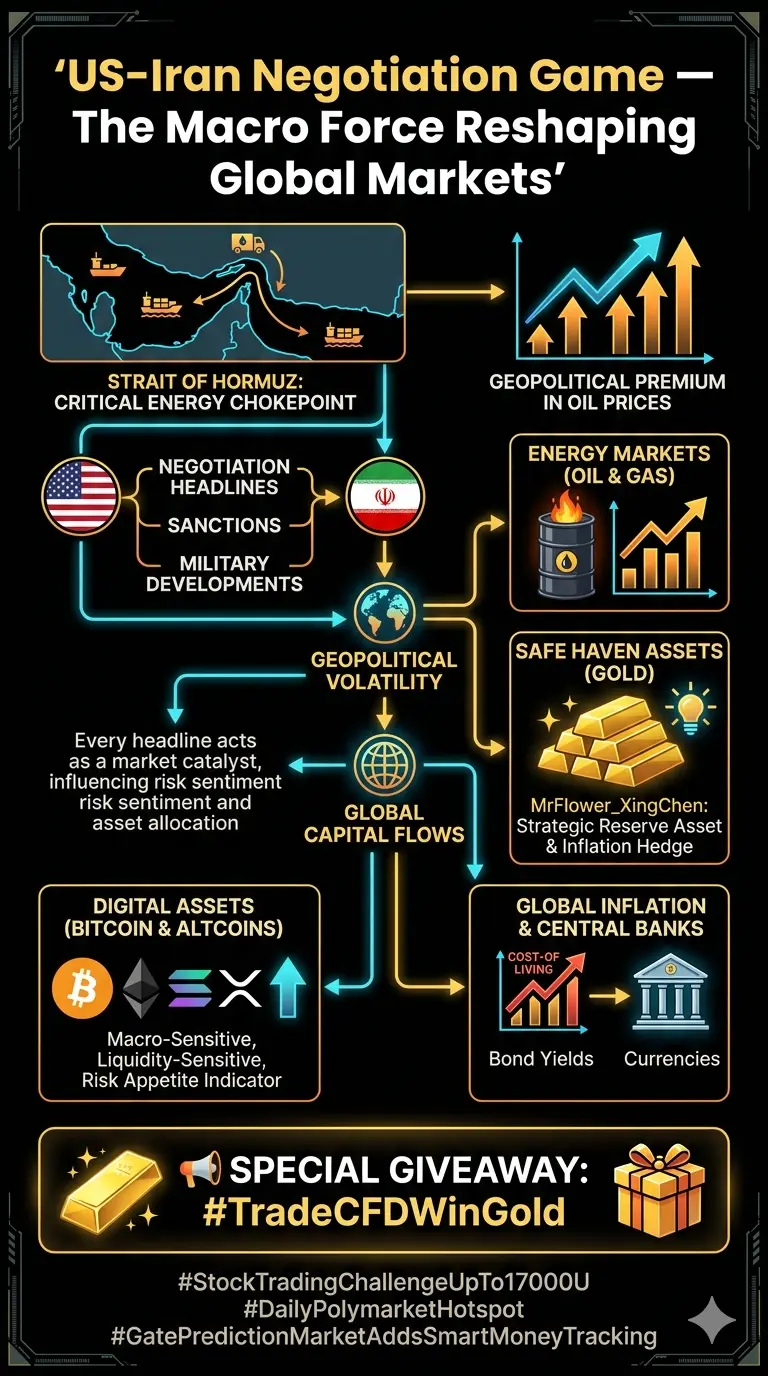
#USIranNegotiationGame The US–Iran Negotiation Game has evolved into one of the most dominant macro forces shaping global financial markets in 2026, and it now functions not as a conventional diplomatic dispute but as a continuous geopolitical pricing engine that directly transmits risk into oil, gold, Bitcoin, equities, and currency markets, where every statement, every sanction update, every military escalation, and every diplomatic negotiation cycle is instantly interpreted by global traders as a signal for capital reallocation across risk and safe-haven assets.
This environment has created a world where markets no longer move purely on earnings, monetary policy, or traditional supply-demand fundamentals, but instead operate under a geopolitical volatility regime where headlines define short-term direction and macro positioning defines long-term structure.
Core Geopolitical Structure of the US–Iran Conflict
The confrontation between the United States and Iran is built on a multi-layered strategic framework where economic pressure, military signaling, and regional influence all operate simultaneously.
The United States continues to apply pressure through sanctions targeting Iran’s oil exports, shipping logistics, banking systems, and international financial access, effectively restricting Iran’s ability to integrate into the global financial system.
Iran, in response, continues to maintain strategic leverage through nuclear enrichment programs, proxy networks across the Middle East, and its critical geographic control over energy transportation routes, especially the Strait of Hormuz, which remains one of the most important global chokepoints for oil and LNG flows.
This creates a self-reinforcing cycle where escalation leads to sanctions, sanctions lead to counter-moves, and counter-moves feed back into global market volatility.
Strait of Hormuz: The Global Energy Pressure Valve
The Strait of Hormuz has become the single most important geopolitical asset in global energy markets because nearly one-fifth of global oil supply passes through this narrow maritime corridor.
Even partial disruption or increased military tension in this region immediately results in:
Higher shipping insurance premiums
Slower tanker movement and rerouting delays
Reduced effective global supply availability
Immediate repricing of crude oil futures
This is why oil markets now price not only actual supply but also probability of disruption, creating a permanent geopolitical risk premium embedded into global energy prices.
Global Oil Market Structure and Current Pricing Reality
As of current market conditions:
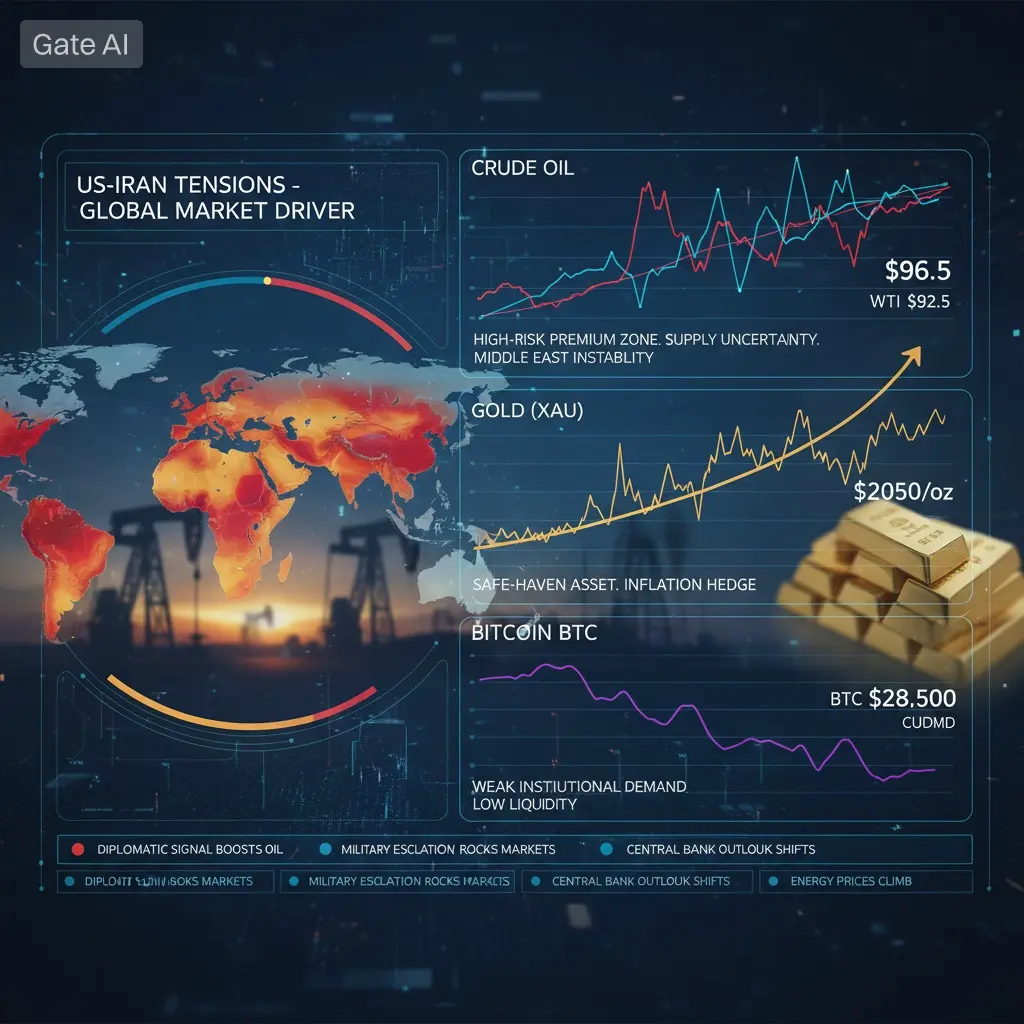
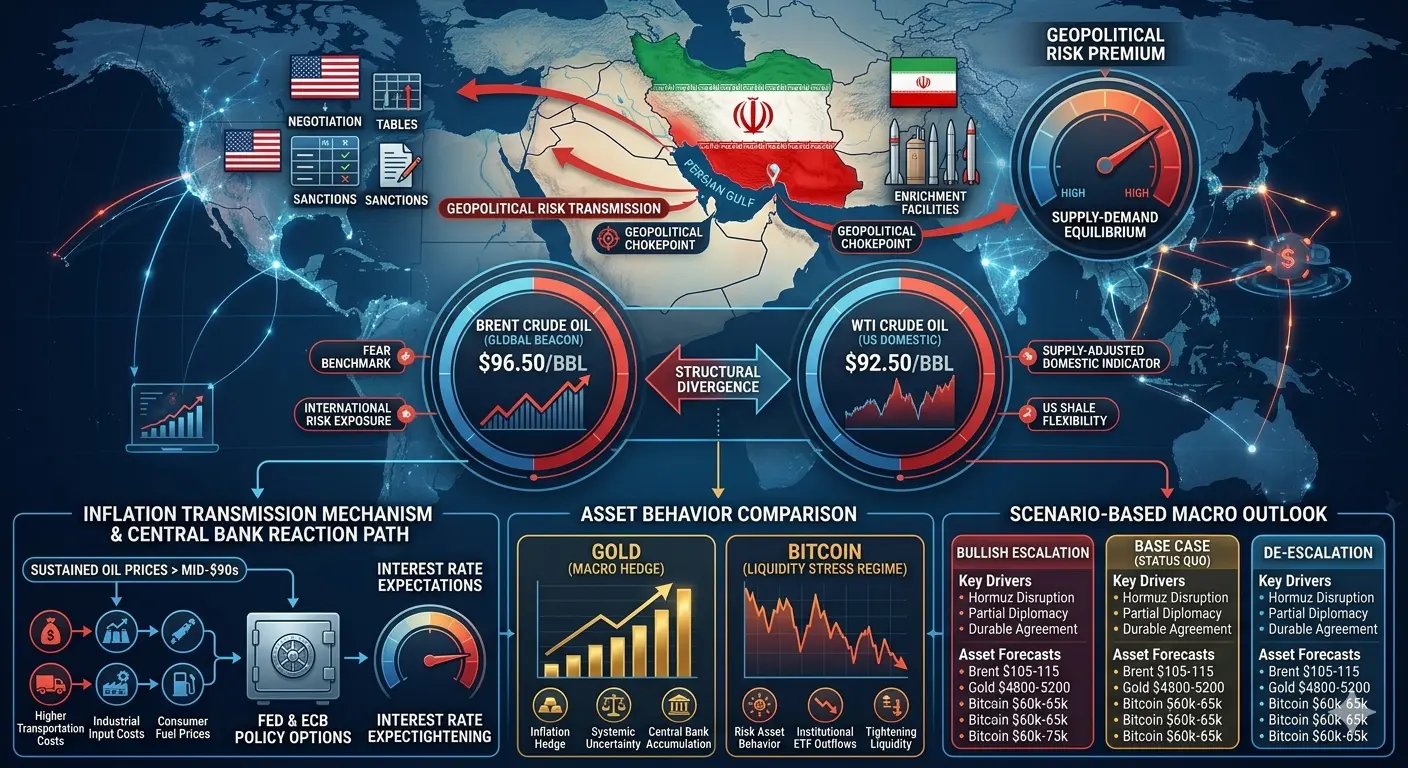
Brent crude oil is trading near $96.5 per barrel
WTI crude oil is trading near $92.5 per barrel
These levels confirm that oil is no longer in a neutral supply-demand environment but instead operating in a geopolitically distorted pricing regime where risk premiums dominate price discovery.
Oil has effectively transitioned from a commodity into a hybrid geopolitical asset where military developments, sanctions updates, and diplomatic negotiations matter more than production changes in determining short-term price direction.
The Brent-WTI spread continues to reflect global risk segmentation, where Brent carries the full geopolitical premium while WTI remains partially supported by domestic US production resilience.
Oil Market Forecast Framework
The oil market is currently structured around three major scenarios:
In a bullish escalation scenario where geopolitical tensions intensify further or the Strait of Hormuz faces additional disruption, Brent crude could move toward $105 to $115, while WTI could trade above $100 to $105, reflecting extreme supply risk repricing.
In a base case scenario where tensions remain elevated but partially contained through intermittent diplomatic engagement, Brent is expected to remain within $92 to $100, while WTI stays within $88 to $95, maintaining a high-volatility equilibrium range.
In a de-escalation scenario where diplomatic progress leads to gradual normalization of maritime flows, Brent could retreat toward $80 to $85, while WTI could stabilize near $78 to $84, reflecting partial removal of geopolitical risk premium.
Inflation Transmission and Global Monetary Policy Impact
Oil at elevated levels directly feeds into global inflation dynamics because energy costs sit at the foundation of transportation, logistics, industrial production, and consumer pricing structures.
When Brent remains near $96.5, the impact is transmitted across multiple channels:
Higher gasoline prices in global consumer markets
Rising diesel costs impacting freight and logistics networks
Increased airline fuel expenses affecting travel costs
Elevated petrochemical input costs impacting manufacturing
This creates a secondary inflation wave that central banks must respond to even if core inflation metrics appear stable in the short term.
As a result, oil has become a direct input variable in monetary policy forecasting, where every sustained movement in crude prices forces revisions in CPI expectations, bond yields, and currency valuation models.
Gold Market: Structural Safe-Haven Accumulation
Gold continues to function as the primary global hedge against both inflation persistence and geopolitical instability.
With oil trading near elevated levels, gold benefits from dual macro support:
Inflation protection demand
Geopolitical uncertainty premium
Central bank diversification flows
Weak real yield environment support
Gold remains structurally elevated in this cycle because global markets are simultaneously facing multiple risk layers rather than a single isolated shock.
Current gold levels near $4,530 per ounce reflect this sustained demand, and price action continues to show accumulation behavior during uncertainty spikes.
Forecast ranges remain broad, with bullish escalation scenarios pushing toward $4,900 to $5,050, while de-escalation phases could temporarily pull prices back toward $4,300 to $4,400, although long-term structural demand remains intact.
Bitcoin Market: Liquidity-Driven Macro Asset
Bitcoin continues to trade as a macro-sensitive digital asset that reacts primarily to liquidity cycles, institutional flows, and risk sentiment rather than purely acting as an inflation hedge.
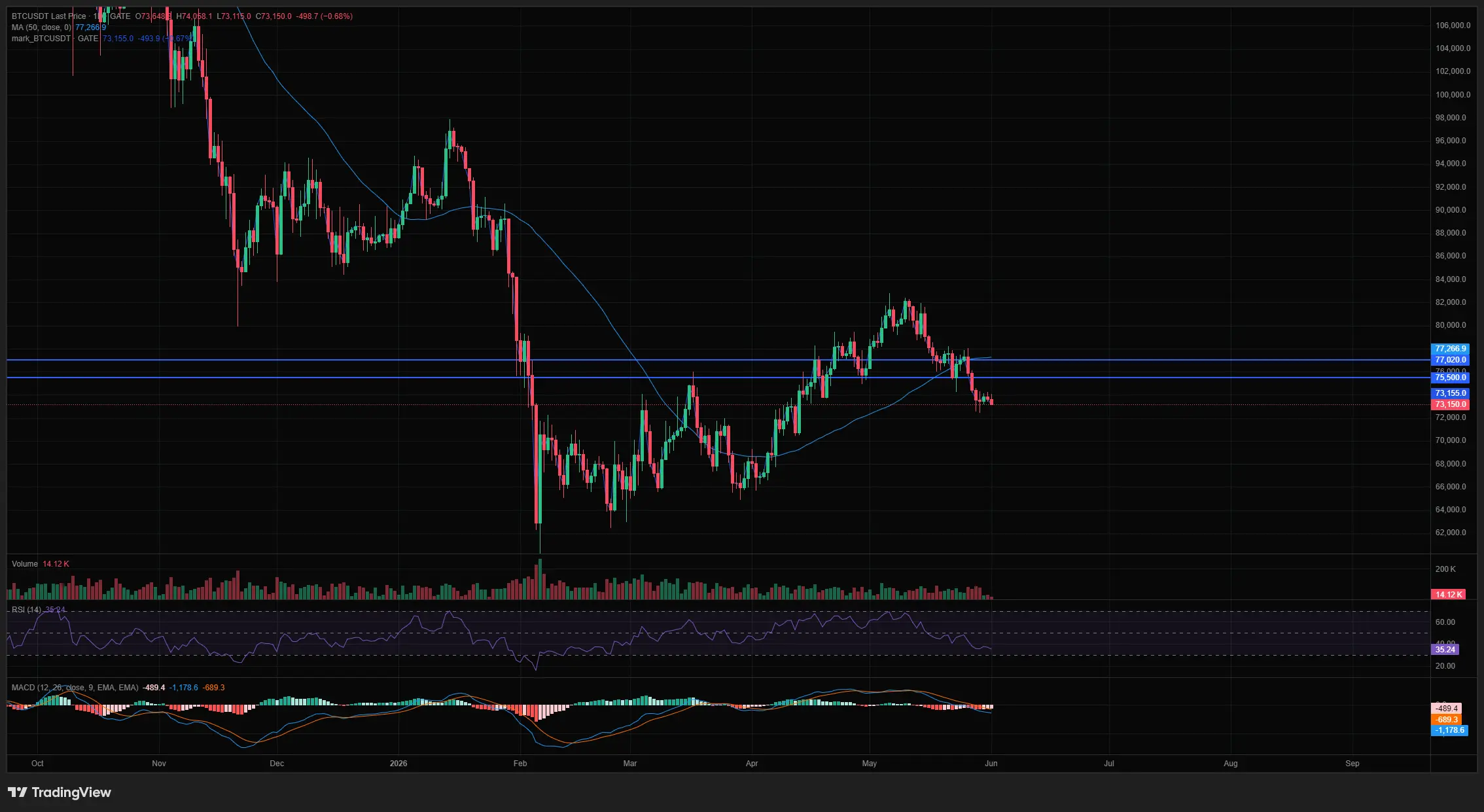
Current Bitcoin price stands near $74,030, reflecting a market caught between competing macro forces.
On one side, geopolitical uncertainty increases demand for alternative assets outside traditional financial systems, while on the other side, institutional ETF outflows, miner selling pressure, and tightening liquidity conditions continue to suppress sustained upward momentum.
Bitcoin is currently oscillating within a structural range where macro uncertainty prevents breakout momentum while also preventing deep structural collapse due to long-term institutional adoption trends.
Ethereum, XRP, and Solana: High-Beta Macro Instruments
Ethereum at $2,080, XRP at $1.34, and Solana near $82.5 are all functioning as higher-beta extensions of Bitcoin’s macro behavior.
Ethereum reflects liquidity cycles and ecosystem activity, while Solana and XRP react more aggressively to speculative sentiment shifts.
These assets tend to amplify Bitcoin’s direction rather than lead independent cycles, making them highly sensitive to geopolitical headlines and macro liquidity changes.
Interconnected Global Market System
The most important structural feature of 2026 markets is that all major asset classes are now deeply interconnected under the US–Iran geopolitical framework.
Rising oil leads to inflation expectations, which supports gold and sometimes Bitcoin under hedging narratives, while simultaneously pressuring equities and tightening monetary policy expectations.
Falling oil supports risk-on sentiment, strengthens the US dollar, and temporarily reduces demand for safe-haven assets.
Escalation events trigger immediate capital rotation into gold and crypto, while diplomatic breakthroughs temporarily reverse hedging flows.
This creates a synchronized macro system where no asset class moves independently anymore.
Crypto Market Under Geopolitical Pressure
Cryptocurrencies have effectively become real-time geopolitical sentiment indicators.
During escalation phases, Bitcoin and major altcoins experience inflows as investors seek alternative stores of value, while during diplomatic stabilization phases, capital rotates back into equities and fiat liquidity systems.
Stablecoins also see increased demand during periods of uncertainty as traders seek dollar exposure outside traditional banking channels.
Ethereum, Solana, and XRP continue to follow Bitcoin’s macro direction but with amplified volatility due to lower liquidity depth and higher speculative exposure.
Macro Trading Strategy Environment
The current environment is a high-volatility macro trading regime where headlines dominate technical structure.
Bitcoin strategy revolves around buying deep dips near structural support zones and reducing exposure during euphoric spikes near resistance levels.
Ethereum remains range-bound and should be accumulated on macro dips while avoiding excessive leverage due to unpredictable geopolitical volatility.
Oil remains the most reactive instrument, where geopolitical news drives sharp intraday swings, making breakout and reversal trading strategies more effective than long-term positioning.
Gold continues to function as the primary hedge asset, with accumulation favored during dips and profit-taking occurring during extreme spikes.
Global Supply Chain and Hidden Inflation Layer
Beyond financial markets, real-world supply chains are experiencing structural stress due to shipping disruptions, rerouting costs, insurance premiums, and logistical inefficiencies.
Trade routes through the Middle East remain partially constrained, Asia-Europe freight costs remain elevated, and alternative transport corridors are being utilized more frequently at higher cost.
This creates a hidden inflation layer that is not always visible in headline economic data but significantly impacts global production and pricing structures.
Structural Outlook for Q3 2026
The global macro outlook remains dominated by uncertainty and geopolitical sensitivity.
Markets are not trending in a traditional sense but are instead oscillating between fear and relief cycles driven by geopolitical developments.
Bitcoin is expected to remain within a broad structural range, Ethereum within a volatility band, oil within a high-risk geopolitical corridor, and gold at elevated structural levels.
Until a durable US–Iran resolution is achieved, global markets will continue operating under a regime of elevated volatility where geopolitical risk is the primary pricing mechanism across all major asset classes.
Final Macro Interpretation
The US–Iran Negotiation Game has transformed into a full-scale global macro control system where oil acts as the central transmission channel, gold functions as the systemic hedge anchor, and Bitcoin operates as the liquidity-sensitive risk indicator.
At Brent $96.5, WTI $92.5, Bitcoin near $74,030, Ethereum around $2,080, and gold at $4,530, global markets are clearly signaling a world defined not by stability but by persistent uncertainty and continuous repricing.
Until geopolitical conditions stabilize, markets will remain in a high-volatility macro regime where every headline has the power to reshape global financial flows within minutes, making this one of the most sensitive and interconnected market environments in modern financial history.