As the global business environment grows more complex, the importance of the risk management industry continues to rise. Natural disasters, supply chain disruptions, cybersecurity threats, interest rate fluctuations, and geopolitical shifts are all driving large enterprises to increase their risk management and insurance coverage needs.
Unlike traditional insurers that primarily bear claims liabilities, AON operates more as a global enterprise services platform. AON's business spans insurance, consulting, data analytics, and capital markets, making it a vital component of the global enterprise risk management ecosystem.
Source: aon.com
What Is AON (Yi'an)
AON's core businesses include insurance brokerage, reinsurance, human capital consulting, and enterprise risk management. Large enterprises typically use AON to design insurance programs, assess operational risks, and establish partnerships with global insurers.
The insurance brokerage industry's core logic is to help companies find more suitable insurance structures and risk solutions. AON does not directly assume claims liability; instead, it generates revenue through service fees, consulting fees, and brokerage commissions.
As the risks facing global large enterprises become increasingly complex, AON has expanded from a traditional insurance intermediary into areas such as data analytics, cybersecurity, employee benefits, and capital management.
How AON's Global Risk Management Business Works
AON's risk management business revolves around enterprise operational risks, including property risk, supply chain risk, cybersecurity risk, natural disaster risk, and financial market risk.
Large multinational corporations typically have complex supply chains and global operations, giving them significantly higher risk exposure than ordinary companies. AON designs tailored insurance and risk control programs for clients based on industry characteristics, regional risks, and corporate asset structures.
In recent years, cybersecurity has become one of the fastest-growing segments of the risk management market. As enterprises digitalize further, risks of data breaches and cyberattacks are driving rapid growth in demand for cyber insurance.
AON also uses data models and risk analysis tools to help enterprises assess potential losses. This data-driven approach is transforming the risk management industry from a traditional insurance intermediary into a more comprehensive enterprise service system.
The Role of Insurance Brokerage in AON's Business Model
Insurance brokerage is one of AON's primary revenue sources.
Companies typically do not purchase all insurance services directly from a single insurer. Instead, they use insurance brokers to compare products, pricing, and coverage structures. AON's role is to bridge the gap between enterprises and insurance companies.
Compared to the personal insurance market, the enterprise insurance market is far more complex. Large enterprises often need to cover multiple risk areas simultaneously—property, liability, transportation, employee benefits, and cybersecurity—requiring customized insurance programs.
AON has a vast global insurance partner network, enabling it to consolidate global insurance resources for multinational clients.
The insurance brokerage industry also benefits from significant economies of scale. The larger the client base, the stronger the brokerage's bargaining power and access to global market resources.
AON's Enterprise Consulting and Human Capital Services
Beyond insurance brokerage, enterprise consulting and human capital services have become a key part of AON's business.
Modern enterprises increasingly focus on employee benefits, pensions, compensation structures, and talent management—areas closely linked to long-term risk management.
AON helps enterprises design employee benefit plans, pension systems, and talent incentive programs, while providing organizational management and data analytics services.
In the human capital market, data analytics capabilities are becoming a core competitive advantage. AON uses compensation databases, industry talent data, and risk models to help enterprises optimize their workforce structures.
This expansion has transformed AON from a traditional insurance intermediary into a comprehensive enterprise service platform.
How Reinsurance Became a Core Market for AON
Reinsurance is the "insurance for insurers" within the insurance industry. Insurance companies use the reinsurance market to spread their own risk, and AON plays a key intermediary role in this process.
For example, after a major natural disaster, a single insurer may be unable to bear all claims alone, so it transfers part of the risk to the reinsurance market.
AON helps insurers design reinsurance structures and establish partnerships with global reinsurers.
The reinsurance market is highly volatile, influenced by natural disasters, climate change, and global risk events.
In recent years, an increase in extreme weather events has prompted both companies and insurers to place greater emphasis on reinsurance arrangements. This trend has further elevated AON's importance in the global risk market.
Why Global Enterprises Rely on Risk Management Firms
Global enterprises increasingly depend on risk management firms because modern business risks extend far beyond traditional property insurance.
Supply chain disruptions, cyberattacks, climate risks, workforce changes, and regulatory issues can all have long-term effects on business operations.
Large multinationals must navigate legal, tax, and operational risks across multiple countries and regions, often requiring professional assistance to integrate risk control systems.
The importance of the risk management industry continues to grow as the global economy becomes more complex.
Unlike the traditional "post-loss compensation" model, modern risk management emphasizes "pre-event assessment" and "long-term risk control."
How Interest Rates, Disasters, and Macro Markets Affect AON
Although AON operates in the enterprise services sector, its business is still influenced by global macro markets.
When interest rates rise, insurance industry investment returns typically improve, which can affect insurance market pricing. At the same time, a high-rate environment may alter corporate risk management budgets.
Natural disasters directly impact global insurance and reinsurance markets. Major disaster events usually drive up premiums and increase demand for enterprise risk management.
Macroeconomic cycles also affect AON's growth. When global corporate investment activity increases, insurance demand typically rises; during economic downturns, some companies may cut back on insurance and consulting budgets.
Thus, AON's market performance not only reflects changes in the enterprise services industry but also shows a clear correlation with the global economic cycle.
AON vs. Traditional Insurance Companies
The biggest difference between AON and traditional insurers is that AON does not directly assume claims liability.
Traditional insurers sell insurance products and bear underwriting risk, while AON functions more as an enterprise risk management and insurance procurement platform.
AON's main revenue comes from:
| Business Type |
Revenue Source |
| Insurance Brokerage |
Brokerage Commissions |
| Enterprise Consulting |
Service Fees |
| Reinsurance |
Intermediary Fees |
| Human Capital Services |
Consulting Income |
This asset-light model clearly differentiates AON from traditional insurers.
While insurers rely heavily on capital reserves and claims provisions, AON leans toward being a global enterprise services and risk data platform.
AON, a U.S.-listed global risk management and insurance brokerage company, can typically be traded on securities platforms that support U.S. stocks. Traditionally, users need an overseas securities account to access the U.S. stock market.
In recent years, as global cross-border securities regulations have evolved, some regions have tightened rules on overseas securities services, leveraged products, and derivatives trading. As a result, more market participants are exploring global asset trading methods beyond traditional stocks.
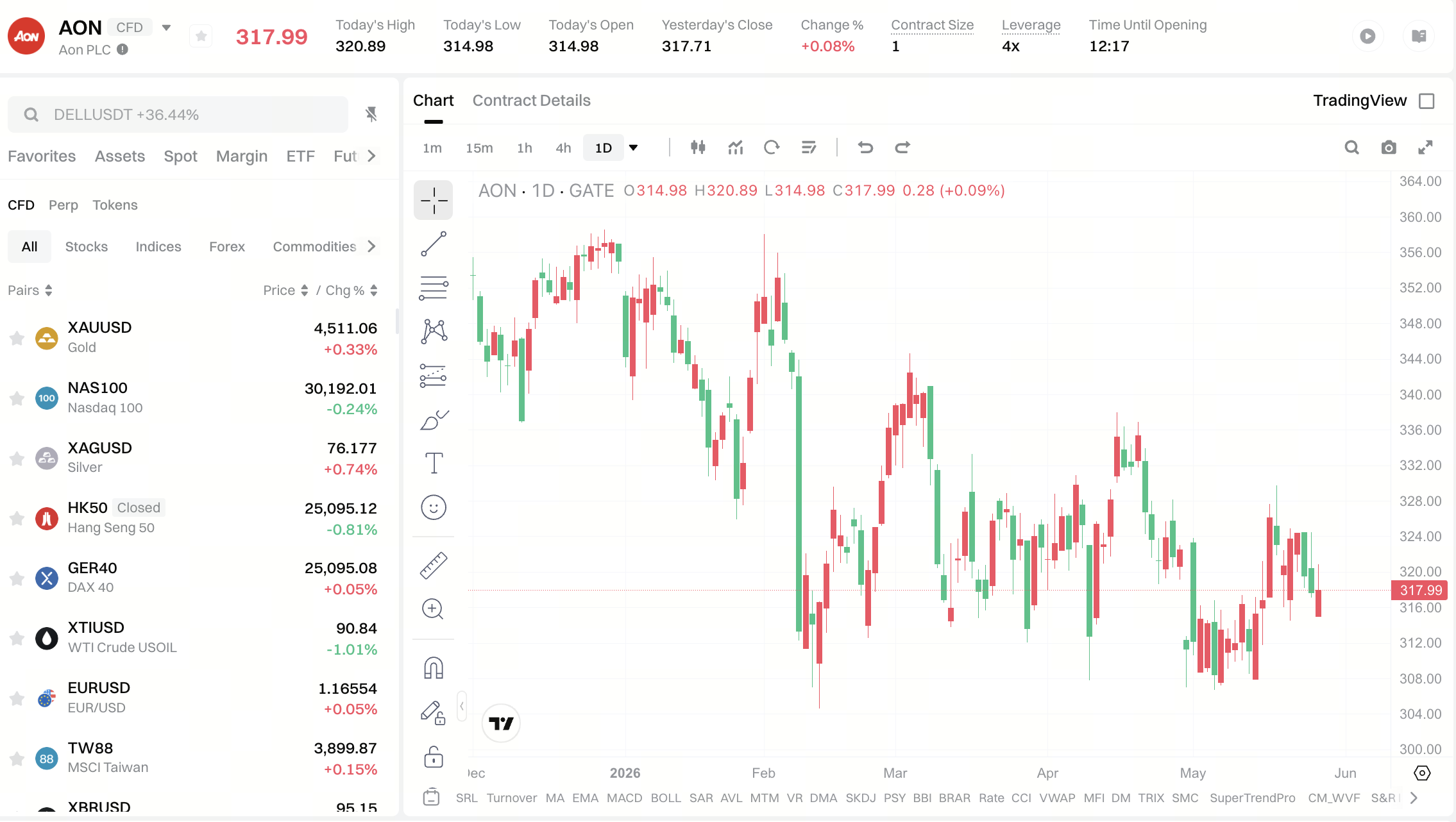
In addition to buying U.S. stocks directly, some platforms offer CFD (Contract for Difference) products tied to U.S. stocks. The CFD model tracks stock price movements through contracts without actual stock ownership, making its trading structure distinct from traditional securities accounts.
Meanwhile, some digital asset platforms are expanding into TradFi products. For instance, Gate TradFi CFD now covers select U.S. stocks, ETFs, indices, and global macro assets, allowing users to monitor both digital and traditional financial markets on a single platform.
Since different regions have varying regulatory requirements for stocks, CFDs, and cross-border financial products, users should carefully consider the following before trading AON or related U.S. stock assets:
- Platform support scope
- Structural differences between stocks and CFDs
- Leverage mechanisms
- Market liquidity
- Regional regulatory restrictions
Compared to traditional stock trading, CFDs focus more on price fluctuation trading, so their risk profile differs significantly from long-term holding assets.
AON's Position in Global Financial and Enterprise Services Markets
AON has become a representative company in the global enterprise services and risk management industry. The global insurance brokerage market has long been dominated by a few large players, with AON and Marsh McLennan as the most core participants.
The risk management industry has high barriers to entry, as large multinationals prefer platforms with global resources, data capabilities, and long-term service experience. As enterprise risks grow more complex, the industry is expanding from a traditional insurance intermediary into enterprise strategy, data analytics, and long-term capital management. This evolution is continuously enhancing AON's strategic value in the global enterprise services market.
AON's Advantages and Limitations
AON's core strengths lie in its global client network, insurance resource integration capabilities, and risk data systems. Large multinationals often need to manage risks across multiple countries and industries, and AON's global network enables them to unify insurance and risk programs.
At the same time, its enterprise consulting, human capital, and reinsurance businesses diversify AON's revenue streams. However, AON still faces limitations. The risk management industry is highly competitive, and global economic cycles, insurance market fluctuations, and natural disaster trends can affect profitability.
Moreover, the enterprise services industry relies heavily on long-term client relationships, so customer growth tends to be steady rather than explosive.
Summary
AON is a leading company in the global risk management and insurance brokerage industry, with core businesses encompassing insurance brokerage, reinsurance, enterprise consulting, and human capital services.
As the global business environment becomes more complex, the importance of the risk management industry continues to grow. Cybersecurity, supply chain risks, natural disasters, and global macro volatility are driving enterprises to increase long-term risk management demand.
Compared to traditional insurers, which focus more on claims liability, AON positions itself as a global enterprise risk solutions platform. This asset-light, service-oriented business model allows AON to occupy a key position in the global enterprise services market.
FAQ
What is AON?
AON is a global large-scale risk management and insurance brokerage company that provides insurance brokerage, enterprise consulting, reinsurance, and risk management services.
What is the difference between AON and an insurance company?
Insurance companies bear claims risk, while AON focuses on enterprise risk management and acts as an insurance intermediary platform.
What are AON's main revenue sources?
AON's revenue comes primarily from insurance brokerage commissions, enterprise consulting services, human capital management, and reinsurance business.
Why do large enterprises need risk management firms?
Large enterprises must manage supply chain, cybersecurity, property, and global operational risks simultaneously, so they rely on professional risk management institutions.
How can I buy AON stock?
Investors can buy AON stock through platforms that support U.S. stock trading; some platforms also offer AON CFD products.
Why is AON affected by macro markets?
Interest rates, natural disasters, economic cycles, and changes in the global insurance market all influence enterprise risk management demand and insurance market structure.