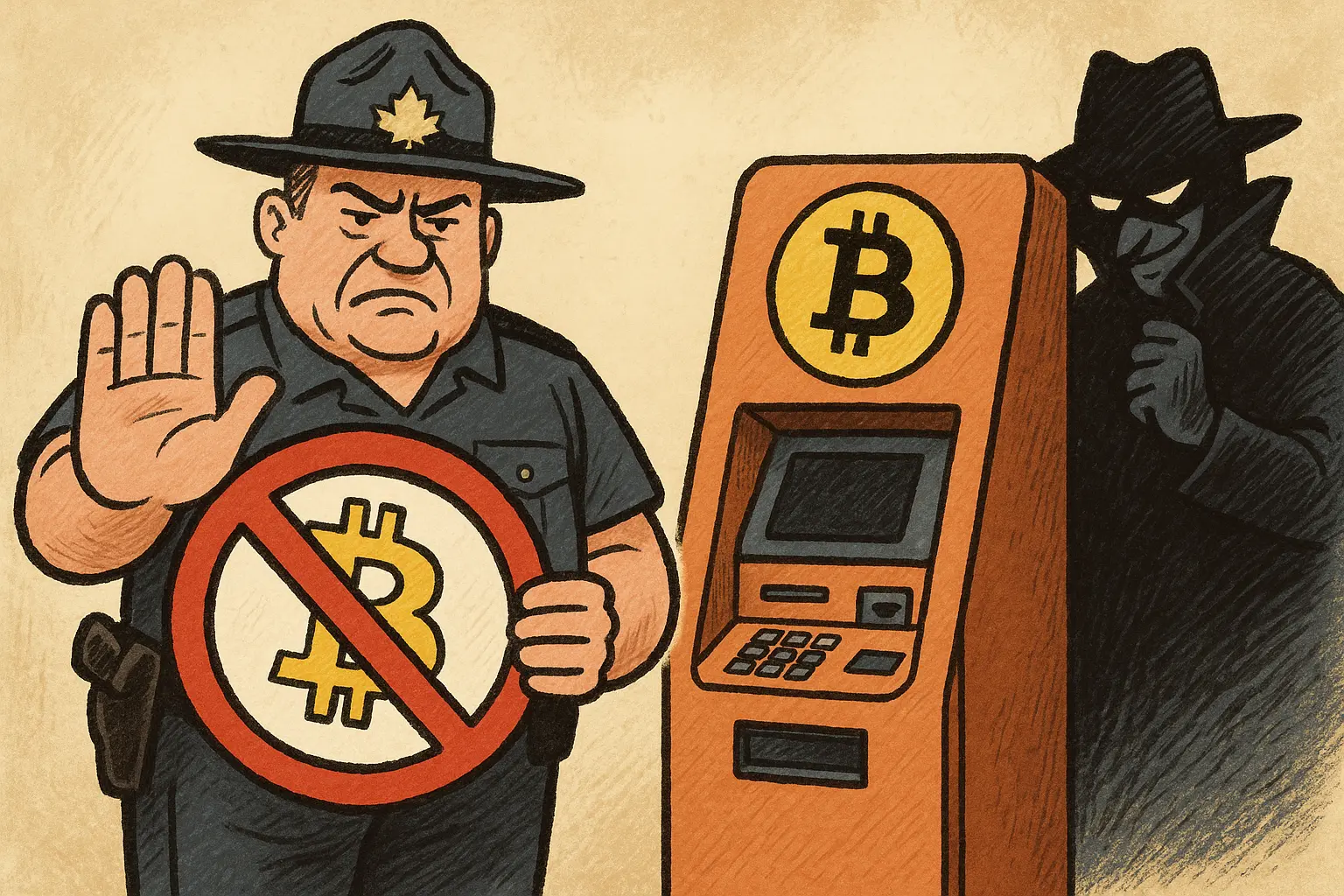
According to CBC, in a report dated April 29, Canada’s Liberal Party’s spring economic update released on Tuesday announced that the federal government plans to ban cryptocurrency ATMs to stop fraudsters from using these machines to commit fraud. The spring economic update characterizes cryptocurrency ATMs as “the primary way fraudsters trick victims and how criminal actors store cash proceeds from crime.”
Spring Economic Update Policy Announcement and Current Regulatory Framework
According to CBC’s April 29 report, the spring economic update released by Canada’s Liberal Party on Tuesday announced plans to ban cryptocurrency ATMs, but the related announcement did not include specific implementation details for the proposed ban.
The government said the measure will ensure Canadians can still buy virtual currencies through “money services businesses (MSBs),” while better protecting money services businesses from unlawful activity.
At present, cryptocurrency ATMs and other Canadian money services businesses (MSBs) are subject to the same regulatory framework, which covers foreign exchange dealers, regular ATMs, and remittance service providers (such as Western Union). Canada has no specific regulations for the cryptocurrency ATM industry.
FINTRAC Analysis and CBC Investigation Findings
According to CBC’s April 29 report, in February 2023 FINTRAC analyzed suspicious transaction reports submitted to the agency and concluded that cryptocurrency ATMs have become the main tool fraudsters use to obtain money from victims across the country. CBC’s three-part investigative series, “Enabling Fraud: The Cryptocurrency ATM Problem,” interviewed law enforcement officials, financial regulators, cryptocurrency experts, former employees of cryptocurrency ATM companies, and fraud victims. The investigation’s findings aligned with FINTRAC’s conclusions.
Both CBC’s investigation and FINTRAC’s analysis point out that cryptocurrency ATMs do not require a bank account, funds arrive quickly, and most machines only require a phone number when depositing amounts under $1,000. They also lack a step involving human intervention. These traits were identified as the core reasons they have become the main tool for fraud.
Last fall, CBC sent interview requests to Finance Minister François-Philippe Champagne and FINTRAC asking about specific measures to address cryptocurrency ATM fraud. Both requests were not approved. When questioned by the parliamentary press, Champagne said the government is “studying, very carefully, very seriously,” all possible financial crime prevention options.
Current Situation of Cryptocurrency ATMs in Canada and International Comparison
According to CBC’s reporting, Canada currently has about 4,000 cryptocurrency ATMs—making it the country with the highest number of cryptocurrency ATMs per capita worldwide. Globally, the total number of cryptocurrency ATMs exceeds 39,000.
According to CBC’s reporting, other jurisdictions have taken action regarding cryptocurrency ATM fraud:
United Kingdom: Established a licensing regime in 2021; to date, it has not issued licenses to any operators, effectively resulting in a ban
New Zealand: Currently proposing to ban cryptocurrency ATMs
Australia: After the financial intelligence agency and police completed a large-scale investigation, it launched daily transaction limits last summer
United States: Half of the southern states have proposed or implemented related laws, including daily transaction limits per customer, transaction fee caps, and requirements for operators to refund fraud victims
Frequently Asked Questions
What is the policy basis for Canada’s plan to ban cryptocurrency ATMs?
According to CBC’s April 29 report, in its spring economic update released Tuesday, Canada’s Liberal Party categorized cryptocurrency ATMs as “the primary way fraudsters trick victims and how criminal actors store cash proceeds from crime.” FINTRAC’s February 2023 analysis also found that cryptocurrency ATMs are the main tool fraudsters use to obtain money from victims in Canada.
How many cryptocurrency ATMs are currently in Canada? What regulations oversee them?
According to CBC’s reporting, Canada has about 4,000 cryptocurrency ATMs, the highest per-capita availability in the world. Under the current framework, these machines are subject to the same rules as other money services businesses (MSBs). Canada still has no specific regulations for the cryptocurrency ATM industry.
What regulatory measures have other countries taken regarding cryptocurrency ATMs?
According to CBC’s reporting, the United Kingdom has effectively formed a ban through its 2021 licensing regime; New Zealand is proposing to ban them; Australia has introduced daily transaction limits; and in the southern United States, half of the states have proposed or implemented measures such as daily transaction limits, fee caps, and refunds to victims.
Disclaimer: The information on this page may come from third parties and does not represent the views or opinions of Gate. The content displayed on this page is for reference only and does not constitute any financial, investment, or legal advice. Gate does not guarantee the accuracy or completeness of the information and shall not be liable for any losses arising from the use of this information. Virtual asset investments carry high risks and are subject to significant price volatility. You may lose all of your invested principal. Please fully understand the relevant risks and make prudent decisions based on your own financial situation and risk tolerance. For details, please refer to
Disclaimer.
Related Articles
CertiK report: $900 million in AML fines; SEC crypto enforcement down 97% year over year
According to a report published by blockchain security audit firm CertiK on April 28, anti-money laundering (AML) enforcement has replaced securities violation findings and become the top regulatory threat facing crypto companies. The report shows that the U.S. Department of Justice and the Financial Crimes Enforcement Network (FinCEN) issued a total of $900 million in AML-related fines in the first half of 2025; in the same period, the U.S. Securities and Exchange Commission (SEC) saw crypto-asset penalties fall 97% year over year.
MarketWhisper9m ago
Stand With Crypto launches a petition, urging the U.S. Senate to move forward with the “CLARITY Act” for review
According to a statement published on April 28 on its official website by “Stand With Crypto,” the cryptocurrency advocacy group is calling on the Senate Banking Committee to schedule a hearing for the “CLARITY Act,” and is simultaneously launching a public petition. As of the time the statement was released, the petition has accumulated 15,924 signatures, with a goal of 20,000.
MarketWhisper49m ago
Hong Kong Monetary Authority Warns: HKDAP and HSBC Token Are Unlicensed Stablecoin Issuers
The Hong Kong Monetary Authority (HKMA) issued an official announcement on April 28, stating that tokens using “HKDAP” or “HSBC” as codes have appeared in the market. These tokens are not issued by a licensed stablecoin issuer, nor are they associated with the relevant licensed issuer(s). According to the HKMA announcement on the same day, the two licensed stablecoin issuers—Ding Dian Financial Technology Limited and The Hongkong and Shanghai Banking Corporation Limited—have both stated that they have not issued any regulated stablecoins.
MarketWhisper58m ago
South Korea's Financial Services Commission Chair Pledges Active Response to Digital Assets, Stablecoin Push Continues
Gate News message, April 29 — Lee Eok-won, chair of South Korea's Financial Services Commission, stated on April 29 that the FSC will actively respond to the convergence of digital assets and traditional finance, with stablecoin development as a key priority. Speaking at the 'Fintech, Connection of
GateNews1h ago
Hong Kong Monetary Authority Warns of Fraudulent Stablecoins Impersonating Licensed Issuers
Gate News message, April 29 — The Hong Kong Monetary Authority issued a public alert warning residents to be vigilant about fraudulent tokens claiming to be associated with licensed stablecoin issuers. Fake tokens using ticker symbols "HKDAP" and "HSBC" have appeared in the market, but these are
GateNews1h ago
Singapore's Anti-Corruption Agency Warns of Enforcement Challenges Posed by Cryptocurrency
Gate News message, April 29 — Singapore's Corrupt Practices Investigation Bureau (CPIB) highlighted that emerging technologies, particularly cryptocurrency, are presenting significant challenges to law enforcement and investigations. Speaking at the bureau's annual data release press conference, CPI
GateNews1h ago


