Is the squad strength gap the core anchor for market pricing?
The stark probability distribution in the market is first based on a fundamental assessment of the two teams’ squad strength. Canada is currently ranked 30th in the world, with the team’s total value estimated at about €190 million to €200 million. The squad is led by key starters from top European leagues, including Alphonso Davies of Bayern Munich and Jonathan David of Juventus, among others. Qatar is ranked 57th in the world, with the team’s total value estimated at about €19.9 million to €20.48 million, led by Afif, a two-time Asian Footballer of the Year. The gap in squad value is close to tenfold, and the difference in world rankings is 27 places.
Although squad value and rankings are important references for market pricing, they are not decisive factors. When Qatar was the host in 2022, its squad value was also not high, and the market expectations for them were relatively low. However, the fact that Qatar drew Switzerland 1-1 in the first round of this World Cup shows that paper strength cannot fully define how a match will play out. The market’s 76% win rate is more based on systematic differences in squad depth and individual ability than on a simple comparison of rankings.
How did the teams’ first-round performances affect market expectations?
The first-round performances in the group stage are an important basis for the market to adjust expectations. In Canada’s first match against Bosnia and Herzegovina, they dominated across the board: possession was 61%, they recorded 13 shots, and had 37 touches in the penalty area (Bosnia and Herzegovina had only 15). On the data level, they were clearly superior in every aspect. Larin, coming off the bench, scored the equalizer just 121 seconds later, and the match ended 1-1. Canada has now gone unbeaten in all competitions for 9 straight matches, with a record of 3 wins and 6 draws.
Qatar’s first match against Switzerland was characterized by being comprehensively passive. Their possession was only 32%, they had 6 shots, and managed just 8 touches in the penalty area (Switzerland had as many as 42). They only squeaked through to equalize when Switzerland scored an own goal in stoppage time at the 94th minute. Goalkeeper Abunada played a major role, making 9 saves across the match and becoming the team’s top point-saver. Qatar has played only 3 matches since entering 2026, and after the World Cup qualifiers ended, they’ve suffered 7 consecutive matches without a win, with a record of 3 draws and 4 losses.
The contrast in the first-round games—Canada being “the better side on the field but lacking efficiency,” while Qatar was “comprehensively passive but favored by luck”—directly affects the market’s assessment of each team’s true level. The market’s 76% win rate, to a significant extent, reflects recognition that Canada’s first-round performance was “not a win but credible in content,” as well as caution about Qatar’s first-round being “too dependent on luck.”
Can the historical head-to-head record provide an effective reference for the market?
The two teams have met only once in official competition historically. In a September 2022 friendly, Canada defeated Qatar 2-0 away. The scorers for Canada then—Larin and Jonathan David—are both in Canada’s current squad for this World Cup. Players who started for Qatar back then, such as Afif and Hadsos, are also in the lineup now.
However, the value of a single friendly match as a reference is limited. That game is now nearly four years old, and both teams’ squads and tactical systems have changed. More importantly, the match intensity and psychological pressure of a friendly cannot be compared to a World Cup group-stage game. The market obviously would not treat this head-to-head encounter as a primary basis, but it does form an incremental psychological factor: Canada won in their only previous meeting.
How does the tactical style comparison affect the probability distribution of how the match will unfold?
Canada’s head coach, Marsch, continues with a mixed system combining high pressing and late-stage penetration through ball control. Canada averages 11.8 shots per match, and their goals conceded efficiency is 1 goal conceded for every 13.8 shots faced, indicating strong stability in their defensive structure. What’s worth noting is that Canada’s possession rate of 49.1% is actually lower than Qatar’s 57.0%, reflecting that Marsch values “getting the ball in the front three zones” more than “controlling the ball across the entire match.” Alphonso Davies has confirmed his return for this game, and his abilities on both offense and defense will further enhance the team’s threat down the flanks.
Qatar’s head coach, Lopetegui, favors a Spanish-style approach focused on possession penetration and ambushes from set pieces. Qatar’s average possession rate of 57.0% is higher than Canada’s, but the reality that Qatar concedes 1.5 goals per game and is outshot 10.7 times per game shows that “holding the ball” and “controlling the match” are two different things. Qatar’s most realistic strategy is to drag the match into a low tempo and wait for Canada’s mistakes in the second half. However, Qatar concedes 0.9 goals per game in the second half, making them more vulnerable as stamina declines. This aligns precisely with Canada’s rhythm in the second half—Canada averages 0.6 goals in the second half (higher than 0.3 in the first half)—creating an overlapping effect.
The core tactical contradiction is this: Canada’s high pressing and rapid transitions are precisely aimed at Qatar’s weakness in building play from the back, while Qatar’s strategy of slowing the match through possession faces a huge test in the home atmosphere at Vancouver. The market’s 76% win rate implicitly confirms this tactical restraint matchup.
How much weight do home factors carry in the prediction market pricing?
As one of the joint hosts of this World Cup, Canada has a clear home advantage at Vancouver’s BC Place Stadium. Canada has won all of their last four home matches, scoring 17 goals and conceding only 2. Six players on the team have previously played for Vancouver Whitecaps FC, a MLS club based at BC Place Stadium, and being familiar with the venue background may bring positive psychological effects.
Home factors influence market pricing on multiple levels: increased morale from fan support, familiarity with the venue conditions, and potential referee tendencies, among others. For Qatar, playing away means having to deal with Vancouver’s home atmosphere and crowd pressure. In the market’s 76% win rate, home factors undoubtedly account for a considerable portion of the weight—if this match were held on neutral ground, Canada’s win probability would most likely be lower than the current level.
What deviations exist between market probabilities and fundamentals data?
Cross-validating market probabilities with fundamentals data reveals several deviations worth paying attention to.
First, Canada’s first-round finishing problem remains unresolved: with 22 shots in the match, they scored only 1 goal. Canada averages only 0.9 goals per match overall, and they average just 0.3 goals in the first half—this indicates they are not a high-output team running wide open; they are more of a “settle first, then penetrate” rhythm team. This means that for Canada to win by more than two goals, they need system-built accumulation rather than a single wave that carries them through.
Second, an unintuitive data point is that Canada’s shot-to-goal efficiency (13.1 shots per goal) is actually lower than Qatar’s (12.4 shots per goal). Qatar are not incapable of scoring; rather, they don’t have enough opportunities to score (9.7 shots per match vs Canada’s 11.8). Once Qatar gets 1-2 clean shot chances from the top of the arc in the penalty area, their conversion ability is not necessarily poor.
Third, even though Qatar were passive in their first match, their defensive organization showed a degree of resilience. If Qatar can drag the game into a deadlock of 0-0 or 1-1, the draw probability (17% as given by the market) could be underestimated.
These deviations suggest that while a 76% win rate reflects the market’s overall judgment, there is room for adjustment. The efficiency of the market’s pricing depends on whether information can be fully absorbed—and the World Cup is precisely one of the situations where information asymmetry is most pronounced.
How does the prediction market provide a differentiated pricing perspective for sports events?
The core difference between prediction markets and traditional sports betting lies in the pricing mechanism. Prediction markets aggregate judgments from large numbers of participants, turning collective intelligence into tradable probabilities. Every price change reflects the injection of new information and the evolution of market sentiment.
Gate, the centralized exchange that integrates Polymarket services globally, saw 24-hour trading volume surpass $10 million during the World Cup. As of June 16, 2026, Gate’s prediction market products have accumulated trading volume of over $251 million. Prediction markets now cover multiple areas, including sports events, cryptocurrencies, and macroeconomics. Users can complete all trades directly using a Gate account and USDT, without cumbersome steps such as creating a wallet, cross-chain transfers, or paying Gas fees.
The differentiated value that prediction markets provide for sports events is that it is not a static odds table, but a dynamic mechanism for discovering probabilities. When news of Alphonso Davies confirming his return spreads, Canada’s win rate rises accordingly; after Qatar drew Switzerland in the first round, the market’s assessment of their defensive resilience would be adjusted as well. This real-time pricing capability makes prediction markets an effective window for observing market sentiment and information efficiency.
Is the 9% upset probability fully priced in by the market?
Qatar’s 9% win rate means the market believes this match is unlikely to produce an upset. However, World Cup history never lacks upsets. Examples from the last World Cup—such as Saudi Arabia defeating Argentina and Japan defeating Germany—show that low-probability events often occur more frequently in a single match than the market expects.
Qatar has several conditions that could enable an upset: their defensive organization showed some resilience against Switzerland in the first round; Afif, a two-time Asian Footballer of the Year, has individual ability to change the course of a match; and Canada’s exposed finishing efficiency problem in the first round (only 1 goal from 22 shots) could give Qatar a survival space.
However, whether these conditions can translate into actual results depends on whether Qatar can maintain defensive discipline for 90 minutes under the pressure of Canada’s home atmosphere in Vancouver. Qatar’s record of 0 wins in their last 10 away matches, as well as the physical test posed by high noon temperatures in North America for teams from West Asia, are all real factors limiting their upset probability. Whether the 9% win rate is being underestimated is, at its core, a question about the “frequency of occurrence of low-probability events”—and that question itself creates ongoing trading space in prediction markets.
FAQ
Q: How are the win-rate data in Gate’s prediction market derived?
The win rates in the prediction market are jointly determined by the buying and selling behavior of market participants. Users express their view of a given outcome by buying “Yes” or “No” contracts; the contract price corresponds to the probability the market assigns to that outcome. As of June 18, 2026, Gate’s prediction market shows Canada winning at 76%, drawing at 17%, and Qatar winning at 9%.
Q: Why is Canada’s win rate so much higher than Qatar’s?
The main reasons include: Canada is ranked 30th in the world, with the squad valued at about €200 million, far higher than Qatar’s 57th rank and about €20 million; as hosts, Canada has a clear home advantage in Vancouver; Alphonso Davies has confirmed his return, boosting the team’s strength; and in Canada’s first match against Bosnia and Herzegovina they dominated the game on the field, while Qatar’s first match against Switzerland depended more on luck and the goalkeeper’s performance.
Q: Does a 9% win rate mean Qatar has absolutely no chance?
No. A 9% win rate means the market believes Qatar’s victory is a low-probability event, but not zero probability. Upsets occur frequently in World Cup history, and Qatar has potential upset conditions such as defensive organizational resilience and Afif’s individual ability. The core value of a prediction market lies in dynamic pricing—once new information is introduced (such as starting lineups, weather, match progression, etc.), probabilities will be continuously adjusted.
Q: What’s the difference between prediction markets and traditional sports betting?
Prediction markets form dynamic probabilities by aggregating the judgments of large numbers of participants, and each price movement reflects the injection of new information and the evolution of market sentiment. Users can buy or sell their holdings at any time without having to hold until the result is revealed. Gate, as a platform integrating Polymarket services, allows users to participate in trading directly using accounts and USDT.


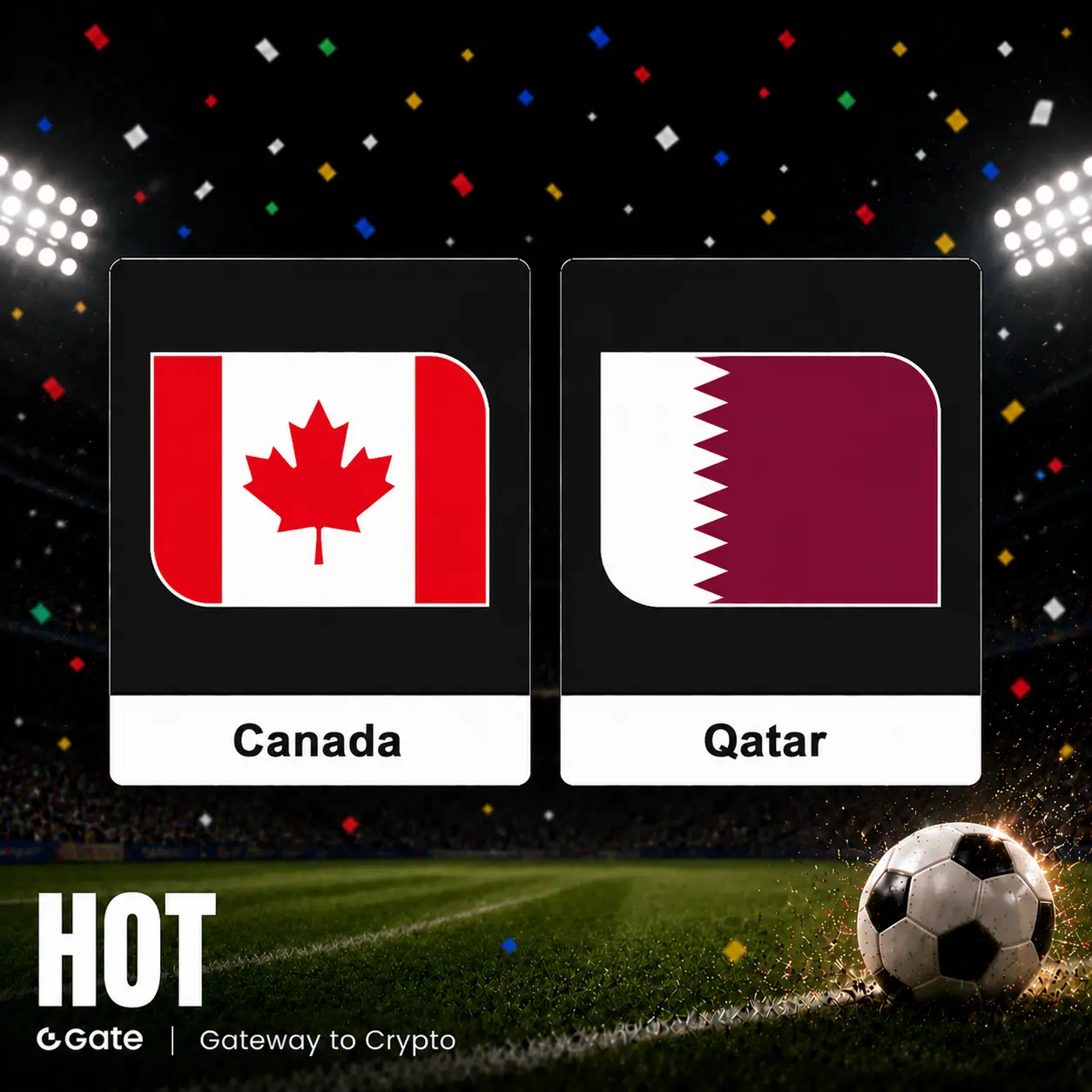 In the second round of the 2026 World Cup group stage Group B, the host Canada will face Qatar at Vancouver’s BC Place Stadium. As of June 18, 2026, Gate’s prediction market data shows that market participants are betting on Canada winning with a probability of 76%, a draw probability of 17%, and Qatar winning at only 9%. This stark probability distribution reflects the market’s basic assessment of the teams’ relative strength. But is Canada’s 76% win rate priced in adequately? Is the 9% upset potential being underestimated?