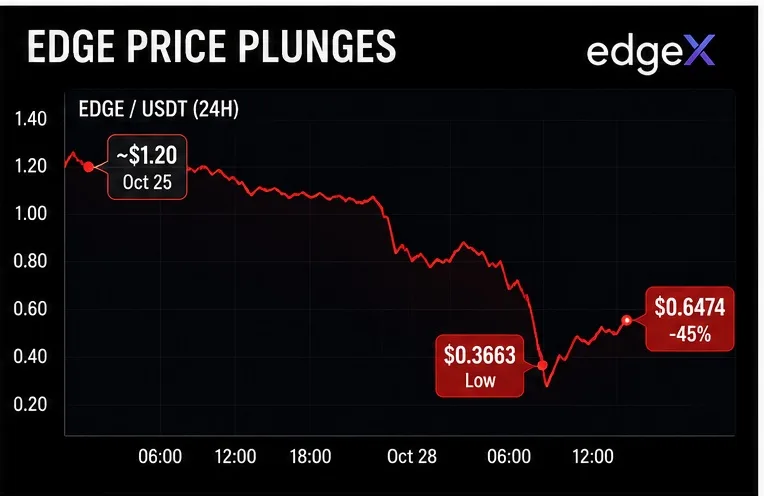
Decentralized exchange edgeX faced scrutiny after its EDGE token fell more than 40% in 24 hours on Tuesday. The project blamed the move on deliberate market manipulation by an unnamed external party. Market data showed EDGE falling from roughly $1.20 to an intraday low of $0.3663, a drop of about 70% at the session low, before later trading around $0.6474. The edgeX team stated it had observed a sudden and irregular price movement and was actively investigating. The project later clarified that the platform itself had not been compromised and framed the incident as a market integrity issue rather than a hack.
EDGE Token Drops 70% Intraday on Tuesday
Market data showed EDGE falling from roughly $1.20 to an intraday low of $0.3663 on Tuesday, a drop of about 70% at the session low. The token later traded around $0.6474, still down about 45% over the past day. The edgeX team said it had observed a sudden and irregular price movement and was actively investigating. In a later statement, the project said the platform itself had not been compromised and framed the incident as a market integrity issue rather than a hack.
The distinction matters for investors. A protocol exploit would point to a technical failure. A market-driven collapse points instead to liquidity structure, token distribution, market-maker conduct, and insider concentration. Those risks can be harder to detect because they may not appear in smart contract audits or security dashboards.
ZachXBT Disputes Market Manipulation Claim
Onchain investigator ZachXBT dismissed edgeX's market manipulation claim and pointed instead to the project's own supply structure. He argued that EDGE was controlled by a small number of insiders and had a low circulating float, making the token vulnerable to extreme price moves. Only 350 million EDGE tokens are currently circulating out of a maximum supply of 1 billion. That means more than two-thirds of the token's total supply has not yet entered the market. A low float can amplify volatility when liquidity is thin, especially if large holders sell into shallow order books or if market-maker arrangements are opaque.

ZachXBT also called on edgeX to publicly disclose the counterparties and market-maker agreements linked to the crash. His criticism focused on whether the token's structure made the collapse predictable, regardless of whether an external party actively pushed the price lower. His response to edgeX's internal findings was blunt. "We investigated ourselves and did not find ourselves guilty even though we control nearly the entire supply," he wrote sarcastically.
edgeX Ranks 16th Largest DEX by Volume
edgeX remains a notable decentralized exchange by activity. It ranks as the 16th largest DEX by daily trading volume and has about $137 million in total value locked, according to DeFi data. That size does not remove token-specific risk. DEX tokens can trade with different liquidity conditions than the platforms they represent. A protocol may have meaningful total value locked while its token still trades in a shallow market, especially when most supply remains locked, reserved, or controlled by early holders.
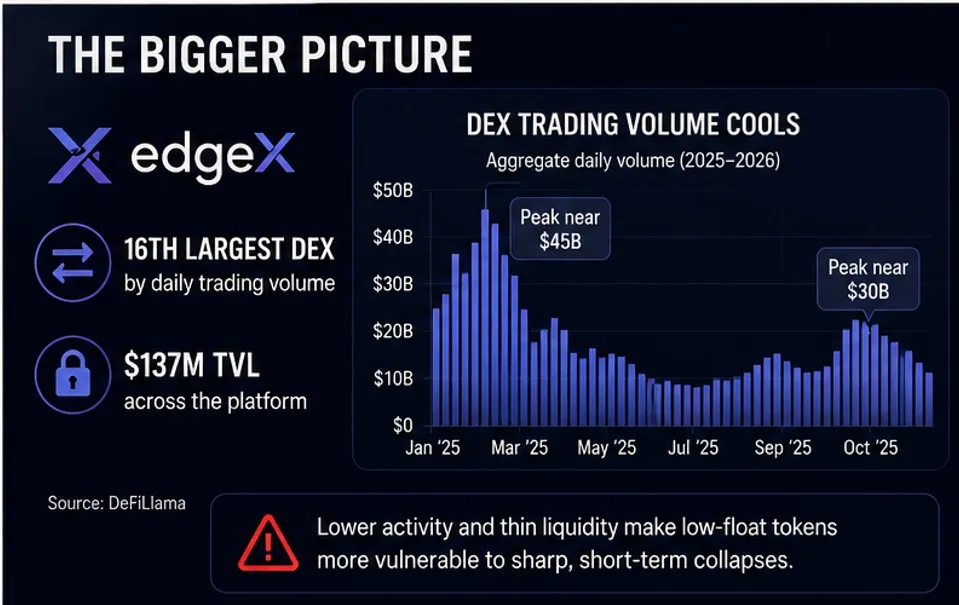
The EDGE collapse also comes as decentralized exchange volumes have cooled from earlier peaks. Aggregate DEX trading activity surged near $45 billion in early 2025, then fell into a lower daily range of roughly $5 billion to $20 billion through the first half of 2026. A secondary peak near $30 billion in October 2025 also faded. Lower market activity can magnify price dislocations. When fewer traders are active and order books are thinner, large sell flows can have a bigger price impact. For low-float assets, that risk increases because the available trading supply is limited and often more concentrated.
ZachXBT Calls for Market-Maker Disclosure
The dispute around edgeX raises a question about whether crypto projects should disclose more about token supply control, market-maker mandates, loaned token inventories, and counterparties responsible for liquidity. For investors, these details can be more important than headline exchange volume or total value locked. A token with limited circulating supply may appear liquid during normal market conditions but fail quickly when large holders or market makers withdraw support, rebalance inventory, or sell into weak demand.
For exchanges and DeFi protocols, the risk is reputational as well as financial. Blaming an unnamed external party may not satisfy users if supply concentration and internal arrangements are not transparent. The more a project relies on low float and controlled liquidity, the more pressure it faces to explain how token markets are being managed. The EDGE crash leaves edgeX with 2 problems: restoring confidence in the platform and answering questions about the token's market structure.
FAQ
What caused the EDGE token price drop on Tuesday?
The EDGE token fell more than 40% in 24 hours on Tuesday, dropping from roughly $1.20 to an intraday low of $0.3663. The edgeX project blamed the move on deliberate market manipulation by an unnamed external party, stating it had observed a sudden and irregular price movement and was actively investigating.
What is ZachXBT's explanation for the EDGE collapse?
Onchain investigator ZachXBT dismissed edgeX's market manipulation claim and pointed to the project's own supply structure. He argued that EDGE was controlled by a small number of insiders and had a low circulating float, with only 350 million tokens circulating out of a maximum supply of 1 billion, making the token vulnerable to extreme price moves.
How large is edgeX as a decentralized exchange?
edgeX ranks as the 16th largest DEX by daily trading volume and has about $137 million in total value locked, according to DeFi data. The platform remains a notable decentralized exchange by activity despite the token price collapse.


