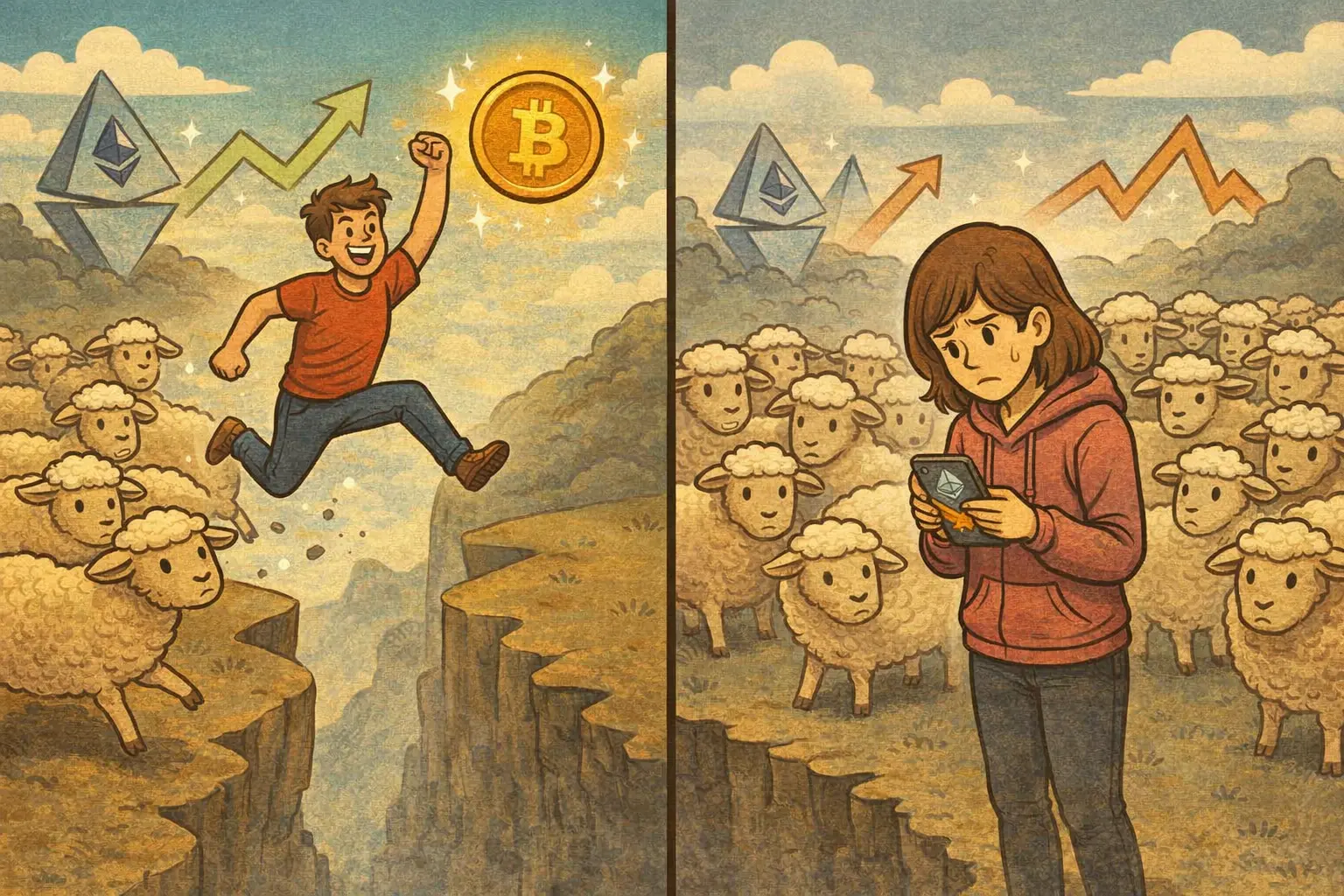
A follow-up study commissioned by the Hong Kong Investor and Financial Education Council (IFEHK) and conducted by the Department of Applied Social Sciences at The Hong Kong Polytechnic University shows that, compared with data from 2022 and 2025, the herd mentality tendency score among Hong Kong virtual asset investors fell from 3.63 to 3.19, and overall investment behavior has become more rational. The study identified that the highest proportion is “bandwagon-and-avoid-risk” behavior (33.9%), with the highest female share; “confident-and-battle” (22.2%) is male-dominated.
Classification and proportions of four types of investors
The study identifies four behavioral types of Hong Kong virtual asset investors:
“Bandwagon-and-avoid-risk” (33.9%): the largest share, mainly among young investors aged 18 to 29. Women have the highest proportion among all types (43%). Its characteristic is being easily influenced by market sentiment; after incurring losses, investors tend to become more cautious and conservative.
“Trapped-and-refuse-to-leave” (25.5%): mostly mid-career professionals aged 30 to 39, tending to hold for the long term after losses while waiting for a rebound.
“Confident-and-battle” (22.2%): mainly high-education and high-wealth men, who are prone to overconfidence and to increasing allocations to high-risk positions.
“Fear-of-losing-out” (18.4%): investors have relatively ample assets but trade frequently, driven clearly by FOMO (fear of missing out).
Behavior improvement data from 2022 to 2025
According to the IFEHK report, the scores for the following four key biases all improved (out of 5):
Tendency to trade with the crowd: 3.63 → 3.19 (less bandwagon investment affected by market trading volumes)
Mimicking the crowd’s buying behavior: 3.49 → 3.30 (less investor behavior of imitating the crowd to buy certain virtual assets)
High-risk tendency after making profits: 3.11 → 2.89 (reduced tendency to immediately increase high-risk trading after profits)
Reliance on past experience: 4.03 → 3.86 (decreased reliance on one’s own past experience)
Persistent biases found: FOMO is widespread and reliance on financial influencers has increased
Although the above indicators all improved, the IFEHK study also points to the following persistent issues: FOMO (fear of missing out) sentiment and overconfidence remain widespread. In both the 2022 and 2025 studies, investors’ reliance on their own instincts and on “authority figures (including financial influencers)” increased.
Common questions
What level of improvement does the herd mentality tendency score falling from 3.63 to 3.19 represent?
Based on the 5-point scale used in the study, both scores of 3.63 and 3.19 fall in the moderately high range; the decline of 3.44 is about 0.44 points. IFEHK describes this as a “significant decline,” but does not define a specific threshold for numeric improvement.
Did the regulatory regime in 2023 directly lead to improvements in investment behavior?
According to the IFEHK report, the study collected data in 2022 (before regulation) and in 2025 (after regulation), and recorded multiple behavioral improvements. The report believes the improvements are related to environmental changes after the implementation of the regulatory regime for virtual asset trading platforms in 2023, but the study itself did not rule out other possible explanatory factors.
What policy implications are there from the research finding that reliance on financial influencers increased?
According to the IFEHK report, in both rounds of studies, investors’ reliance on authority figures such as “financial influencers” increased. This finding was first released at an international seminar hosted by IOSCO, aiming to provide a basis for building an “evidence-based investor education framework” in different jurisdictions.


