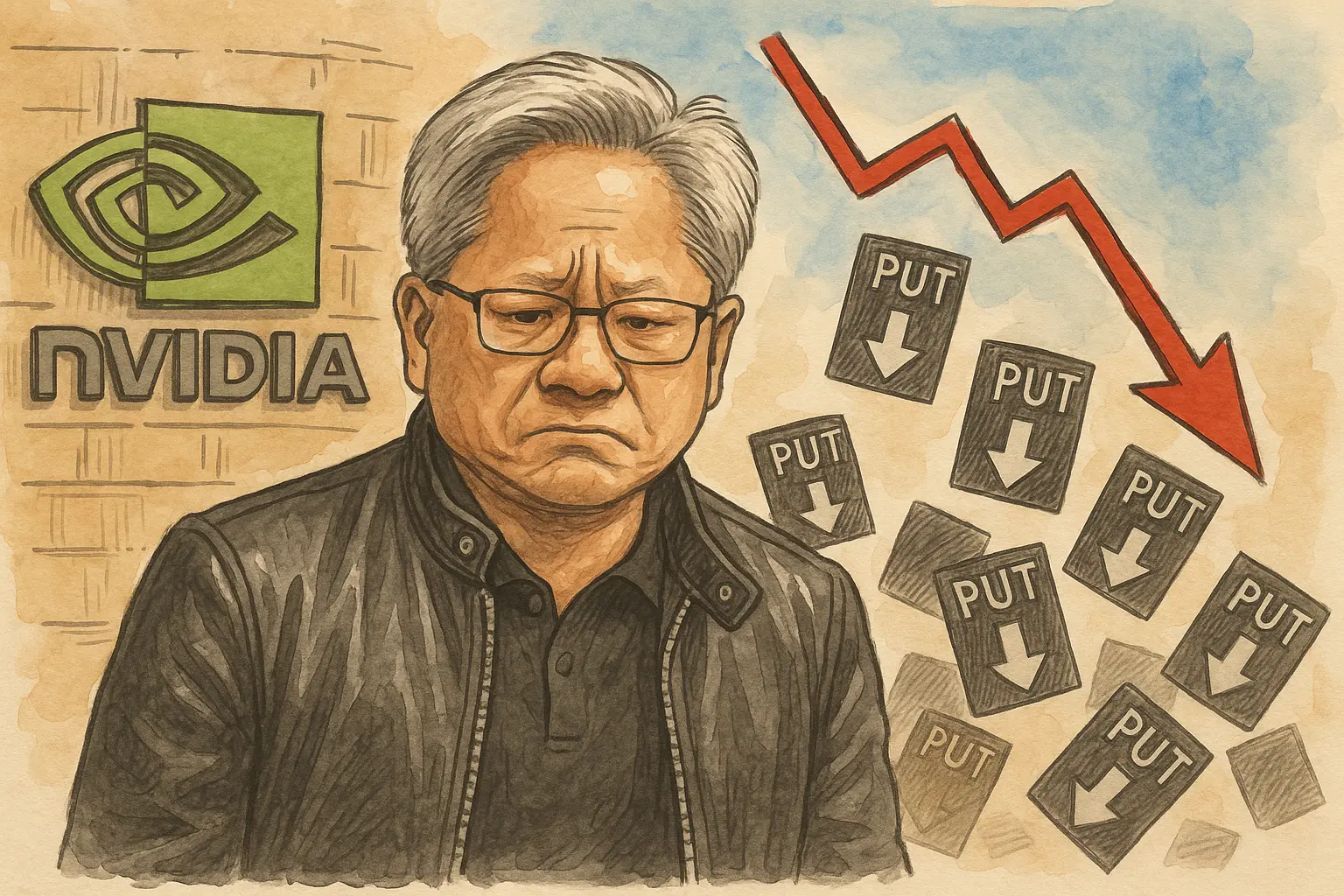
NVIDIA (NVDA) CEO Huang Renxun recently claimed that “we have achieved Artificial General Intelligence (AGI),” sparking widespread market discussion, but NVIDIA’s stock price was not lifted as a result. NVDA is currently trading around $175, with a decline of approximately 9% over the past month. Since late October 2025, it has been confined within a downward channel, and the put-call ratio for options has surged by 31%.
Why Huang Renxun’s AGI Declaration Failed to Translate into Actual Buying
Although the AGI assertion created a strong market narrative, stock valuation logic is not solely determined by narrative. In the current macro environment, rising yields directly compress the discounted valuation of high P/E growth stocks, and NVIDIA’s valuation multiples have long been a major source of technical pressure.
Since late October 2025, when NVIDIA’s stock peaked near $212, it has formed a continuous six-month downtrend, with every attempt to break above the upper trendline ending in failure. In early to mid-March, the stock rose nearly 8%, but the momentum quickly faded, institutional funds withdrew again, and the brief optimism failed to develop into a sustained upward trend.
Two Major Technical Indicators Signal Alerts Simultaneously
CMF (Chaikin Money Flow) Key Divergence: From November 6 to March 20, despite the stock price continuing to decline within the channel, the CMF formed higher lows, indicating that selling pressure during each decline is gradually weakening—key CMF bottom at -0.23. If it falls below this level again, the last structural support within the channel will collapse.
20-Day / 100-Day EMA Death Cross: Completed around March 19, after which the stock price fell more than 6%. Currently, NVDA is below all three key moving averages, with only the 200-day moving average (around $173) remaining as the last support.
A Second Death Cross Is Forming: The 50-day moving average is rapidly approaching the 100-day moving average. If a crossover occurs, it will strengthen the downward momentum and make the lower channel boundary the primary focus for attack and defense.
Technical Logic Is Simple and Direct: The divergence in CMF is the last line maintaining the channel, while the death cross of moving averages is like scissors that could cut this line.
Options Market Evidence: Short Positions Are Being Held, Not Just Traded
Options market data further confirm the bearish sentiment indicated by technical analysis. When NVIDIA released its earnings on February 25 (closing at $195, EPS $1.62), the put-to-call volume ratio was 0.55, and the open interest ratio was 0.83. The trading frequency of call options was nearly twice that of put options, indicating market confidence was still relatively positive.
As of the current price of $175, both indicators have significantly worsened: the volume ratio has risen to 0.72 (an increase of about 31%), and the open interest ratio has risen to 0.88. The latter’s increase is particularly noteworthy—it suggests that not only are short positions being established, but they are also being maintained, showing that short sellers have a clear conviction in a downward move.
Key technical resistance levels are at $176, $181, and $187; a break above $197 (the high after earnings) is needed to break the downtrend. Key support levels are at $171 (the 0.618 Fibonacci retracement), with a break below potentially extending the decline to $163 and $154.
Frequently Asked Questions
Q: Why did Huang Renxun’s AGI declaration fail to boost NVIDIA’s stock price?
A: Although the AGI announcement generated market buzz, in the macro environment of rising yields and inflation driven by the Iran war, investors are more sensitive to the discounted valuation pressure on high-growth stocks. The six-month downtrend and ongoing institutional fund withdrawals make it difficult for positive narratives to translate into actual buying.
Q: What is the most critical technical support level for NVIDIA’s stock now?
A: $171 is the most important support, corresponding to the 0.618 Fibonacci retracement and a significant low since February 5. A daily close below this level could trigger further declines toward $163 and $154. Conversely, a break above $197 could break the downtrend and shift the bias to bullish.
Q: What signals does the options market data convey?
A: The put-to-call volume ratio has increased from 0.55 at earnings to 0.72, and the open interest ratio from 0.83 to 0.88. The rise in open interest indicates that short positions are not only being established but also maintained, showing that short sellers have a firm conviction in a further decline. The options market confirms the technical bearish signals.
Disclaimer: The information on this page may come from third parties and does not represent the views or opinions of Gate. The content displayed on this page is for reference only and does not constitute any financial, investment, or legal advice. Gate does not guarantee the accuracy or completeness of the information and shall not be liable for any losses arising from the use of this information. Virtual asset investments carry high risks and are subject to significant price volatility. You may lose all of your invested principal. Please fully understand the relevant risks and make prudent decisions based on your own financial situation and risk tolerance. For details, please refer to
Disclaimer.


