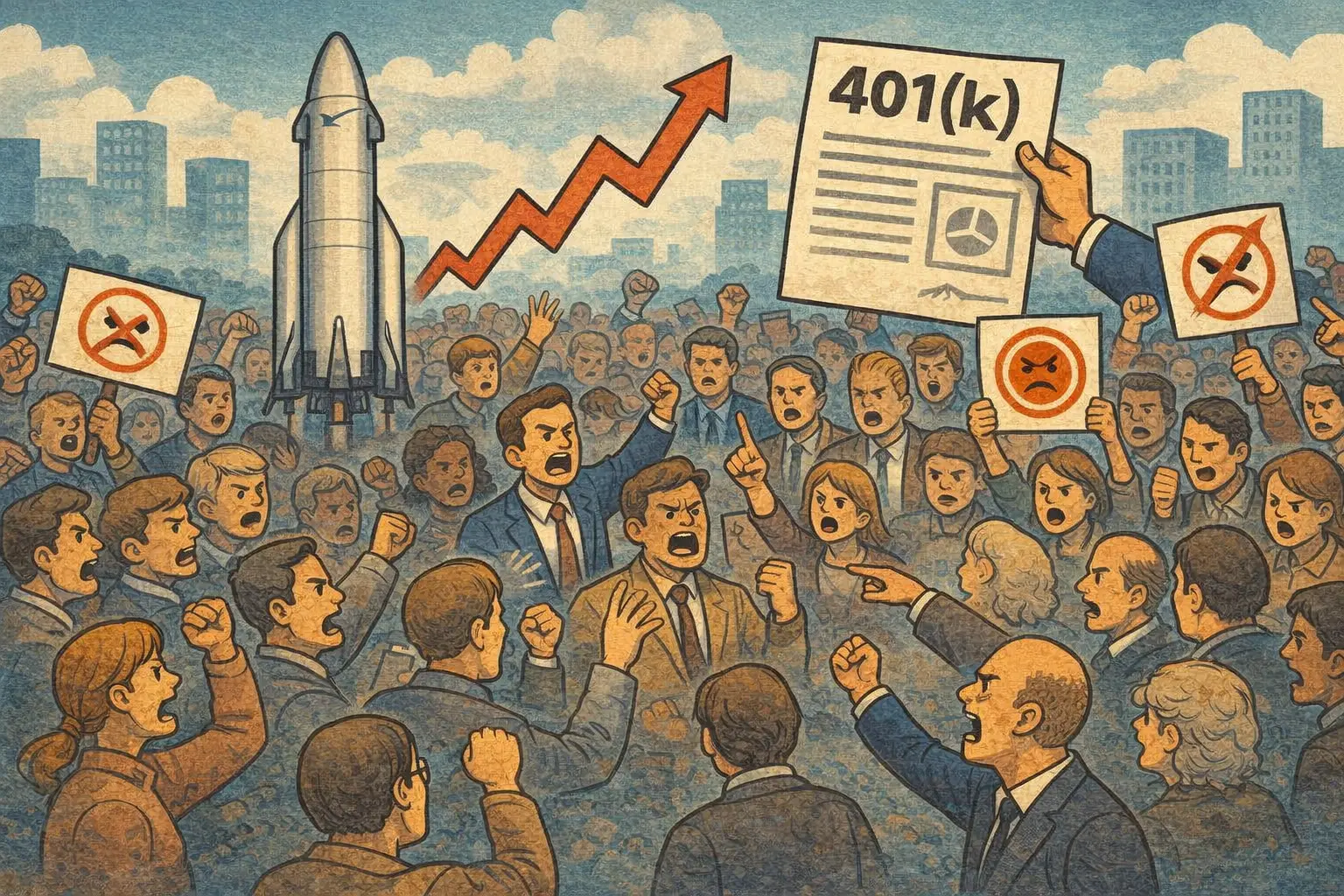
On June 19, the British newspaper The Guardian reported that after SpaceX completed its IPO with a valuation of $1.77 trillion, it was brought into mainstream index funds ahead of schedule due to changes in market rules, meaning millions of Americans indirectly hold SpaceX shares through passive investments in private retirement plans such as 401(k)s. The Guardian compiled feedback from more than 150 U.S. readers, and the vast majority strongly disapproved of this.
Over 150 Readers Respond to The Guardian: Most Strongly Oppose SpaceX Forced Retirement Funds
According to The Guardian’s June 19 in-depth report, The Guardian collected feedback from more than 150 U.S. readers, reflecting their views on the policy of bringing SpaceX into index funds early, with the vast majority expressing strong resentment and unease. The report explains that Americans’ retirement funds are often invested in the stock market through private plans such as 401(k)s, closely tracking major index funds like the S&P 500.
Driven heavily by Musk, market rules were changed to allow SpaceX to be included in mainstream index funds earlier than in typical circumstances, meaning that even ordinary retail investors who did not directly buy SpaceX shares have their retirement savings indirectly tied up passively.
Specific Voices from Interviewees: California Engineer, Washington Professor, and Michigan Engineer Each Express Their Unease
In The Guardian’s report, the voices from interviewees across different age groups are as follows (all are personal opinions):
Tim, 62, a California engineer: “I never want to be involved in the so-called AI bubble. My entire retirement is in the S&P 500; that’s not something I chose. Ordinary people can’t diversify risk at all—we’ve all been forced into a huge casino.”
Matt Reynolds, 57, a professor in Washington: Criticized his finances as being forced to be tied to “racist, narcissistic and childish men,” saying, “All of this is wrong.”
Stephen, 33, a Michigan engineer: Said SpaceX’s valuation is completely absurd and disconnected from actual value, tying his savings to “corporate bosses who lack a moral compass,” which makes him feel sick.
Kendra Ford, 54, a climate activist: Pointed out that while Musk rapidly got rich, most Americans face the difficulties of unfair pay and being unable to afford food and medical care.
Dimitris Eleas, 52, a political science scholar: While he admired SpaceX’s technological achievements in space and the AI field, he was also uneasy about wealth and power becoming overly concentrated.
Some Retail Investors Take Concrete Action: Denver Retired Businessman Pedro Withdraws All Funds from Index Funds
According to The Guardian’s report, Mia, a 58-year-old writer from Washington, D.C., chose not to invest in the stock market at all, calling it an “absurd scam.” Pedro, a retired businessman in Denver, has withdrawn all his money from index funds, saying he is trying to send a protest signal to those “corporate giants who think they rule the world.” These are statements about personal financial decisions and do not represent broader market trends.
Frequently Asked Questions
Why was SpaceX able to be included in index funds early?
According to The Guardian’s report, under Musk’s push, market rules were changed, allowing SpaceX to be included in mainstream index funds earlier than typical publicly listed companies. The report does not further explain the specific rule changes or which index providers made corresponding adjustments (for details on the index inclusion mechanism, please refer to previous reports on Russell, MSCI, and the Nasdaq 100).
Is The Guardian’s survey of 150 readers statistically representative?
According to The Guardian, this time it collected feedback from more than 150 U.S. readers. This is a qualitative readers’ letter survey, not a public-opinion poll with statistical sampling design, so it cannot represent the views of all U.S. investors. The Guardian’s reporting positioning is to present people’s voices rather than provide a representative sample analysis.
Do these retail investors’ sentiments reflect broader market behavior?
Based on existing reports, some interviewees (such as Pedro) chose to withdraw from index funds, but this is a statement about individual financial decisions. At present, there is no publicly available market data supporting the claim that retail investors massively withdrew from index funds. For passive investment fund flows, official data from institutions such as the ICI or index fund providers needs to be referenced.


