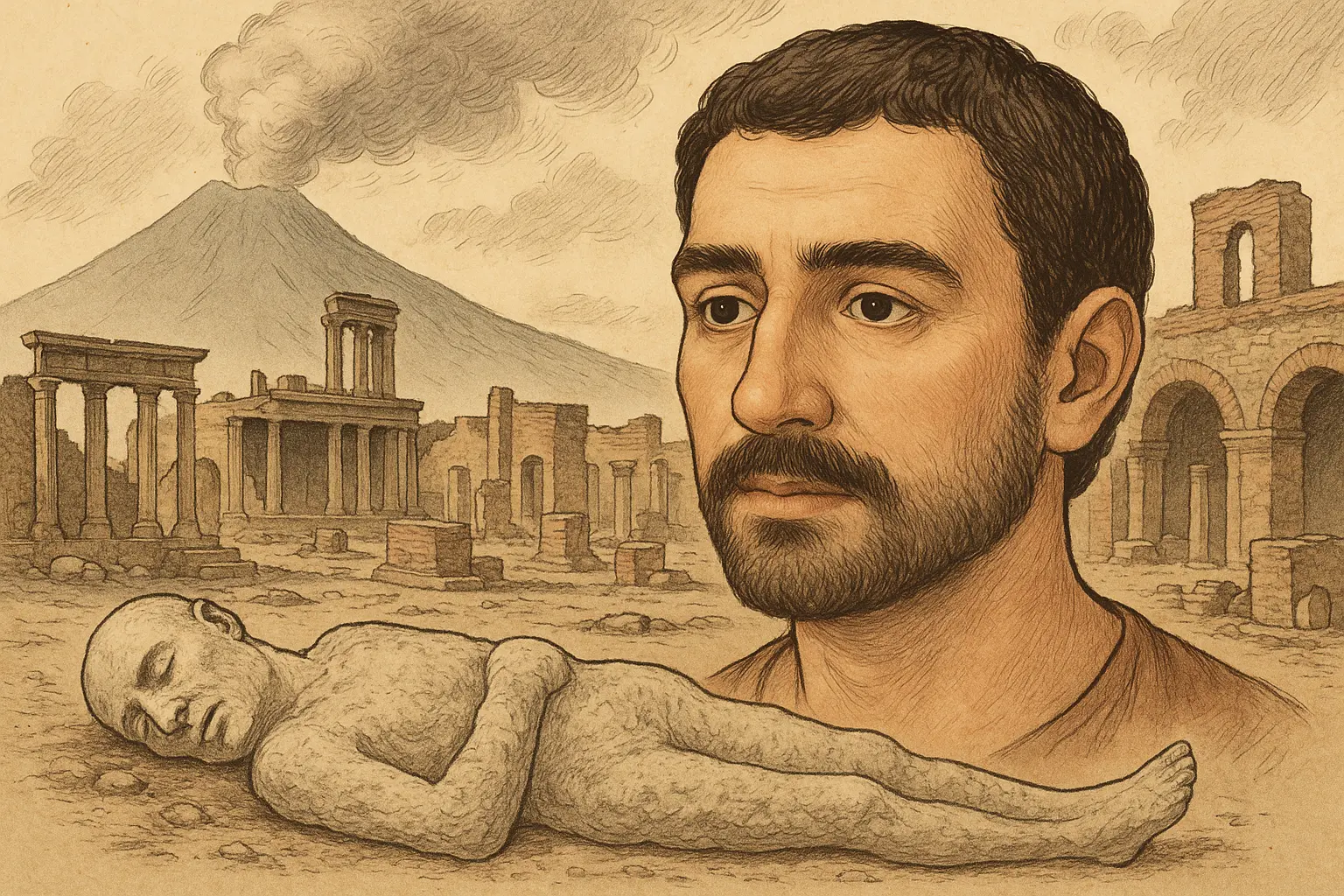
According to a report on April 28 by National Public Radio (NPR) in the United States, the Parco Archaeologico di Pompei (Pompeii Archaeological Park) announced that researchers for the first time used AI technology to digitally reconstruct the face of a man who died in the eruption of Mount Vesuvius in AD 79. According to a notice on the official website of the Pompeii Archaeological Park, the reconstruction work was completed in collaboration between the Pompeii Archaeological Park and the University of Padua.
AI Facial Reconstruction Method and Research Partner Organizations
According to the notice on the official website of the Pompeii Archaeological Park, this digital portrait uses AI technology and photo-editing techniques as tools to convert skeletal measurement data and archaeological findings into realistic images of a human face. It is the first time the Pompeii site has used AI technology to reconstruct the faces of the deceased. The reconstruction results were completed jointly by the Pompeii Archaeological Park and the University of Padua.
In an official statement, Gabriel Zuchtriegel, director of the Pompeii Archaeological Park, said: “Today, the vast scale of archaeological data can only be fully preserved and improved with the help of artificial intelligence. If used appropriately, artificial intelligence can contribute to the revival of classical research.”
Location Where the Deceased Remains and Archaeological Artifacts Were Found
According to an NPR report, the remains of the man whose face was reconstructed were unearthed together with the remains of another deceased person. The discovery site was on a path the man had tried to flee along, toward the coastline of present-day Italy. Based on archaeological data, the researchers concluded that the man died in the early phase of the volcanic eruption due to the violent impact of pyroclastic material.
According to a notice from the Pompeii Archaeological Park, archaeologists found the following personal archaeological artifacts beside the deceased remains:
· Ceramic mortar: archaeologists believe the man held it above his head, using it as temporary protection against volcanic rocks; ancient accounts by the Roman writer Pliny the Younger also describe that Pompeii residents protected themselves with objects
· Oil lamp
· Small iron rings
· Copper coins: a total of 10
According to an NPR report, the Pompeii Archaeological Park’s official website notice displays AI-generated images showing the man running along a rugged road and holding up the ceramic mortar to protect his head, with the backdrop depicting the eruption of Mount Vesuvius.
Research Goals: Scientific Basis and Public Engagement
According to an NPR report, the Pompeii Archaeological Park said that the AI reconstruction project aims to make archaeological research findings easier for the public to understand and engage with, while maintaining scientific rigor.
According to an NPR report, Pompeii is located near Naples in Italy. It is a UNESCO World Heritage site. When Mount Vesuvius erupted in AD 79, it was covered by volcanic ash and pumice, allowing the city remains and a large number of residents’ remains to be preserved intact.
Frequently Asked Questions
Which organization announced the results of Pompeii’s AI facial reconstruction? When was it released?
According to an April 28, 2026 NPR report, the Pompeii Archaeological Park announced the above research results on its official website, and the reconstruction work was completed in collaboration between the Pompeii Archaeological Park and the University of Padua.
What technical methods and data sources were used for this AI reconstruction?
According to the notice on the official website of the Pompeii Archaeological Park, the reconstruction is based on archaeological survey data from near the Stabian Gate cemetery. It combines skeletal measurement data and performs digital facial reconstruction through AI technology and photo-editing techniques.
What archaeological artifacts did the deceased whose face was reconstructed carry?
According to an NPR report, archaeologists found beside the deceased remains a ceramic mortar (archaeologists believe it was used as head protection), an oil lamp, a small iron ring, and 10 copper coins.
Disclaimer: The information on this page may come from third parties and does not represent the views or opinions of Gate. The content displayed on this page is for reference only and does not constitute any financial, investment, or legal advice. Gate does not guarantee the accuracy or completeness of the information and shall not be liable for any losses arising from the use of this information. Virtual asset investments carry high risks and are subject to significant price volatility. You may lose all of your invested principal. Please fully understand the relevant risks and make prudent decisions based on your own financial situation and risk tolerance. For details, please refer to
Disclaimer.
Related Articles
Global Accounts on the Bitcoin Network: Grid integrates 65 fiat currencies and cryptocurrencies, enabling AI to automatically make payments
Grid Global Account integrates fiat currency, stablecoins, and Bitcoin into a single wallet, and uses AI agents to help manage and make payments, enabling a new model for cross-border transactions. Through a global payment network covered by Visa, it supports multi-currency exchange and instant transfers; businesses can use stablecoins/fiat as the underlying cash flow to maintain decentralization and neutrality.
ChainNewsAbmedia14m ago
Pi Network: 1 Million KYC Users Complete 526 Million AI Verification Tasks
According to an article published on April 28 on the official Pi Network website, Pi Network announced that its decentralized workforce infrastructure has been completed by more than 1 million KYC identity-verified users with over 526 million verification tasks. The tasks are part of Pi’s native KYC system, and contributors are compensated with Pi tokens.
MarketWhisper2h ago
AWS Bedrock Now Offers OpenAI's Latest Models and Managed Agent Service
Gate News message, April 29 — Amazon Web Services announced that its Bedrock platform now supports OpenAI's latest models, including Codex, alongside a new managed agent service. The move follows changes to OpenAI's agreement with Microsoft, which had previously granted Azure exclusive rights to
GateNews3h ago
Blaize, Nokia, Datacomm Partner on AI Infrastructure in SEA
Partnership Announcement
Blaize, a US AI computing company, announced on April 28 a three-way partnership with Nokia and PT Datacomm Diangraha, an Indonesian IT services firm, according to Blaize Holdings. The companies will deploy hybrid AI inference infrastructure in Indonesia and Southeast
CryptoFrontier4h ago
Amazon Web Services Launches AI-Powered Tools for Logistics and Recruitment
Gate News message, April 28 — Amazon Web Services (AWS) announced the launch of Amazon Connect Decisions and Amazon Connect Talent, two AI-powered tools designed for logistics workers and recruiters.
The tools leverage AI agents to automate tasks on behalf of users, including conducting automated i
GateNews4h ago
Liquid Raises $18M in Series Seed Funding to Expand Multi-Asset Trading Platform
Gate News message, April 28 — Liquid, a non-custodial multi-asset trading platform, has closed an $18 million Series Seed funding round co-led by Left Lane Capital and Neo. The round also included participation from Paradigm, General Catalyst, Haun Ventures, K5 Global, SV Angel, AntiFund, and Sunflo
GateNews16h ago


