
The Solana Foundation announced the launch of the Solana Developer Platform (SDP) on March 24. This AI-ready developer platform is designed for enterprises and financial institutions, aiming to assist organizations in building and deploying financial products on the Solana blockchain in a compliant and scalable manner, all accessible via APIs. At launch, Mastercard, Western Union, and Worldpay were confirmed as early adopters.
Core Architecture of SDP: Three Main API Modules Supporting Institutional Finance Applications
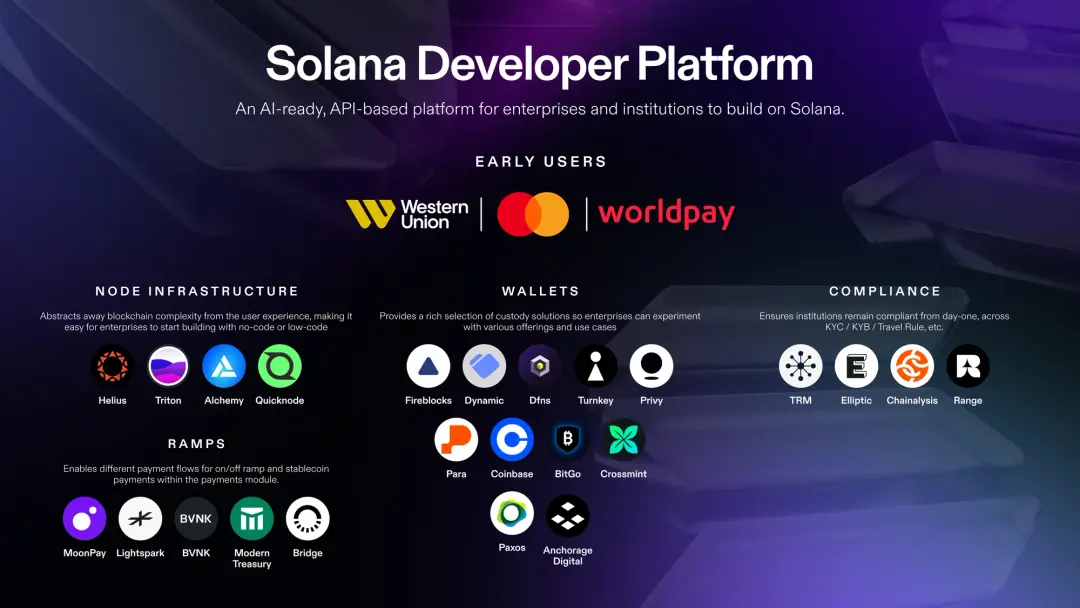
SDP integrates top infrastructure within the Solana ecosystem into a unified interface, consisting of three core functional modules:
Issuance Module: Supports tokenized deposits, issuance of stablecoins compliant with the GENIUS Act standards, or tokenized real-world assets (RWA); now live.
Payments Module: Coordinates fiat and stablecoin fund flows, covering on-ramp, off-ramp, and on-chain stablecoin transactions, supporting B2B, B2C, and P2P scenarios; now live.
Transactions Module: Supports atomic swaps, vaults, and on-chain forex, among other financial flows; scheduled for release in late 2026.
Catherine Gu, Head of Digital Asset Products at the Solana Foundation, stated: “SDP provides a convenient entry point for any financial institution to build on Solana from the start. It is fully API-based, eliminating technical and operational barriers that enterprise developers might face.”
Real-World Applications by Early Adopters and Four Infrastructure Ecosystem Categories
Three global financial institutions have adopted SDP based on their respective business needs. Mastercard is leveraging SDP to enable direct stablecoin settlement, combining blockchain speed and programmability with the reliability of its global payment network. Western Union uses SDP to add an API-driven on-chain layer, enabling end-to-end fiat and stablecoin transfers—viewed as a “modernization extension” rather than a replacement of existing networks. Worldpay utilizes the payments and issuance modules to provide merchants with on-chain settlement and tokenized asset access.
On the infrastructure level, SDP categorizes partners into four groups: node infrastructure (Alchemy, Helius, QuickNode, Triton); custodial wallet solutions (including Fireblocks, Coinbase, BitGo, Paxos, among others); compliance services (Chainalysis, Elliptic, Scope, TRM); and fiat ramp services (Bridge, BVNK, Lightspark, MoonPay).
AI Coding Integration and Sandbox Environment: Key to Lowering Institutional Onboarding Friction
SDP can be used in a sandbox environment built on the Solana testnet at launch, allowing institutions to conduct low-risk testing before deployment. It can also be directly integrated with AI coding platforms like Anthropic’s Claude Code and OpenAI’s Codex, significantly reducing the technical barriers for enterprise development teams lacking blockchain expertise.
SDP incorporates the latest Solana protocol features, including token extension for permission management and privacy protection, and connects directly to Solana’s rich developer ecosystem, ensuring institutions meet KYC/KYB and travel rule compliance from day one.
Frequently Asked Questions
Q: What is the Solana Developer Platform (SDP)?
A: SDP is an API-driven development platform launched by the Solana Foundation for enterprises and financial institutions. It consolidates three core modules—issuance, payments, and transactions—enabling organizations to build financial products on Solana with low technical barriers, compliance, and scalability.
Q: What are the main application scenarios for the three SDP modules?
A: The issuance module supports tokenized deposits, GENIUS-compliant stablecoins, and RWA issuance; the payments module supports fiat and stablecoin inflows and outflows, as well as on-chain transactions (covering B2B, B2C, P2P); the transactions module supports atomic swaps, vaults, and on-chain forex, with the latter scheduled for late 2026.
Q: Why did Mastercard, Worldpay, and Western Union choose SDP?
A: Each organization values different capabilities of SDP: Mastercard needs stablecoin settlement infrastructure; Western Union requires an on-chain extension for cross-border payments; and Worldpay seeks to provide merchants with access to tokenized assets. SDP’s API architecture allows these organizations to quickly deploy compliant solutions without building blockchain tech stacks from scratch.
Disclaimer: The information on this page may come from third parties and does not represent the views or opinions of Gate. The content displayed on this page is for reference only and does not constitute any financial, investment, or legal advice. Gate does not guarantee the accuracy or completeness of the information and shall not be liable for any losses arising from the use of this information. Virtual asset investments carry high risks and are subject to significant price volatility. You may lose all of your invested principal. Please fully understand the relevant risks and make prudent decisions based on your own financial situation and risk tolerance. For details, please refer to
Disclaimer.


