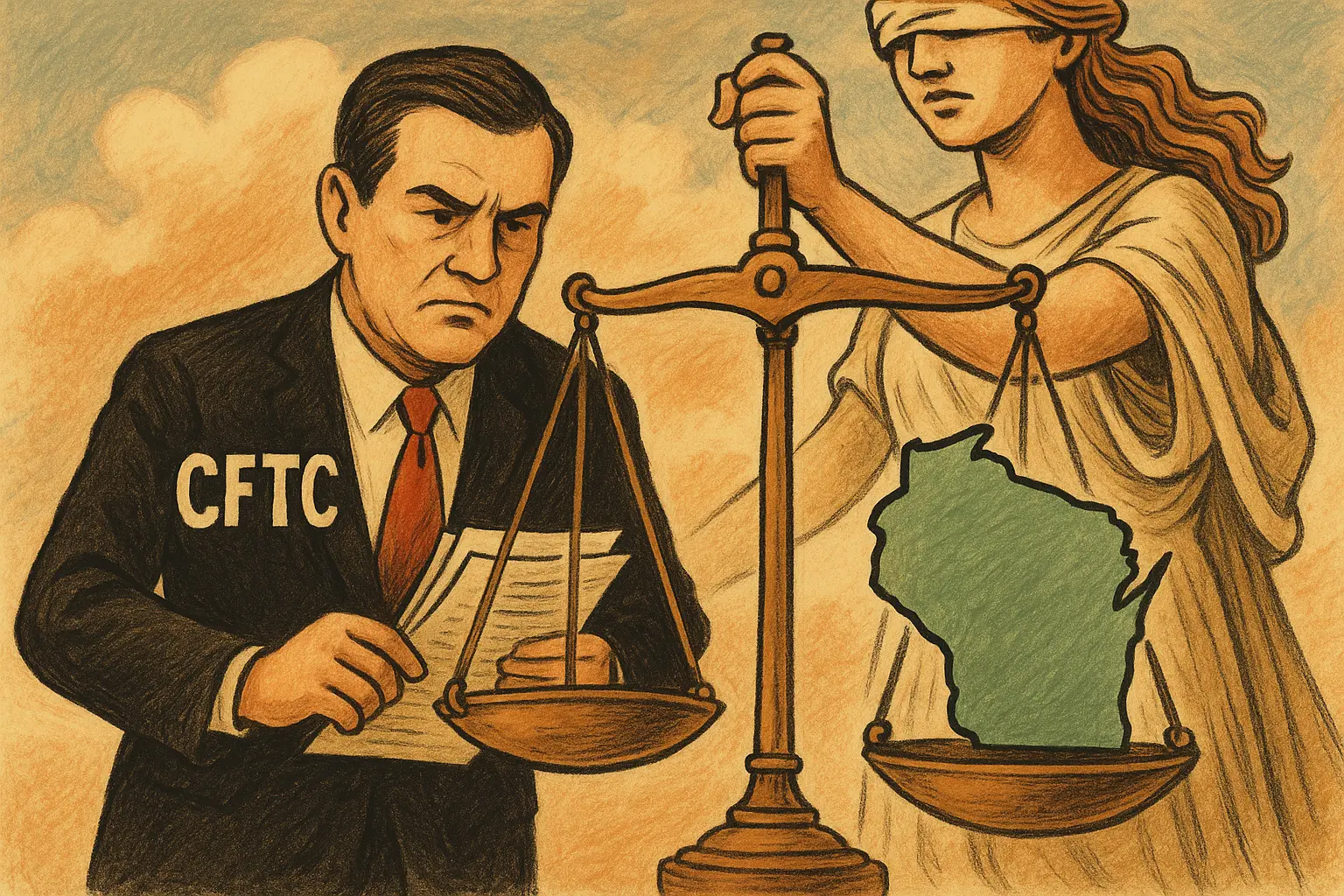
According to a report by The Block, on April 28 the U.S. Commodity Futures Trading Commission (CFTC) filed a lawsuit in the U.S. District Court for the Eastern District of Wisconsin, which is the fifth state in the past month that the CFTC has sued over the issue of jurisdiction over prediction markets. In its complaint, the CFTC argues that it has “exclusive jurisdiction” over prediction markets, saying that Wisconsin is trying to label federally regulated markets as criminal and is infringing on the federal regulatory framework designed by Congress.
CFTC’s Lawsuit Content and Claims of Federal Jurisdiction
According to the CFTC complaint cited by The Block, the CFTC states explicitly in the complaint: “Wisconsin is trying to criminalize federally regulated markets and shut down those markets, infringing on the exclusive federal plan Congress designed to regulate national swap markets.” The CFTC asks the court to declare that Wisconsin’s bans or regulations—where they apply to event-contract swaps traded on designated contract markets (DCMs) regulated by the CFTC—have been preempted by federal law and are therefore illegal.
According to The Block, the five states that CFTC has sued in the past month regarding regulatory jurisdiction disputes over prediction markets, in order, are:
· Illinois
· Arizona
· Connecticut
· New York
· Wisconsin (April 28, 2026)
According to The Block, CFTC Chair Michael Selig has begun drafting new rules and has publicly said that the agency has broad regulatory authority under existing regulations.
Wisconsin’s Earlier Litigation Action
According to The Block, in late April 2026 Wisconsin was the first to sue Coinbase, Robinhood, Crypto.com, Polymarket, and Kalshi, accusing the sports-event-related contracts on the aforementioned platforms of constituting “public nuisance.” With Wisconsin’s lawsuit action first, the CFTC subsequently filed this federal lawsuit against Wisconsin on April 28.
Alliance of 37 State Attorneys General: Amicus Brief
According to The Block, including New York and Oklahoma, 37 state attorneys general jointly submitted an amicus brief to a Massachusetts court last week, supporting the states’ ruling on the regulation of prediction markets. The brief urges the court to uphold the January 2026 ruling, which found that Kalshi had not obtained a Massachusetts gaming commission license and therefore may not offer sports-event contracts to residents of the state.
In a joint statement, New York Attorney General Letitia James said: “If Congress intended to overturn the longstanding tradition of state oversight of the gambling industry since the founding, it should say so clearly… The CFTC cannot claim exclusive authority to regulate a gambling industry worth billions of dollars based on a legal provision that fundamentally does not mention gambling.”
Frequently Asked Questions
When did the CFTC sue Wisconsin? Which officials are the defendants?
According to The Block’s report dated April 28, 2026, on the same day the CFTC filed suit in the U.S. District Court for the Eastern District of Wisconsin. The defendants include Governor Tony Evers, Attorney General Joshua Kaul, and John Dillett, director of the state agency’s sports wagering oversight office.
Which states has the CFTC sued in the past month over prediction-market jurisdiction issues?
According to The Block, in one month the CFTC has sued Illinois, Arizona, Connecticut, New York, and Wisconsin in sequence—five states in total.
Which platforms did Wisconsin sue last week? What are the allegations based on?
According to The Block, Wisconsin sued Coinbase, Robinhood, Crypto.com, Polymarket, and Kalshi, accusing the sports-event-related contracts on the aforementioned platforms of constituting “public nuisance.”
Disclaimer: The information on this page may come from third parties and does not represent the views or opinions of Gate. The content displayed on this page is for reference only and does not constitute any financial, investment, or legal advice. Gate does not guarantee the accuracy or completeness of the information and shall not be liable for any losses arising from the use of this information. Virtual asset investments carry high risks and are subject to significant price volatility. You may lose all of your invested principal. Please fully understand the relevant risks and make prudent decisions based on your own financial situation and risk tolerance. For details, please refer to
Disclaimer.
Related Articles
Prediction Market ETF Set to Launch Next Week, Focused on U.S. Congressional Election Outcomes
Gate News message, April 29 — Roundhill's prediction market ETF is expected to launch next week (May 5), according to Bloomberg ETF analyst James Seyffart. The firm has submitted its application, with an effective date set for May 5.
The inaugural prediction market ETF will track outcomes of U.S. c
GateNews55m ago
Polymarket Data Breach Exposes Over 300K Records, Threat Actor Releases Exploit Tools
Gate News message, April 29 — Decentralized prediction market platform Polymarket appears to have suffered a data breach, with threat actor xorcat releasing over 300,000 data records and accompanying exploit tools on a known cybercriminal forum. According to reports, attackers exploited undisclosed
GateNews1h ago
Gate Daily Report (April 29): Prediction market ETF is expected to launch next week; Trading Protocol treasury was attacked
Bitcoin (BTC) continued its soft trading posture, with it temporarily trading around $76,250 as of April 29. A Bloomberg ETF analyst posted that the market is expected to roll out the ETF next week. According to PeckShield monitoring, a suspected Trading Protocol YieldCore-3rd-deal treasury was attacked, resulting in losses of about $398k.
MarketWhisper2h ago
Low-Probability Account Bets $70K on Knicks to Beat Hawks in NBA Playoff Game 5 on Polymarket
Gate News message, April 29 — On Polymarket's prediction market for NBA Eastern Conference First Round Game 5 between the Knicks and Hawks, an account with a 35% win rate (0xe5b70fd855af9258d9463992e4f1ed7987905ee3) purchased approximately $70,000 in contracts betting on a Knicks victory. The accoun
GateNews4h ago
Polymarket Pushes CFTC for US Main Exchange Access
Polymarket has been in active discussions with the Commodity Futures Trading Commission in recent weeks to lift the ban on US-based customers trading directly on its international exchange, Bloomberg reported Tuesday. The company recorded over $10 billion in monthly trading volume in March 2026 with
CryptoFrontier4h ago
Polymarket in Talks with CFTC to Bring Main Exchange Back to U.S.
Gate News message, April 28 — Polymarket is exploring a path to bring its main exchange back to the United States through discussions with the Commodity Futures Trading Commission (CFTC), according to Bloomberg.
The prediction market platform re-entered the U.S. market last year after acquiring QCE
GateNews13h ago


