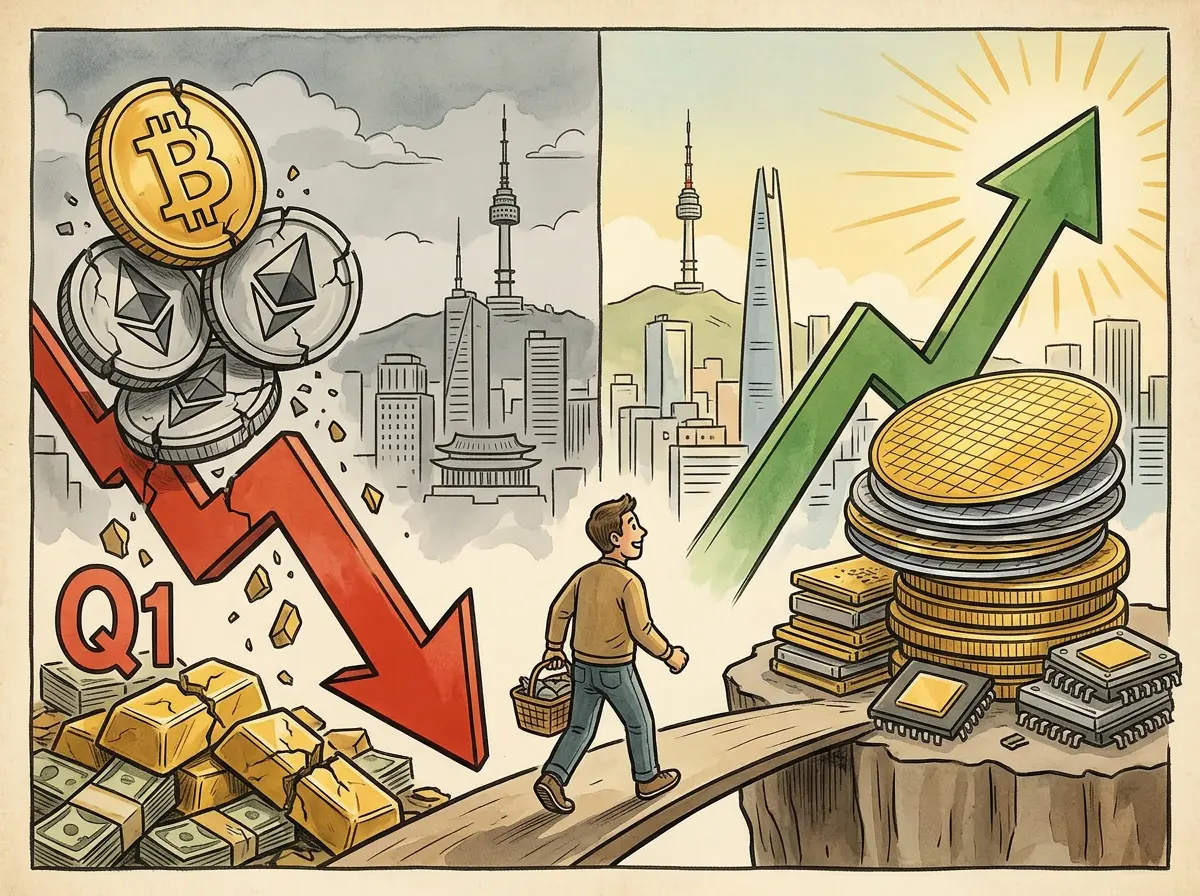
TRM Labs data shows that in Korea, retail crypto trading volume in Q1 2026 was $69 billion, ranking second globally, but down 28% year-on-year from the same period last year. It recorded the largest decline among major markets, well above the global average decline of 20% for the same period. The Korea Times reported on June 17, citing analysts who said that one of the main reasons is that AI semiconductor stocks absorbed the retail speculative funds that would otherwise have flowed into the crypto market.
TRM Labs’ Global Market Ranking and Korea’s Decline
Based on TRM Labs’ Q1 data, the top five countries for global retail crypto trading volume are confirmed as follows: the United States led with $212 billion, Korea ranked second with $69 billion, followed by Russia ($48 billion), India ($46 billion), and Turkey ($40 billion). Korea’s 28% year-on-year decline is the largest among major markets, while the global average decline is 20%.
KOSPI’s 196% Surge and the Confirmed Diversion Effect from Semiconductor Stocks
KOSPI has surged by about 196% over the past year, ranking first among G20 countries and overtaking all developed economies. It has been driven mainly by AI semiconductor stocks. Some KOSPI constituent stocks’ single-day gains have already surpassed mainstream crypto: on Monday, Bitcoin rose 4.7%, while SK Hynix and Samsung Motors increased 6.42% and 16.63%, respectively.
Kaiko Research analyst Laurens Fraussen confirmed that Korea’s share of Bitcoin and altcoin allocations reflect heavy use by retail investors, with speculative capital rapidly rotating among small-cap assets seeking returns driven by volatility and momentum. KOSPI’s high everyday volatility is replacing the incentive that previously drove retail investors into the crypto market.
Analyst Notes on Regulatory Constraints and the Product Gap
Dispatch (a Nexo subsidiary) analyst Dessislava Ianeva said that the Virtual Asset User Protection Act raises compliance requirements for domestic exchanges in South Korea. Current rules limit them to spot trading only, while overseas platforms offer a wider range of products such as derivatives, leverage, and pre-market trading.
Ianeva said: “The continuous recovery of Bitcoin prices and broader crypto prices will be the most direct catalyst for retail investors to re-enter. A regulatory framework that can bridge the product gap between domestic and overseas platforms—especially in derivatives—will be a more enduring structural driver.”
Frequently Asked Questions
Why is South Korea’s crypto trading volume decline higher than the global average?
According to the analysts’ confirmation, South Korea’s retail speculative capital is highly sensitive to volatility and opportunities for momentum-driven returns. When KOSPI offers higher returns and greater daily volatility, the funds that would have flowed into the crypto market accelerate their shift. In addition, the Virtual Asset User Protection Act restricts the product range of domestic platforms, further reducing the relative attractiveness of South Korea’s crypto market.
Is South Korea still a major crypto market globally?
Based on TRM Labs’ Q1 data, although trading volume is down 28% year-on-year, South Korea still ranks second globally with $69 billion, ahead of Russia, India, and Turkey, and remains one of the most active retail crypto markets in the world.
What does Ianeva mean by a “regulatory framework that can bridge the product gap”?
Ianeva confirmed that what she refers to is regulatory liberalization that would allow South Korean domestic exchanges to offer derivatives (such as Bitcoin and Ethereum futures), margin trading, and pre-market trading—products that are currently limited on domestic platforms in South Korea, leading investors who want to use these tools to flow to overseas platforms.


