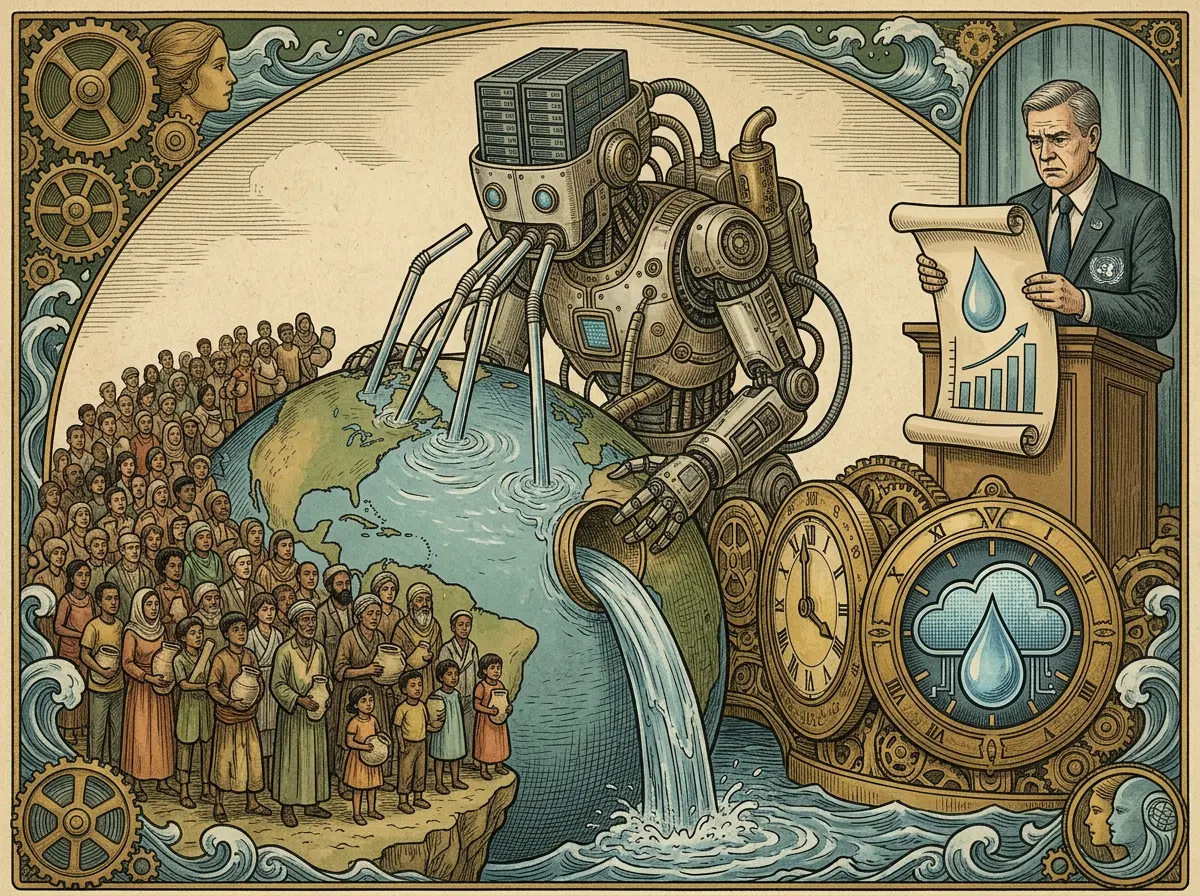
Miriam Aczel, a researcher at the United Nations University Institute for Water, Environment and Health (UNU-INWEH) and the report’s main author, warned on June 7 that, by 2030, data center facilities running AI systems could consume 9.3 trillion liters of water per year—equivalent to the annual basic water needs of 1.3 billion people in sub-Saharan Africa.
Three Confirmed 2030 Resource Estimates
According to UNU-INWEH’s report, the three key resource estimate figures are as follows: annual water use reaches 9.3 trillion liters (equivalent to the annual basic water needs of 1.3 billion people); electricity consumption reaches 945 terawatt-hours; land demand exceeds 14,500 square kilometers (covering sites, energy infrastructure, and supply chains).
Ren Shaolei, a professor of computational engineering at the University of California, Riverside (via the English edition of The National News), said: “This report is both timely and important in reminding us that AI isn’t limited to models and algorithms—it also has real physical and environmental impacts on data centers, power systems, water supply systems, land use, and hardware supply chains.”
Confirmed Mechanisms of AI Resource Consumption
AI inference (everyday use, not training) accounts for 80% to 90% of total AI energy consumption, making routine daily use the primary source of resource consumption. ChatGPT processes around 2.5 billion prompt messages per day; a single standard chatbot conversation consumes far more energy than a simple classification task. Alex Hernandez, a researcher at the Quebec AI Institute, noted that the energy consumption of AI systems is still difficult to measure precisely, which limits the accuracy of forecasts.
Common Questions
What is the basis for UNU-INWEH’s forecast of 9.3 trillion liters of water?
UNU-INWEH’s water-use estimates cover two levels: the direct water use of data center cooling systems (water footprint), and indirect water use related to electricity generation. The report incorporates water consumption from electricity sources into its calculation framework, rather than limiting it to direct water consumption at data center sites. Researcher Alex Hernandez pointed out that energy-consumption data for AI facilities themselves still remains difficult to measure precisely, so this estimate contains inherent uncertainty.
Why would carbon-reduction measures lead to more than a 30-fold increase in water use?
Based on UNU-INWEH’s research analysis, shifting data center electricity from coal to bioenergy is a common carbon-reduction pathway that could reduce carbon emissions by about 70%; however, growing bioenergy requires large amounts of irrigation water and also occupies extensive agricultural land. This results in water use increasing by more than 30 times and land-use increasing by roughly 100 times. Aczel said that using only carbon emissions as the metric for environmental impact would hide the costs of these water resources and land.
Can more efficient AI models significantly reduce water resource consumption?
UNU-INWEH’s report mentions the risk of a “rebound effect”: cheaper, more efficient AI may reduce resource consumption per use, but the lower costs typically lead to a large increase in usage frequency, which could ultimately make overall resource consumption higher than before efficiency improvements. Therefore, whether model-efficiency improvements can reduce AI’s impact on water resources at the macro level depends on whether the growth rate of usage scale outpaces the magnitude of the efficiency gains.


