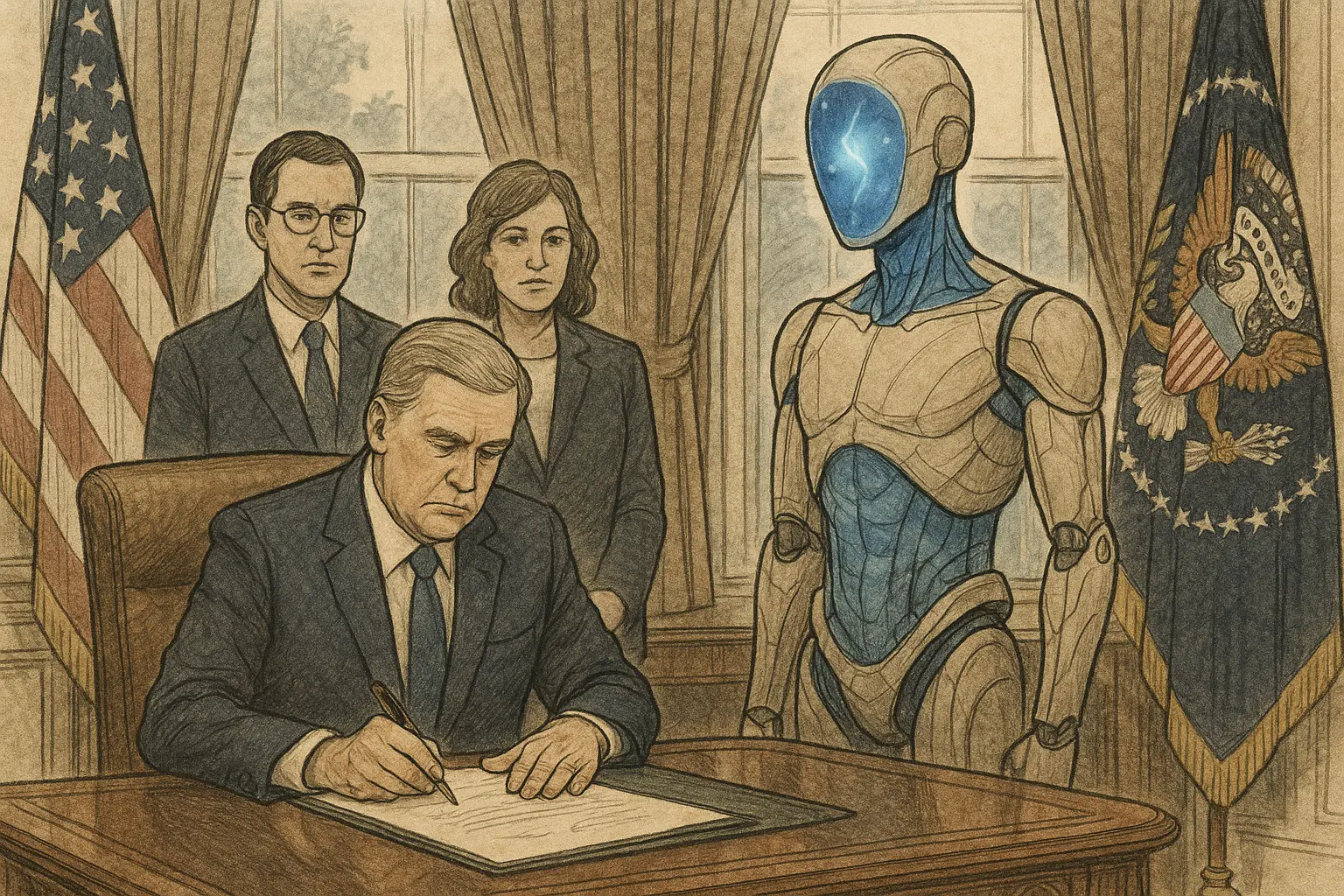
According to a report from Axios citing an insider on April 28, the White House is drafting guidance that would allow federal agencies to bypass Anthropic’s Supply Chain Risk Determination (SCRD), and introduce new models for government use, including Anthropic’s Mythos model. In this connection, the White House issued an official statement saying that any policy announcements would be released directly by the president, and that any other claims are purely speculation.
White House Recent Contact and Proposed Measures
According to an Axios report on April 28, earlier this month, White House Chief of Staff Susie Wiles and U.S. Treasury Secretary Scott Bessent met with Anthropic CEO Dario Amodei together. Both sides described the meeting as a productive introductory discussion that covered areas for cooperation between the company and the government.
This week, the White House convened companies across the industry to share information on potential administrative measures and best practices for deploying the Mythos system. According to the Axios report, the relevant meetings included “table reads” of the proposed guidance. The guidance could overturn instructions previously issued by the Office of Management and Budget (OMB) that government departments may not use Anthropic systems. Anthropic declined to comment on the Axios report.
Dispute Background: Supply Chain Risk Determinations and Pentagon Legal Lawsuits
According to an Axios report on April 28, the Department of Defense (DoD) previously issued supply chain risk determinations regarding Anthropic and filed a lawsuit in court. The crux of the dispute is that Anthropic refused to sign an agreement allowing the Pentagon to use Claude models under an “all lawful purposes” standard (covering drone applications). Anthropic’s explicit prohibitions include large-scale domestic surveillance and the development of fully autonomous weapons. The Pentagon said Anthropic’s refusal shows it is not a reliable partner.
According to the Axios report, although the legal lawsuit is ongoing, government agencies—including the Pentagon—are still able to use some of Anthropic’s models. The U.S. National Security Agency (NSA) is also using Mythos. However, the Pentagon is currently relying on older versions of the service terms that both sides consider too strict, and it cannot obtain the latest updated versions of Anthropic models.
Anthropic’s Core Position and Peer Comparisons
According to an Axios report on April 28, Anthropic insists on refusing to sign an “all lawful purposes” agreement and clearly prohibits uses that include large-scale domestic surveillance and the development of fully autonomous weapons.
The Axios report also noted that OpenAI and Google have both signed agreements with the Pentagon allowing, in classified environments, the use of their models under an “all lawful purposes” standard; both companies claim that the agreements respect the two prohibitions that Anthropic defined.
FAQ
What exactly does the White House’s proposed guidance on Anthropic include?
According to an Axios report citing an insider on April 28, the White House is drafting guidance that would allow federal agencies to bypass Anthropic’s supply chain risk determinations. The measures may be issued in the form of an executive order and would include deployment guidance for the Mythos model. The White House’s official statement says that any policy announcements would be issued directly by the president.
What is the root cause of the dispute between the Pentagon and Anthropic?
According to an Axios report on April 28, the dispute began when Anthropic refused to sign an agreement allowing the Pentagon to use Claude models under an “all lawful purposes” standard. The explicitly prohibited uses include large-scale domestic surveillance and the development of fully autonomous weapons. The Pentagon then issued supply chain risk determinations and brought a legal lawsuit.
What are OpenAI and Google’s positions on the same issue?
According to an Axios report on April 28, both OpenAI and Google have signed agreements with the Pentagon allowing, in classified environments, the use of their models under an “all lawful purposes” standard. The two companies both claim that the agreements respect the two prohibitions that Anthropic defined.
Disclaimer: The information on this page may come from third parties and does not represent the views or opinions of Gate. The content displayed on this page is for reference only and does not constitute any financial, investment, or legal advice. Gate does not guarantee the accuracy or completeness of the information and shall not be liable for any losses arising from the use of this information. Virtual asset investments carry high risks and are subject to significant price volatility. You may lose all of your invested principal. Please fully understand the relevant risks and make prudent decisions based on your own financial situation and risk tolerance. For details, please refer to
Disclaimer.
Related Articles
Ant Group's Ling-2.6-flash Model Open-Sourced: 104B Parameters With 7.4B Active, Achieves Multiple SOTA Benchmarks
Gate News message, April 29 — Ant Group's Ling-2.6-flash model weights are now open-sourced, having previously been available only via API. The model features 104 billion total parameters with 7.4 billion activated per inference, a 256K context window, and MIT licensing. BF16, FP8, and INT4
GateNews4m ago
Sam Altman posted screenshots of the Codex dual-mode, with office and programming functions officially split.
OpenAI CEO Sam Altman shared screenshots and a statement on X on April 29, and Codex is rolling out a new guided interface. When users enter for the first time, they must choose between two modes: Excelmogging and Codemaxxing. Codex’s current weekly active users have already exceeded 4 million, and its use cases have expanded from code generation to non-technical applications.
MarketWhisper16m ago
OpenAI's Codex Rolls Out Dual-Mode Interface: Excelmogging for Office Work, Codemaxxing for Coding
Gate News message, April 29 — OpenAI CEO Sam Altman announced a redesigned Codex interface on X today, introducing two distinct modes for users. "Excelmogging" targets everyday office tasks with a simplified interface and the tagline "Same tools, simpler interface," featuring example tasks like
GateNews1h ago
Taylor Swift applies for audio and image trademarks to prevent the spread of AI impersonation content
According to a report by the BBC on April 28, American pop singer Taylor Swift has filed three trademark applications in the United States, covering sound audio clips and stage images. The purpose is to protect her voice and appearance from AI impersonation; trademark attorney Josh Gerben first disclosed the details of the above applications on his blog.
MarketWhisper1h ago
White House Drafts Guidance to Allow Anthropic Use, Waive Supply Chain Risk Determinations
Gate News message, April 29 — The White House is drafting executive guidance that would allow government agencies to waive supply chain risk determinations for Anthropic and introduce new AI models including Mythos, according to sources familiar with the matter. The proposed administrative measure c
GateNews2h ago
GPT-5.4 Pro Solves the 60-Year Erdős Conjecture #1196
According to reports from OpenAI and Scientific American, 23-year-old amateur Liam Price, with help from GPT-5.4 Pro, solved the Erdős#1196 original set problem that had gone unsolved for 60 years. It took about 80 minutes of reasoning, 30 minutes to organize the results into LaTeX, and submit them to erdosproblems.com for review. The key is linking integer structures with Markov processes; Tao and Lichtman have expressed approval. It is still in the community verification stage and has not yet been completed for peer review. The information is available in ABMedia and the OpenAI 4/28 Podcast.
ChainNewsAbmedia2h ago


