PopulusEuphratica

vip
Age 1.5 Year
Peak Tier 1
Not seeking big profits, only aiming for small losses, playing it safe and steadily making profits.
Many projects talk about combining AI and Web3, but most only stay at the application layer, whereas @0G_labs gives me the feeling that it's adapting to AI's needs from the foundational level.
One of AI's biggest challenges is massive data volume and frequent computation, which actually conflicts with traditional blockchain design. However, 0G tackles this by separating storage and data availability and combining it with high-throughput design, attempting to enable the chain to handle heavier data loads.
From a user perspective, the significance of this design is that truly on-chain AI service
0G0.01%
View Original
post-image
  • Reward
  • 4
  • Repost
  • Share
Tony88888vip:
Wishing you great wealth in the Year of the Horse 🐴
View More
As you continue experiencing @easydotfunX, you gradually realize one thing: when users feel something is simple, it doesn't mean the system is actually simple—complexity has just been shifted elsewhere.
What you see on the frontend is smooth interaction, but behind the scenes, it actually involves account abstraction, transaction processing, and an entire middleware logic stack. The core of this design is that users don't bear the complexity; the system does.
From a user's perspective, this experience is very comfortable because you can focus on the action itself rather than operational detail
View Original
post-image
  • Reward
  • Comment
  • Repost
  • Share
Many people look at @dgrid_ai and start with the technology, like distributed computing and AI scheduling, but my personal feeling is that these aren't actually the most critical factors.
What really determines whether this project can succeed is whether the network itself can achieve scale. Are there enough compute providers? Is there stable demand? And can the two sides continuously match?
From a user's perspective, it's actually very practical. You don't care about technical details; you care about whether it works, if the price is reasonable, and if the results are stable.
In my experience
View Original
post-image
  • Reward
  • Comment
  • Repost
  • Share
At first, I thought @watchdotfun was just moving luxury goods onto the chain to sell, but after using it for a while, I discovered it's more like building a lightweight on-chain entertainment infrastructure.
The platform regularly launches different watch drops, with participation details and winning probabilities for each pool publicly disclosed, and results generated through on-chain randomization mechanisms—a design that's more transparent than traditional raffles.
But the key point is that it transforms the uncertainty of outcomes into content that can be continuously consumed. You keep ch
View Original
post-image
  • Reward
  • Comment
  • Repost
  • Share
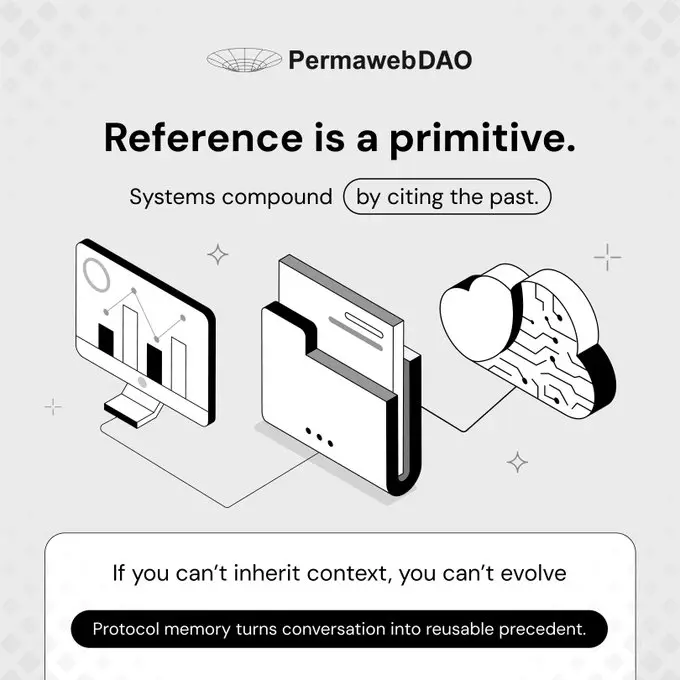
As current content platforms continue to evolve, the emergence of @Permaweb_DAO has actually led the way in implementing censorship-resistant content infrastructure.
A core characteristic of traditional content platforms is that they maintain ultimate control over content. Whether it's deletion, throttling, or rule adjustments, users remain in a passive position. This structure improved management efficiency in the early stages, but also limited the boundaries of content expression.
Based on permanent storage networks, Permaweb allows content, once published, to be extremely difficult to delet
View Original
post-image
  • Reward
  • Comment
  • Repost
  • Share
As DeFi gradually evolves toward specialization, the emergence of @TermMaxFi has actually pioneered a yield management approach that better aligns with institutional-grade requirements.
Traditional DeFi yields mostly stem from liquidity mining or short-term strategies, fundamentally relying on market volatility and incentive mechanisms. This yield structure is unstable for ordinary users and difficult for institutions to incorporate into their risk management frameworks. What TermMaxFi provides is a yield pathway that can be predefined and managed in advance.
By dividing capital into positions
View Original
post-image
  • Reward
  • Comment
  • Repost
  • Share
In the context of continuously evolving AI infrastructure, the emergence of @dgrid_ai actually pioneers a network architecture better suited for long-term scalability.
Many AI projects can develop rapidly in their early stages, but as they scale, centralized architectures gradually expose bottlenecks, including rising costs, limited expansion capabilities, and increased single points of failure. dgrid_ai chose to adopt a distributed network structure from the start, embedding scalability into the system design.
The advantage of this architecture is that it can naturally scale as nodes increase
View Original
post-image
  • Reward
  • Comment
  • Repost
  • Share
  • Pin