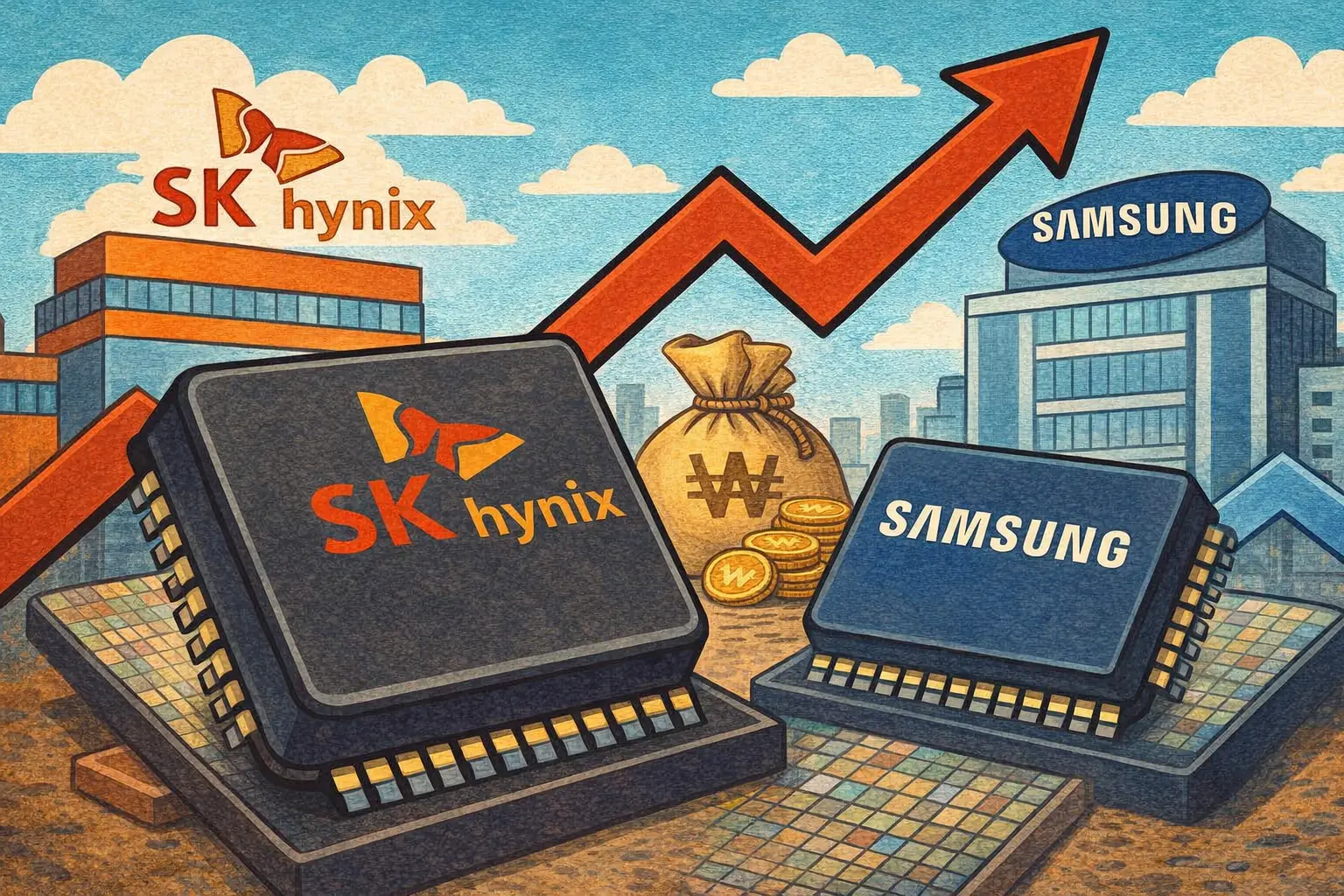
According to data from a Korean exchange on June 22, SK hynix’s share price closed at 291.9 ten thousand Korean won (+5.61%), and its market capitalization reached 2,080.38 trillion Korean won. It surpassed Samsung Electronics’ intraday market cap of 2,066.66 trillion Korean won for the first time, becoming the largest company by market capitalization listed on the Korea Composite Stock Price Index (KOSPI). This marks the end of Samsung Electronics’ 25 years and 7 months reign as the top KOSPI market-cap company.
Korean exchange data: SK hynix’s market cap of 2,080.38 trillion Korean won surpasses Samsung Electronics
According to June 22 closing data from a Korean exchange: SK hynix closed at 291.9 ten thousand Korean won, up 5.61% from the prior trading day; its market cap was 2,080.38 trillion Korean won. Samsung Electronics’ market cap on the same day was 2,066.66 trillion Korean won. SK hynix surpassed Samsung by about 13.72 trillion Korean won. This is the first time since November 21, 2000 that the company at the top of the KOSPI market-cap ranking has changed hands; Samsung Electronics’ dominance has continued for 25 years and 7 months.
SK hynix secretly filed ADR listing documents with the SEC in March
According to reports, SK hynix plans to issue American Depositary Receipts (ADRs) in the United States. In March this year, it secretly submitted the relevant registration documents to the U.S. SEC in order to seek a U.S. listing. Market participants believe that listing in the U.S. would help global investors access its shares more easily and could bring its valuation closer to the level of major U.S. semiconductor companies. The news of the ADR listing plan is considered one of the factors that recently boosted investor sentiment.
Asia stock markets on June 23 opened lower in Japan and South Korea: KOSPI falls below 90,000 points; SK hynix down 1.3%
According to market data during the Asia trading session on June 23: KOSPI opened down 1.6%, falling below the 90,000-point mark to 8,968.43 points. The Nikkei 225 opened down 0.33%, falling more than 200 points to 72,112.43 points. SK hynix opened down 1.3% to 291 ten thousand Korean won, while Samsung Electronics opened down more than 1% at 349,500 Korean won. Kioxia (Kioxia) opened up 1.79% to 110,600 Japanese yen.
Factors weighing on the market include: U.S. Alphabet leading lower and the Nasdaq index down 1.32%; SpaceX (SPCX) shares plunging more than 16%; crude oil prices falling sharply after comments from Trump about “possibly controlling the Strait of Hormuz”; and the release of MSCI’s annual market classification assessment results.
Frequently asked questions
When did SK hynix’s market cap first surpass Samsung Electronics?
Based on June 22, 2026 closing data from the Korean exchange, SK hynix’s market cap reached 2,080.38 trillion Korean won after the close that day, first surpassing Samsung Electronics’ 2,066.66 trillion Korean won. It became the No. 1 company on KOSPI by market capitalization, ending Samsung’s 25 years and 7 months long dominance since November 21, 2000.
If preferred shares are included, is Samsung Electronics still larger than SK hynix by market cap?
Yes. According to reports, as of June 22, if Samsung Electronics’ preferred shares (market cap of about 180 trillion Korean won) are included in total market cap, Samsung Electronics’ combined market cap still remains in the lead. The SK hynix surpassing Samsung mentioned in this article is based on a comparison of ordinary-share market cap and does not include preferred shares.
Why does SK hynix benefit more directly from AI demand than Samsung Electronics?
According to reports, SK hynix’s business is mainly focused on memory semiconductors (DRAM and HBM). Therefore, it benefits more directly than Samsung Electronics, whose business is more diversified, from the AI-driven supply tightness and price increases of memory chips. Samsung Electronics, in addition to memory semiconductors, also covers smartphones, TVs, home appliances, and displays. Rising memory prices simultaneously increase its component costs for finished products, while weak performance in its non-memory semiconductor business (foundry and system-on-chip) is also considered to limit the relative upside of Samsung’s stock price.


