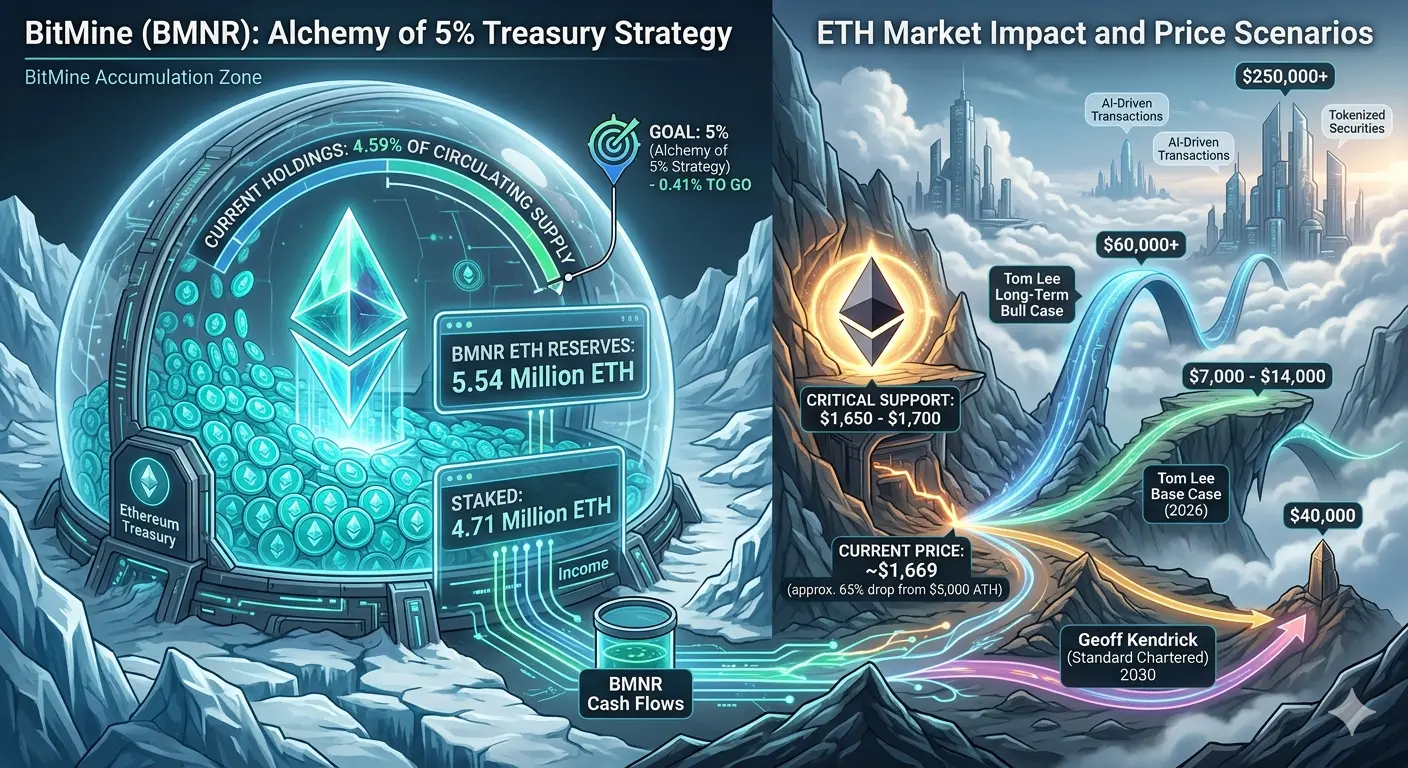
#BitmineAddsAnother25KEther
When Price Weakness Becomes a Supply-Side Conviction Signal
Markets rarely tell the truth in price.
They reveal it in positioning.
The latest accumulation of 25,000 ETH (~$42M) during a market dip is not just a buy-the-dip event.
It is a structural reinforcement under volatility stress.
And in institutional markets, that distinction matters more than the headline itself.
---
🧠 1. THE REAL SIGNAL: THIS IS NO LONGER RETAIL FLOW
When an entity accumulates roughly 4.5% of total ETH supply (~5.42M ETH), market behavior shifts fundamentally.
It is no longer speculation.
It becomes:
• Supply positioning strategy
• Yield-optimized capital deployment
• Long-duration network exposure construction
Especially when over 85% of holdings are staked, generating ~$230M annualized yield, the asset stops behaving like a trade.
It starts behaving like a yield-bearing macro infrastructure position.
---
📉 2. PRICE VS POSITIONING DIVERGENCE
The recent break below $1,700 ETH was interpreted by retail as weakness.
But institutional flow suggests something else entirely:
• Price is falling
• Accumulation is accelerating
• Staking exposure is increasing
• Liquid supply is tightening
This is a classic divergence regime:
👉 Short-term price discovery vs long-term capital conviction
And historically, these phases do not resolve quietly.
They resolve through repricing events.
---
🔒 3. SUPPLY MICROSTRUCTURE SHIFT: WHY 4.5% MATTERS
Holding ~4.5% of circulating ETH is not symbolic — it is structural.
It implies:
• Reduced free float in open markets
• Higher sensitivity to marginal demand
• Lower liquidity depth in spot order books
• Amplified impact of institutional flows
When supply migrates into staking + custody, markets transition from:
👉 Liquid speculation → Illiquid accumulation regime
This is where future volatility clusters are often born.
---
🔁 4. THE STAKING FLYWHEEL: YIELD BECOMES ACCUMULATION ENGINE
The reported $230M annualized staking yield introduces a compounding mechanism:
• ETH is accumulated on weakness
• Immediately staked for yield
• Yield reinvested into further accumulation
• Supply tightens further
This creates a self-reinforcing capital loop:
👉 Yield → Reinvestment → Supply absorption → Further yield expansion
This is not passive holding.
It is active supply compression through yield mechanics.
---
🏛️ 5. FUNDAMENTALS VS MARKET PSYCHOLOGY
As highlighted by Tom Lee’s macro framing:
Markets often misprice during transitions where:
• Price reflects short-term liquidity stress
• Fundamentals reflect long-term network monetization
This gap is where structural inefficiencies emerge.
Because markets are emotional in the short term…
But structural in the long term.
---
⚖️ 6. TWO POSSIBLE REGIMES FROM HERE
🟢 Bullish Structural Path: Supply Shock Formation
If accumulation continues:
• Free float shrinks further
• Staking ratio increases
• Liquidity becomes thinner
• Demand shocks have amplified impact
This creates conditions for a latent supply shock regime.
---
🔴 Bearish Structural Path: Absorption Without Repricing
If macro liquidity weakens:
• Accumulation absorbs supply but does not lift price
• Market remains range-bound
• Retail demand stays weak
• Repricing is delayed, not denied
This becomes a long-duration absorption phase.
---
⚠️ 7. KEY RISK: CONCENTRATION IS A DOUBLE-EDGED STRUCTURE
High supply concentration introduces two opposing forces:
✔ Positive: Scarcity increases over time
❌ Negative: Liquidity fragility increases short-term volatility risk
When liquidity is thin, even small shifts in behavior can trigger sharp repricing events.
---
🧠 8. TRADER TAKEAWAY: THIS IS NOT A TREND — IT IS AN ABSORPTION PHASE
Current structure is defined by:
• Weak directional trend
• Strong institutional accumulation
• High staking lock-up ratio
• Declining liquid supply
This is not expansion yet.
This is pre-expansion accumulation mechanics.
💡 FINAL INSIGHT
Bitmine’s continued ETH accumulation below $1,700 is not a timing signal.
It is a structure signal.
It suggests that Ethereum is increasingly being treated not as a speculative asset…
But as a yield-bearing, supply-constrained macro infrastructure layer.
And in markets, when liquidity, yield, and accumulation align on one side of the equation…
Equilibrium rarely lasts for long.
---
📊 Final Question for Traders:
If ETH supply continues shifting into staking while price remains suppressed… are we witnessing undervaluation — or just delayed repricing of a new macro asset class?
#BitmineAddsAnother25KEther #CryptoMarkets #GateSquare
When Price Weakness Becomes a Supply-Side Conviction Signal
Markets rarely tell the truth in price.
They reveal it in positioning.
The latest accumulation of 25,000 ETH (~$42M) during a market dip is not just a buy-the-dip event.
It is a structural reinforcement under volatility stress.
And in institutional markets, that distinction matters more than the headline itself.
---
🧠 1. THE REAL SIGNAL: THIS IS NO LONGER RETAIL FLOW
When an entity accumulates roughly 4.5% of total ETH supply (~5.42M ETH), market behavior shifts fundamentally.
It is no longer speculation.
It becomes:
• Supply positioning strategy
• Yield-optimized capital deployment
• Long-duration network exposure construction
Especially when over 85% of holdings are staked, generating ~$230M annualized yield, the asset stops behaving like a trade.
It starts behaving like a yield-bearing macro infrastructure position.
---
📉 2. PRICE VS POSITIONING DIVERGENCE
The recent break below $1,700 ETH was interpreted by retail as weakness.
But institutional flow suggests something else entirely:
• Price is falling
• Accumulation is accelerating
• Staking exposure is increasing
• Liquid supply is tightening
This is a classic divergence regime:
👉 Short-term price discovery vs long-term capital conviction
And historically, these phases do not resolve quietly.
They resolve through repricing events.
---
🔒 3. SUPPLY MICROSTRUCTURE SHIFT: WHY 4.5% MATTERS
Holding ~4.5% of circulating ETH is not symbolic — it is structural.
It implies:
• Reduced free float in open markets
• Higher sensitivity to marginal demand
• Lower liquidity depth in spot order books
• Amplified impact of institutional flows
When supply migrates into staking + custody, markets transition from:
👉 Liquid speculation → Illiquid accumulation regime
This is where future volatility clusters are often born.
---
🔁 4. THE STAKING FLYWHEEL: YIELD BECOMES ACCUMULATION ENGINE
The reported $230M annualized staking yield introduces a compounding mechanism:
• ETH is accumulated on weakness
• Immediately staked for yield
• Yield reinvested into further accumulation
• Supply tightens further
This creates a self-reinforcing capital loop:
👉 Yield → Reinvestment → Supply absorption → Further yield expansion
This is not passive holding.
It is active supply compression through yield mechanics.
---
🏛️ 5. FUNDAMENTALS VS MARKET PSYCHOLOGY
As highlighted by Tom Lee’s macro framing:
Markets often misprice during transitions where:
• Price reflects short-term liquidity stress
• Fundamentals reflect long-term network monetization
This gap is where structural inefficiencies emerge.
Because markets are emotional in the short term…
But structural in the long term.
---
⚖️ 6. TWO POSSIBLE REGIMES FROM HERE
🟢 Bullish Structural Path: Supply Shock Formation
If accumulation continues:
• Free float shrinks further
• Staking ratio increases
• Liquidity becomes thinner
• Demand shocks have amplified impact
This creates conditions for a latent supply shock regime.
---
🔴 Bearish Structural Path: Absorption Without Repricing
If macro liquidity weakens:
• Accumulation absorbs supply but does not lift price
• Market remains range-bound
• Retail demand stays weak
• Repricing is delayed, not denied
This becomes a long-duration absorption phase.
---
⚠️ 7. KEY RISK: CONCENTRATION IS A DOUBLE-EDGED STRUCTURE
High supply concentration introduces two opposing forces:
✔ Positive: Scarcity increases over time
❌ Negative: Liquidity fragility increases short-term volatility risk
When liquidity is thin, even small shifts in behavior can trigger sharp repricing events.
---
🧠 8. TRADER TAKEAWAY: THIS IS NOT A TREND — IT IS AN ABSORPTION PHASE
Current structure is defined by:
• Weak directional trend
• Strong institutional accumulation
• High staking lock-up ratio
• Declining liquid supply
This is not expansion yet.
This is pre-expansion accumulation mechanics.
💡 FINAL INSIGHT
Bitmine’s continued ETH accumulation below $1,700 is not a timing signal.
It is a structure signal.
It suggests that Ethereum is increasingly being treated not as a speculative asset…
But as a yield-bearing, supply-constrained macro infrastructure layer.
And in markets, when liquidity, yield, and accumulation align on one side of the equation…
Equilibrium rarely lasts for long.
---
📊 Final Question for Traders:
If ETH supply continues shifting into staking while price remains suppressed… are we witnessing undervaluation — or just delayed repricing of a new macro asset class?
#BitmineAddsAnother25KEther #CryptoMarkets #GateSquare