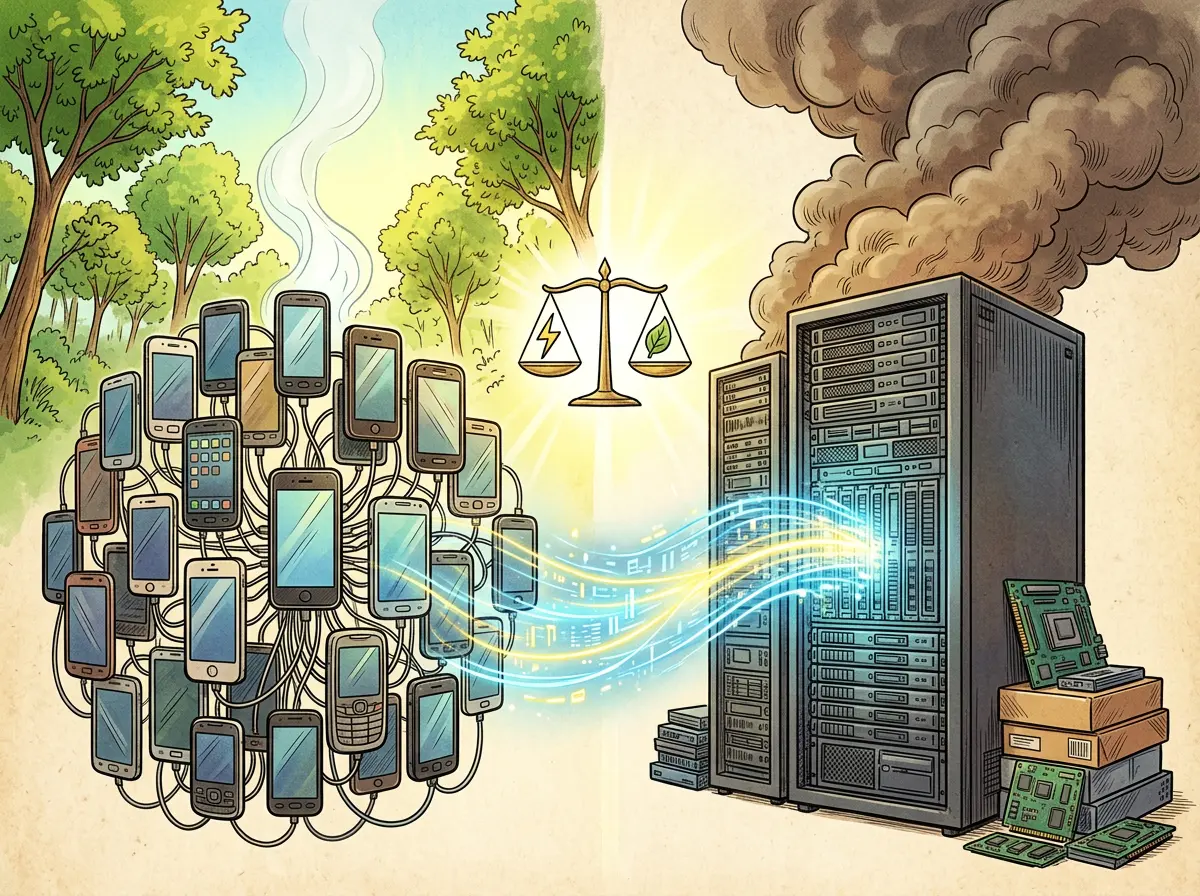
On June 14, Google Research published a study on its official blog, proposing a solution to turn retired smartphones into data center computing nodes; the core data is that the compute power of 25 to 50 old phones is equivalent to a modern server, and in 2023, most tests of the Pixel Fold performance core outperformed data center standard server ASUS RS720A-E11.
SPEC CPU2017 confirmed test results: Pixel Fold performance core vs ASUS RS720A-E11
According to the benchmark test data confirmed by Google Research’s official blog:
Test setup: 2023 Pixel Fold performance processor core vs ASUS RS720A-E11 data center server
Benchmark tool: SPEC CPU2017 (an industry-standard CPU performance evaluation)
Test results: The Pixel Fold performance core, in most test items, surpasses the single-core performance of the ASUS RS720A-E11 server’s single-core performance
Google Research’s explanation: Smartphone chips have been refined for years in performance per watt due to power constraints of mobile devices; data center servers are designed with a focus on multi-core parallelism, large memory, and I/O throughput, and single-core performance is not a design priority.
Conversion specifications: keep the motherboard, fully disassemble the rest, replace the software with Linux
According to the confirmed conversion steps in Google Research’s proposal:
Hardware layer: Remove the display, battery, chassis, and camera module, and keep the motherboard. Based on Google’s internal carbon footprint evaluation, the motherboard accounts for about 50% of the carbon included in the entire phone.
Software layer: Replace the mobile Android userspace with a general-purpose Linux distribution; disable consumer-grade protection mechanisms such as “low memory killer” (this feature is designed to keep the phone interface smooth, and in a cloud server environment it interferes with normal memory allocation).
Cluster architecture: A cluster of 25 to 50 phones forms a self-managed cluster, using containerized applications with Kubernetes orchestration; to upper-layer workloads, the cluster’s behavior is equivalent to a single cloud machine.
Measured data and UC San Diego’s plan for 2,000 phones
Completed real-world tests with 20 phones: During peak submission periods for courses with 75 people or more, the scoring latency of the 20-phone cluster was lower than the default AWS backend; the compute power of each phone is roughly equivalent to an AWS t3.micro instance (2 virtual CPUs, 1GB memory).
UC San Diego’s plan for 2,000 phones (target timeline, still in the planning stage): The purpose is to support information courses such as “parallel computing” and “system programming”; after full deployment, it can simultaneously support hundreds of courses, with equivalent computing power of about 50 servers; the cost is a small fraction of a normal procurement; the target go-live time is the fall of 2026. As of June 14, 2026, the UC San Diego cluster has not yet confirmed completion or launch.
Unresolved issues confirmed by the research team: reliability of consumer-grade hardware
Open issues clearly marked in Google Research’s paper: The phone motherboard has never been designed for running server workloads around the clock; for consumer-grade hardware, the parts lifetime curve and failure-rate distribution when operating for long periods under high loads still lack large-scale long-term data. Among UC San Diego’s 2,000-phone cluster, one of its functions is to systematically collect such reliability data.
FAQ
Why can single-core performance of mobile chips exceed that of data center servers?
According to Google Research’s explanation, mobile chips have been optimized for years in terms of power efficiency (performance per watt), due to the strict battery limitations of mobile devices; while data center servers focus on multi-core parallel processing and I/O throughput, and single-core performance is not a priority. In the single-core benchmark tests of SPEC CPU2017, this difference allows the Pixel Fold performance core to outperform the ASUS RS720A-E11 in most items.
With a cluster of 25 to 50 phones, how do you make upper-layer applications look like they’re using a server?
According to Google Research’s proposal, the cluster uses containerized applications with Kubernetes orchestration, so that for upper-layer workloads the cluster presents behavior equivalent to a single cloud machine. Administrators operate through Kubernetes’ standard interface, without needing to manage individual phone nodes.
Why is the carbon number of 50% contained in the motherboard important for carbon accounting in the proposal?
According to Google’s internal carbon footprint evaluation, the motherboard accounts for about 50% of the carbon emissions from raw material extraction to factory output of an entire phone. The conversion plan keeps the motherboard and removes other components, which means continuing to use the most carbon-intensive part, maximizing the dilution of existing carbon emissions rather than turning it into sunk costs of scrapped phones.


