The landscape of the 2026 NBA Finals has already gone beyond what the vast majority of people expected. The New York Knicks won two straight games in San Antonio to take a 2:0 series lead and return to their home court at Madison Square Garden. At 8:30 AM Beijing time on June 9, the Finals G3 will officially tip off. For the San Antonio Spurs, who are down big 0:2, this is a true “last stand” moment—there has never been any team in NBA history that completed a comeback after falling behind 0:3.
Meanwhile, in the crypto prediction market, as of June 8, 2026, based on Gate data from its prediction market, the Knicks’ win probability for G3 is 54%, and the Spurs’ is 47%. This figure reflects not only a quantitative assessment of the teams’ current competitive form, but also the market participants’ comprehensive pricing of multidimensional variables such as tactical chess-matches, psychological factors, and home-court momentum.

How the 2:0 start reshapes the narrative logic of the Finals
Before the Finals began, the Spurs had been viewed as an overwhelming favorite in prediction markets, with a 64% championship probability. At the time, the market’s pricing logic was built on Victor Wembanyama’s dominance and the strength of the Spurs’ path through the Western Conference playoffs—especially the resilience shown in the West Finals Game 7, where they defeated the defending champion Oklahoma City Thunder on the road. That conveyed to the market the idea that this young team could handle high-pressure situations. However, what actually happened in G1 and G2 completely overturned those expectations. The Knicks won consecutive away games 105:95 and 105:104, directly rewriting the series score to 2:0. As a result, the market quickly adjusted its pricing direction: after G2, the Knicks’ probability of ultimately winning in the prediction market had risen to 78%, surpassing the Spurs’ 22%.
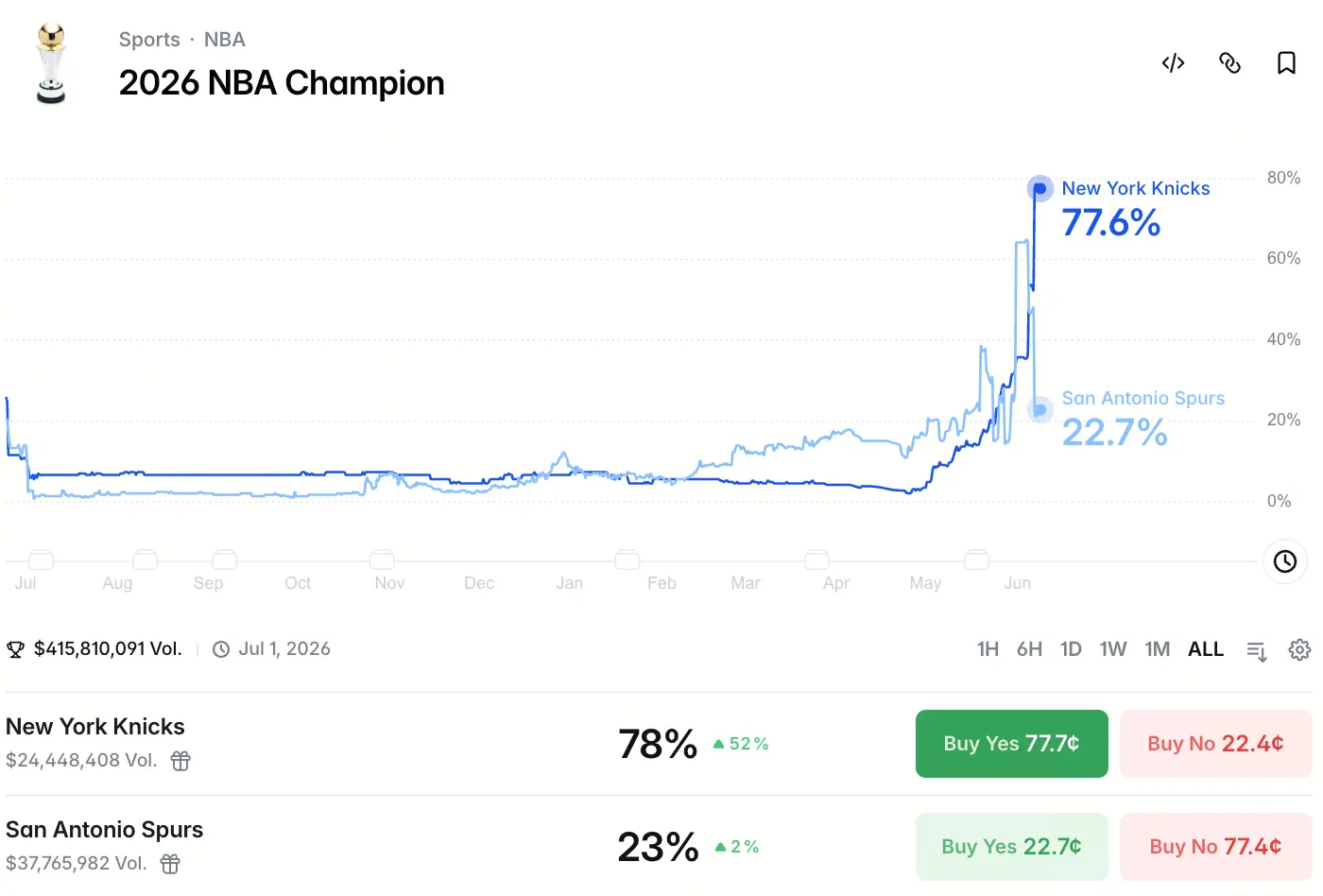
The reason the 2:0 start has the power to fundamentally reconstruct the narrative is that it rips open a dimension widely ignored in pre-series analysis—execution in the closing stages of games. In both games, the Spurs had moments when they led, yet control collapsed at the critical moments. In the final stages of G2’s fourth quarter, Wembanyama’s fatal turnover and the subsequent missed game-winner directly led to a one-point loss, 104:105. Such decision-making deviations in high-pressure possessions are hard to attribute to luck; they more clearly reflect structural differences in accumulated experience and psychological toughness.
How team core configuration shapes the pricing signals for G3 in prediction markets
To understand the real competitive logic behind the G3 win-probability distribution, you have to deeply analyze each team’s core lineup and tactical structure. The Knicks have a top-tier backcourt and wing-depth combination in the league. Jalen Brunson averaged 25.0 points across the first two Finals games, making him the most reliable ball-handler for the Knicks in the closing stages. Karl-Anthony Towns is the hub for the Knicks’ inside offense-and-defense transition; he posted 19.5 points and 12.5 rebounds per game, combining the stretching ability of a space-stretching five with finishing efficiency in the paint. Mikal Bridges, through his defensive “glue” on the perimeter and off-ball movement, along with OG Anunoby’s steady 17.0 points per game, together form a balanced five-man unit on both ends of the floor.
The Spurs’ talent structure is also not to be underestimated. Wembanyama leads the Finals scoring race with averages of 27.5 points, 10.5 rebounds, and 3.5 blocks. De’Aaron Fox contributed 20 points and 5 assists in G2, gradually shaking off the impact of an ankle injury from earlier. Rookies Stephon Castle and Dylin Harper also delivered averages of 15.5 points per game, showcasing the potential of their young core. However, an implicit weakness of this roster at Finals intensity is gradually becoming visible: when the game enters crucial possessions, the Spurs lack a second reliable ball-handler who can consistently tear apart the defense and create efficient shot opportunities. While Fox has the ability to drive vertically, his decision stability and shooting threat in half-court set plays have not yet reached an elite level. This problem becomes even more pronounced after defensive intensity increases.
Can the home-court factor continue to support the predicted-market advantage expectation?
The Knicks’ 54% win probability given by the prediction market needs to be interpreted cautiously in conjunction with the home-court bonus. Madison Square Garden returns to host the NBA Finals again after 27 years; the atmosphere certainly adds something, but it does not have the power to be amplified infinitely. In fact, the Knicks already delivered two straight away wins in G1 and G2. That alone means the team’s road adaptability and psychological resilience are strong enough—on top of that, the home-court advantage is more like a “cherry on top” than a structural variable.
But there is a detail that is easy to overlook and worth expanding on: the pressure environment the Spurs face in G3 is different from all the playoff experiences they’ve had before. Being down 0:2 essentially means near-zero tolerance for error—every defensive rotation and every offensive possession decision will be magnified and scrutinized. This kind of pressure cannot be directly converted just by cheers from home fans; instead, it is internalized into the players’ quality of in-game decisions. Wembanyama’s turnovers and missed game-winner attempt at the end of G2 are a snapshot of exactly this pressure. The Knicks, by contrast, are the opposite—they have a 2:0 advantage and return home, meaning on a psychological level they have more room to adjust. That could allow Towns, Brunson, and others to play with greater composure and settle into a steadier rhythm.
How key variables in the matchup chess can drive the game’s direction
The most central tactical chess-match in G3 still comes down to the center matchup between Wembanyama and Towns. The overall trends from the first two games suggest that Towns has a certain edge in the matchup. In the second half of G2, the Spurs found a better offensive rhythm around Wembanyama—he scored 22 of 29 points in the last two quarters, and the Spurs gave him more opportunities to get looks in the low post. However, throughout the series when Wembanyama is on the floor, the Spurs average only a net rating of plus 1.5. That figure is far from enough to sustain competitiveness during the rotation phases. The key in G3 is whether the Spurs can extend Wembanyama’s efficient stretch and, during his rest periods, keep the gap from widening.
The battle in the backcourt is equally crucial. Brunson’s shooting efficiency in G2 was not ideal—he made 7 of 25 attempts—but his value in the quality of decisions in crucial possessions and the stability of his free-throw shooting far exceeds what the raw numbers show. Fox in G2 went 8-for-12, showing signs of a rebound. But whether he can continue to function as the second ball-handler under the high-intensity defensive pressure of an away game will directly affect the quality of the Spurs’ offensive system. Bridges’ 20-point output in G2—especially his three-point efficiency of 4-for-8 from the perimeter—was an important reason the Knicks could still “hold onto” the score even when Brunson’s touch was off. Overall, the Knicks have a slight advantage in the stability of role players.
The true impact of injuries and roster completeness
Before G3 begins, the injury reports for both teams remain very clear. The only player on the Knicks listed in the official injury report is center Mitchell Robinson, and he has been marked as available. The Spurs have no players listed on the injury report, including Fox, who had previously been affected by an ankle injury—he was not wearing protective gear or limping during training before G3. This means G3 will be the most roster-complete game in the current series, with both teams’ core rotation framework and depth not limited by injuries.
This condition has two implications for forecasting the game’s trajectory. On one hand, neither side can attribute a loss to a missing roster component; the outcome will reflect, to the maximum extent, differences in tactical execution and in-game performance. On the other hand, a complete lineup means the Knicks’ advantage in rotation depth—thanks to the dual-center system with Towns and Robinson, which provides inside “staying power,” as well as the defensive versatility of Bridges, Anunoby, and Josh Hart in wing rotations—will be fully realized. The Spurs, meanwhile, will hope that the backcourt pairing of Fox and Castle can carry forward the performance rhythm seen in G2.
How much can historical patterns provide for G3 market expectations
From historical data, there have been 32 instances in NBA Finals where a team took a 2:0 lead. In 28 of those cases, the team that led went on to win the championship, a rate as high as 87.5%. Meanwhile, reversals where a team down 0:2 ultimately came back to win have occurred only 4 times, the most recent dating back to the 2016 Cleveland Cavaliers. This data alone does not have causal predictive power, but it reflects a structural reality: in a high-intensity, best-of-seven series, the competitive advantage embedded in sweeping two road wins early is far from something that can be offset by simple home-court advantage alone.
On top of that, the Knicks’ 13-game postseason winning streak is also worth attention—this number has tied for second place in NBA history for a single season postseason consecutive wins record. A sustained high-win-rate state suggests the team’s tactical system and psychological patterns have formed a positive feedback loop. The Spurs, however, must face a more urgent reality: there has never been any team in NBA history that won the championship after falling behind 0:3. Therefore, G3 for the Spurs is not just a normal contest in the series—it is a turning point that determines whether the season continues.
The prediction market’s dynamic signals and the real pricing logic for G3
Let’s return to the prediction market’s data structure itself. As of June 8, 2026, Gate data shows a 54% win probability for the Knicks in G3 and 47% for the Spurs. This is a distribution that leans toward the Knicks, but not by an overwhelming margin. To understand the balance point of this distribution, you need to go back to two core variables: the Spurs’ probability of rebounding and the Knicks’ home-court premium.
The Spurs’ actual performance in G1 and G2 is not as one-sided as the series score implies. In both games, the team held leads, and in G2 they lost by only one point. The 47% win probability pricing can be interpreted as: taking into account that the Spurs have exposed “soft spots” in their late-game decision-making in two straight games, the market has not assigned them a very high probability of completely turning things around on the road. But it still retains the expectation that their core talent is enough to produce a win. Additionally, the Spurs’ 6-3 away record in the postseason this season provides empirical support for that judgment.
The Knicks’ 54% win probability, meanwhile, reflects the market’s recognition of their stability—the combination of the 2:0 start, the psychological momentum of a 13-game winning streak, and the environment advantage of playing at home, which together form a pricing signal that leans toward the Knicks but has not yet formed absolute dominance. This number is different from the typical meaning of market betting odds: the gap between 54% and 47% is only 7 percentage points. That means the market’s view of whether G3 is won is still essentially in a highly uncertain range. The Spurs’ talent is enough to create threats, and the Knicks’ stability is enough to protect their advantage. The marginal difference between the two may depend on the execution quality in just one or two key possessions.
Prediction markets act as multidimensional pricing systems that integrate global information. Their value is not in giving an absolute directional judgment, but in revealing the weight relationships among different variables. For the Spurs to break the 0:2 situation in G3, they must build a more stable backcourt support system beyond Wembanyama’s efficient periods, and demonstrate decision quality in key possessions that is different from what they showed in G2. The Knicks, on the other hand, only need to continue the pace-control ability and late-game resilience they displayed in the previous two games to take another step closer to returning to the Finals championship at home. The market’s signal is this: the Knicks have a slight edge, but they have not locked up the win. That is exactly what makes competitive sports so fascinating—before the final whistle, data is always just data, and what truly defines the outcome is every defensive rotation and shot selection on the court.
The Green Turf Oracle: Gate’s limited-time World Cup prediction market event
While keeping an eye on the NBA’s annual Finals, Gate Prediction Market is also launching a limited-time event for the 2026 world football feast 「The Green Turf Oracle」. The total prize pool exceeds 500,000 USDT, running from June 4 to July 21, 2026. Users can register to receive free prediction tickets; completing tasks such as spot, contracts, CFD, and VIP upgrades will earn additional prediction experience tickets and prediction tickets for participating in football event predictions. The top 100 on the prediction points leaderboard can share 30,000 USDT plus limited jersey gift boxes, and the champion prediction prize pool is set separately at 5,000 USDT. VIP users can also enjoy exclusive registration rewards and jersey gift boxes.
Frequently Asked Questions
Q1: How are the win-rate data of 54% for the Knicks and 47% for the Spurs derived?
This win-rate data is based on Gate prediction market data. The data is formed into market consensus after the prediction market’s global participants trade based on public information, reflecting the collective judgment of the market about event outcomes—not any prediction or viewpoint from a single institution.
Q2: Do the Spurs still have a chance to come back after falling behind 0:2?
In NBA Finals history, there have been 4 teams that ultimately reversed and won the championship after being down 0:2. The Spurs showed in both G1 and G2 that they had the competitiveness to go toe-to-toe with the Knicks—combined across the two games, they lost by only 11 points, and in G2 they even lost by a single point. The Spurs still have room to adjust, but G3 is decisive for the series’ direction.
Q3: What is Wembanyama’s biggest challenge in G3?
On the offensive end, Wembanyama needs to continue the high-efficiency performance he showed in the second half of G2 while reducing the risk of turnovers in key possessions. On the defensive end, he needs to deal with Towns’ space-based style, avoiding being pulled out beyond the paint in a way that creates a vacuum in interior protection. In addition, keeping the intensity on both ends of the floor while playing more than 38 minutes per game is also an important issue in managing stamina.
Q4: What key factors could determine the winner of G3?
Based on current market signals and historical patterns, the winner of G3 will mainly be determined by three factors: the quality of offensive decisions and turnover control in crucial moments, the comparative performance of Towns and Wembanyama in the interior matchup, and how well each team’s bench can control the point differential during stretches when key players rest.


